- Advertisement -spot_img

South Africa repatriates remains of Namibian liberation heroes in act of rehumanisation

- Advertisement -spot_img

Must read

By Lebone Rodah Mosima

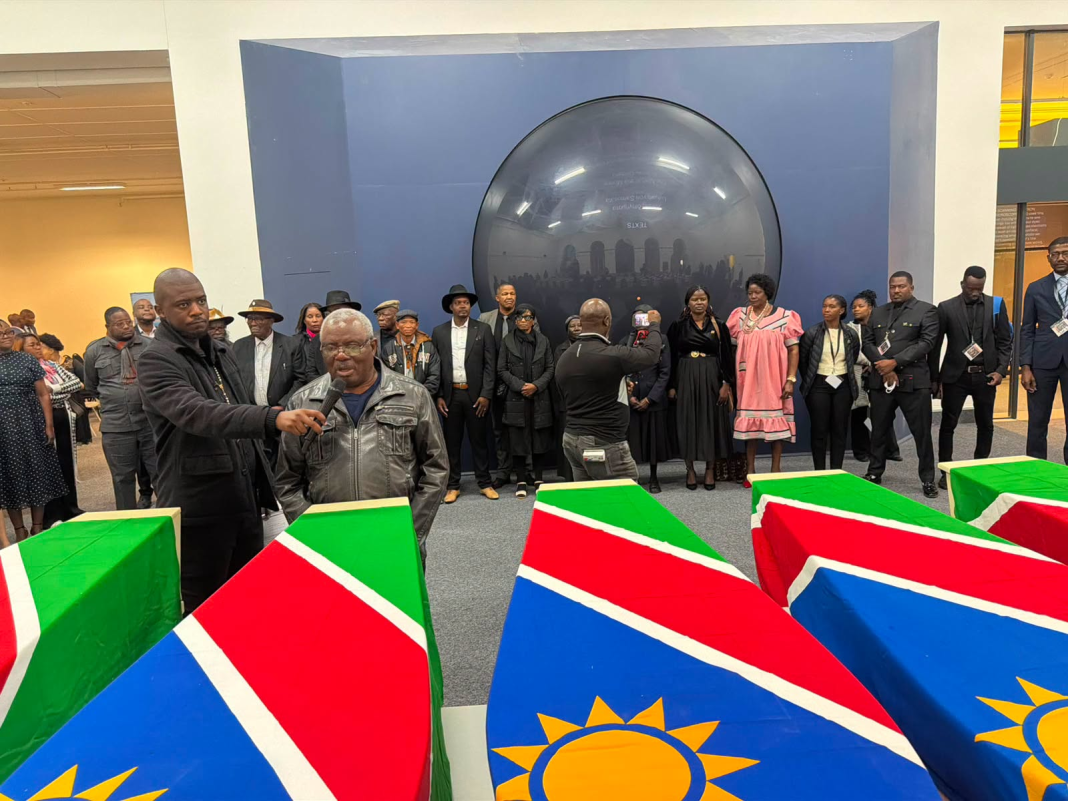
The remains of Namibian liberation struggle heroes and other ancestral human remains held in South African institutions will be repatriated to Namibia in an act of restoration, dignity and rehumanisation, Minister of Sports, Arts and Culture Gayton McKenzie said on Wednesday.

McKenzie was speaking at a repatriation ceremony hosted by the Department of Sports, Arts and Culture (DSAC) and representatives of the Namibian government at the Iziko South African Museum in Cape Town.

The ceremony marked a milestone in efforts by South Africa and Namibia to confront the legacy of colonialism and apartheid and restore human remains and cultural objects taken from Namibia.

“Today is not an ordinary day. It is a moment of history in which we return mortal remains and cultural objects from the Republic of South Africa to the Republic of Namibia,” McKenzie said.

“It is a day of profound significance, remembrance and reckoning. It is also a day of restoration, healing and hope.”

McKenzie said the repatriation went beyond the transfer of remains between institutions, forming part of a broader effort to confront the countries’ shared colonial and apartheid histories.

He said two Namibian liberation struggle heroes, Simon Petrus Niilenge and Festus Nehale, who were imprisoned on Robben Island for opposing colonialism and apartheid, were among those being returned.

“Niilenge and Nehale were incarcerated at Robben Island for standing up against oppression and apartheid violence. They fought for the freedoms we cherish today,” he said.

“Both of them died in the 1970s while serving time as political prisoners at Robben Island.”

McKenzie said the exhumation process had taken place decades after their deaths and that their remains could now be returned to their families and fellow countrymen.

“It’s time for their bodies and spirits to be allowed to go home and rest,” he said.

He said colonial borders had divided the territories of South Africa and Namibia but had not separated the people or their shared liberation struggle.

“It could divide the map, but it could not divide the struggle,” he said.

“What our brothers suffered on this soil, they suffered for all of us – and so, today, we grieve together, and we heal together.”

McKenzie said colonial authorities had collected, researched and displayed human remains in museums as part of race-based pseudo-scientific practices that sought to dehumanise African people.

He said some remains had also been subjected to casting processes and displayed as curiosities without the consent of those involved.

“Today is a monumental achievement for our countries as we return home the remains, and the spirits of our struggle activists and ancestral human remains, body casts, and cultural objects that were looted from the graves of innocent people,” he said.

“This is a process of rehumanisation and respect that was not afforded to those who faced, endured, and succumbed under brutal environments because of the colour of their skins.”

McKenzie said people had for too long been separated from their land, families, descendants and communities.

“Today, we are returning them home,” he said.

“We are saying we appreciate, recognise, and honour their struggles.”

He said the consequences of the forced separation continued to affect descendants generations later.

“This is why repatriation must be understood as an act of rehumanisation,” he said.

McKenzie said colonial and apartheid practices had stripped people of their individuality by reducing them to numbers and objects.

“Where they were assigned numbers, we call them our liberators and ancestors. Where they were seen as objects, we restore their humanity. Where they were removed without consent, we return them with respect,” he said.

“And where their voices were silenced, we listen to the voices of their descendants.”

He said the people being repatriated had families and communities to which they belonged and could now return home after decades of displacement.

“They are leaving to ceremony, remembrance, dignity, and rest,” he said.

McKenzie said descendants had the right to mourn their ancestors and determine how they should be remembered.

“We acknowledge your right to mourn and we recognise your right to take them home,” he said.

The minister said the repatriation followed provenance research, exhumations and cooperation between the South African and Namibian governments and heritage institutions to identify the graves of Niilenge and Nehale and establish their origins.

The process also involved cultural ceremonies, memorialisation and arrangements for reburial.

“To the fallen and to our ancestors: go home now, and rest. The soil that made you has waited half a century and more, and today it opens to receive you home,” McKenzie said.

Namibia’s Ministry of Education, Innovation, Youth, Sports, Arts and Culture executive director Sanet Steenkamp said the Namibian delegation had come to bring home its compatriots.

“We have one profound purpose. We have come to bring back home our compatriots,” she said.

Steenkamp said the ceremony was not simply about transferring human remains between countries, but about welcoming home people who had been separated from their families, communities and homeland during a painful period of shared colonial history.

She said many ancestors had been taken from their communities and treated as objects in colonial scientific and museum collections rather than as people with names, identities and families.

Steenkamp said Nehale and Niilenge were taken because they fought colonial oppression and sought Namibia’s freedom.

“They were imprisoned, as we heard from the various speakers before, on Robben Island, far from home, and they died in captivity,” she said.

She said the return of the ancestral remains of 84 people to Namibia was an important step in addressing the consequences of colonialism.

She said the remains would no longer be treated as museum specimens but would return to Namibia as part of the country’s living history.

“We are restoring as far as we can the dignity that was denied to them when they were separated from their communities and incorporated into museum collections,” she said.

“Therefore, the return of our ancestral remains is fundamentally different from the ordinary return of museum objects, because a human being, surely, as we’ve experienced, is not an artefact.”

Steenkamp said the repatriation affirmed the human, cultural, spiritual and family ties between the living and the dead.

She said governments, museums, researchers and heritage practitioners also had a responsibility to ensure that language, classifications and practices used to represent these histories respected the dignity of those involved.

She said repatriation should be conducted with communities rather than simply to them.

“Our traditional authorities have, therefore, guided us for the past weeks on the cultural, spiritual, but also the customary aspects of this process,” she said.

“Equally, the families of the late Nehale and the families of Mr Simon Pietrus Nilenge were consulted throughout.”

Steenkamp said the families participated in the process from the beginning and witnessed the exhumations.

She said the homecoming demonstrated what could be achieved when South Africa and Namibia confronted their shared history through cooperation.

“Our histories are deeply intertwined, and our people have experienced colonialism, racial oppression, displacement, imprisonment, and the struggle for freedom,” she said.

“This is a history that we cannot erase, neither change, but we choose how we wish to respond to it.”

Deputy Minister of Sports, Arts and Culture Peace Mabe described the ceremony as a milestone for both countries and an act of justice, dignity, healing and restoration.

She said the exhumation of the two former political prisoners had been conducted with respect and care, describing it as an act of rehumanisation that recognised their sacrifices and humanity.

“This milestone is also a testament to the strong bonds of friendship and solidarity between the Republic of South Africa and the Republic of Namibia,” she said.

“It demonstrates what can be achieved when nations work together to confront painful histories and correct the wrongs of the past.”

Mabe said the remains would begin their final journey home to Namibia on Friday, 21 August 2026.

She said they would be transported with dignity, befitting their status as ancestors, freedom fighters and symbols of resilience.

INSIDE POLITICS

More articles

LEAVE A REPLY

Please enter your comment!
Please enter your name here

Inside Education E-edition June 2026

spot_img

Services Seta 2026

spot_img

CATHSSETTA

spot_img

AVBOB STEP 12

spot_img

Inside Metros G20 COJ Edition

spot_img

JOZI MY JOZI

spot_img

QCTO

spot_img

Latest article