
By Johnathan Paoli
The Madlanga Commission has criticised as “vague” an application by suspended Crime Intelligence deputy head Major-General Feroz Khan to have portions of his testimony heard behind closed doors, before Khan’s legal team withdrew the bid.
Proceedings resumed on Wednesday morning as the commission considered Khan’s application to testify partly in camera, while also hearing that the senior police officer remains unconscious and under sedation in hospital following an alleged failed hit on his life on Sunday.
ALSO READ: Court torpedoes Cat Matlala’s plea deal, wants 12 year sentence
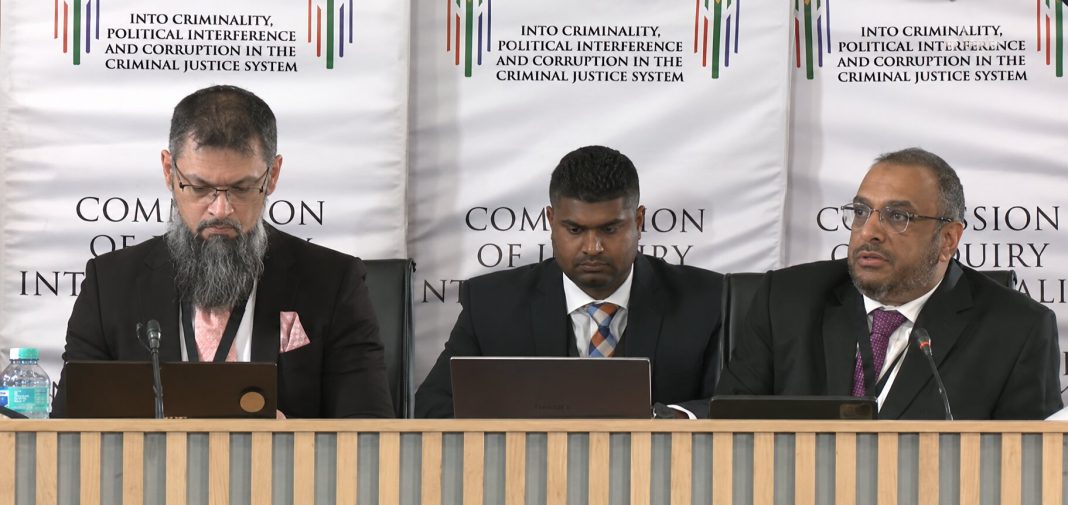
Appearing for Khan, advocates Zubair Khan and Muhammad Valley told the commission that their client was in a serious condition and unable to provide instructions.
“Despite what is floating around in the media, General Khan is actually unconscious, sedated and we have not been able to get access to him for purposes of instruction in relation to this matter,” Khan said.
Khan added that they had received a J88 medical form to facilitate the issuing of a medical certificate and even invited the commissioners to visit Khan in hospital and consult with his doctors to verify his medical condition.
Khan’s legal team had sought an order allowing only evidence relating to the Aeroton cocaine bust to be heard in public, while the remainder of his testimony would be presented in camera because it allegedly involved confidential intelligence information.
However, Madlanga questioned the timing and substance of the application.
He said that when the application had originally been drafted, Khan had not yet been hospitalised, making it difficult to understand why it had not been brought earlier.
ALSO READ: Cat Matlala’s ex ‘lover’ Brigadier Rachel Matjeng axed over Medicare24 tender
Madlanga repeatedly pressed counsel to explain precisely which parts of Khan’s evidence required confidentiality and on what legal basis.
He said the application failed to adequately explain why an in-camera hearing was necessary.
Madlanga said the application primarily offered context and outlined the relevance of intelligence, adding that this was insufficient to justify excluding the public.
He said that he was struggling to understand the basis of the application and that he “could go further to say the application is hopeless”.
The commission also heard that Khan’s legal team had been confronted with a substantial volume of evidence disclosed shortly before his anticipated testimony.
Advocate Khan said investigators had provided approximately 370,000 pages of WhatsApp messages last week, which they estimated would take roughly 200 days to analyse properly.
He said another 11,000 pages of bank statements had only been delivered over the weekend, arguing that these late disclosures were among the reasons they wished to reformulate their application and requested an opportunity to sharpen its focus.
Evidence leader Adila Hassim opposed the request, while commissioner Sesi Baloyi argued that the commission could not indefinitely delay proceedings while Khan’s lawyers sought further instructions.
Baloyi told the commission that although the evidence leaders accepted that certain information might legitimately require an in-camera hearing, Khan’s application failed to make the necessary factual case.
She recommended that the legal team withdraw the current application and submit a properly motivated replacement.
“There is no impediment to submitting a new application addressing the same subject matter with enhanced clarity,” Baloyi said.
She said that if no proper case had been made, the existing application should simply be dismissed.
Madlanga agreed that the commission could not be held “in abeyance” pending consultations with Khan, emphasising that although commissions of inquiry share certain procedural similarities with courts, they are not courts of law.
Commissioner Sandile Khumalo also urged Khan’s lawyers to withdraw the application rather than attempt to supplement it.
Drawing an analogy with motion court proceedings, Khumalo said the appropriate course would be to remove the matter from the roll, correct the defects in the notice of motion and return with a properly substantiated application.
“As it stands, it’s a vague application,” he said.
Following the criticism from the commissioners, Khan’s legal team withdrew the application but requested until Friday to consider filing a revised version.
The commission confirmed that Khan remains free to submit a fresh application seeking an in-camera hearing, provided it is supported by a more comprehensive factual explanation.





