
By Thapelo Molefe
The State Information Technology Agency (SITA) has been ordered to implement sweeping governance reforms within 60 business days after a Public Service Commission (PSC) investigation uncovered systemic failures in procurement, leadership, accountability and record-keeping that have undermined the agency’s ability to deliver critical ICT services to government.
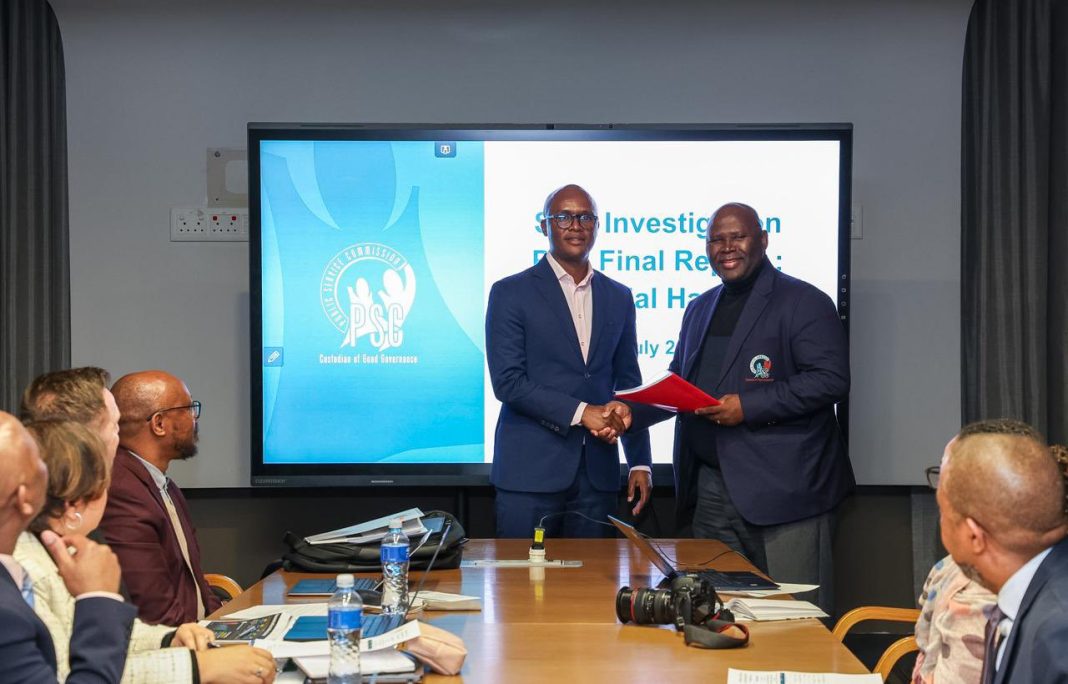
Communications and Digital Technologies Minister Solly Malatsi and PSC Chairperson Somadoda Fikeni on Monday released the investigation report after Malatsi requested an independent probe in December 2024.
The investigation examined allegations of governance failures, leadership instability, procurement irregularities, corruption, internal infighting and weak decision-making at SITA.
The report found that governance weaknesses at the agency were “systemic, cross-cutting and mutually reinforcing”, creating an environment in which delays, poor decision-making and corruption risks could flourish.
Among its most serious findings, the Auditor-General flagged more than R2 billion in irregular expenditure over four audited financial years.
Investigators also found little evidence that consequence management had been applied consistently.
The investigation identified significant weaknesses in SITA’s procurement processes.
Of the 1,443 procurement matters reviewed, 278 were withdrawn, 52 were cancelled and 34 were closed without any recorded reason, meaning nearly one in four tenders analysed did not result in an award.
Investigators further found that 529 procurement matters remained unresolved, with the oldest spending an average of more than 400 days in adjudication and contracting.
Another 203 procurement matters took longer than a year to reach a final outcome.
According to the report, the delays affected government’s ability to procure critical ICT systems and services, forcing departments including the South African Police Service, Home Affairs and Justice to seek exemptions to procure services outside SITA.
“This report is difficult reading, but it is necessary reading. SITA is the state’s central ICT engine. When SITA fails, departments wait longer for the systems they need, budgets are placed under pressure, and citizens ultimately experience the consequences through poorer public services,” Malatsi said.
He said the report provided a clear roadmap to restore the agency.
“The value of this report is that it does not leave us with vague concerns. It gives us a clear diagnosis, a set of practical reforms and hard deadlines. The era of drift at SITA must end. The Board and management now have a direct mandate to stabilise the organisation, restore basic controls, clear procurement blockages and rebuild trust through evidence, not promises,” he said.
The investigation also identified weaknesses in contract management, recruitment processes and board administration.
SITA lacked a reliable central contract register, while investigators found missing board meeting records, incomplete resolutions and poor record-keeping that made it difficult to establish how key decisions had been taken.
Fikeni said the agency’s governance shortcomings became more apparent during the Covid-19 pandemic as government departments increasingly relied on digital services.
“It was functioning, but it was limping forward,” he said.
Fikeni said the investigation showed that leadership instability, rather than a lack of technical expertise, had undermined the organisation.
“The problem is not technology in South Africa. It is the people. It is the leadership. It is the orientation. It is the organisational culture,” he said.
To address the shortcomings, SITA’s board has been instructed to submit a board-approved stabilisation and recovery plan, together with a verified procurement backlog baseline, within 30 business days.
Within 60 business days, the agency must also submit a governance reform plan covering procurement controls, contract management, board administration, record-keeping and executive accountability.
It must provide quarterly governance reports to enable government to monitor implementation.
Malatsi said the report did not conclude that every transaction or appointment at SITA had been irregular, but instead highlighted institutional weaknesses requiring urgent intervention.
“Our responsibility now is to create an institution that can support ethical public servants, that restores confidence amongst the client departments, and ensures that public funds are managed with integrity, discipline, and accountability,” he said.
The minister added that the Department of Communications and Digital Technologies had begun reviewing SITA’s mandate and operating model to ensure the agency remained fit for purpose as government accelerates its digital transformation.
SITA Managing Director Magatho Mello said the agency remained a critical technology partner to government, supporting more than 100 departments and public entities.
He acknowledged that governance failures had hampered the organisation’s growth.
“The evolution of SITA has been stunted because of the challenges that are shared in the report,” Mello said.
He said SITA would strengthen its executive leadership, cybersecurity capabilities and artificial intelligence capacity as part of its turnaround strategy.
INSIDE POLITICS





