
By Johnathan Paoli
The Madlanga Commission of Inquiry has reserved judgment on an application by controversial North West businessman Suliman Carrim to indefinitely postpone his testimony, after hearing arguments over whether his medical condition justifies further delays.
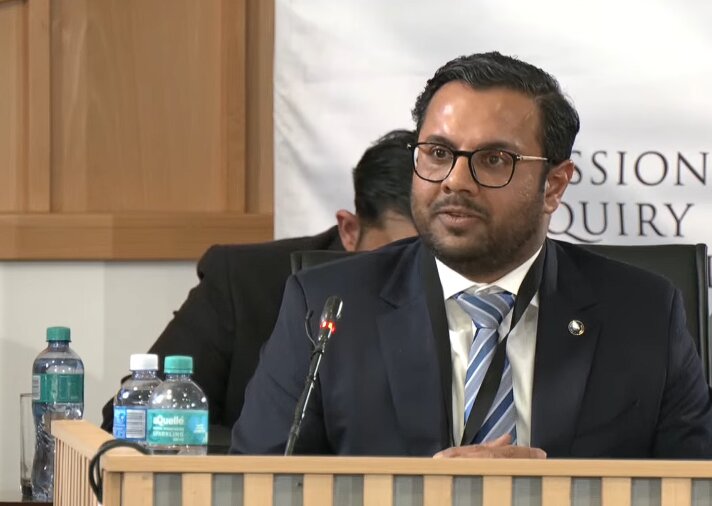
Appearing for Carrim on Friday, advocate Kameel Premhid argued that his client’s medical condition remains unstable and requires ongoing assessment, warranting an open-ended postponement.
Evidence leader advocate Adila Hassim opposed the application, arguing that any further delay should be conditional on Carrim first undergoing an independent medical examination (IME).
Premhid submitted that Carrim’s condition was “dynamic” and subject to change.
“What the treating doctor says is that the position of my client is dynamic and it is subject to change, and that’s why one of the things that the treating doctor himself proposes is to account to the commission under oath once every two weeks to update the commission regarding the client’s position and whether he can or cannot testify,” Premhid said.
He also asked the commission to issue directives protecting sensitive information contained in the court record, including the identity of the medical facility treating Carrim, his medical records and mobile phone geolocation data.
Premhid argued that publication of the information could reveal Carrim’s location.
Addressing CCTV footage obtained by the commission, Premhid said there was no need for it to be played publicly because Carrim did not dispute that he had been at the shopping centre shown in the footage.
He argued that publicly screening the footage served no legitimate purpose, saying the commission’s inquiry should focus on Carrim’s medical condition rather than whether he had left the treatment facility.
He described the footage as an “inappropriate form of evidence” because it did not address the medical issues underpinning the postponement application.
Commission chairperson Justice Mbuyiseli Madlanga rejected that argument, describing the footage as objective evidence confirming Carrim’s movements.
“I see it as objective material which says he was there, so I don’t see the connection with what a medical practitioner might have to say on the issue,” Madlanga said.
Madlanga also criticised Carrim’s continued failure to provide information previously requested by the commission relating to his businesses.
Evidence leaders have sought financial statements and details of Carrim’s companies, but the documents have not been produced.
Madlanga described as “patently false” the claim that no one within Carrim’s businesses, including his personal assistant or those overseeing operations in his absence, could identify the company’s auditors or produce its financial statements.
Premhid responded that Carrim’s personal assistant performed only administrative duties and had no authority over the business, while those currently managing operations lacked the institutional knowledge required to produce the requested records.
He said Carrim would need to be consulted before agreeing to an independent medical examination but indicated there was no objection in principle if suitable arrangements could be made.
Opposing the application, Hassim argued that the evidence showed a pattern of changing explanations whenever objective evidence emerged.
She told the commission Carrim had been asked as early as March to provide details of his auditors and financial statements, but the documents remained outstanding despite an affidavit from his wife stating that he had remained actively involved in the day-to-day running of his businesses until 13 April.
Hassim said an independent medical examination was necessary because the commission had received inconsistent accounts from Carrim’s doctor and family members regarding his condition and his movements outside the treatment facility.
“That is the heart of the opposition by the evidence leaders to a postponement,” Hassim said.
She argued that the treating doctor’s opinion could not be regarded as an independent assessment of Carrim’s ability to testify, citing professional medical guidelines that discourage treating doctors from providing objective medico-legal opinions because they are advocates for their patients.
Hassim also relied on geolocation data, which she said Carrim’s wife had accepted was generally accurate.
“We’ve explained in the answering affidavit the analysis of the maps and the geolocation data and what they show, and what they show is that almost every single day Mr Carrim leaves the facility. And that on most days, he’s out of the facility for at least eight hours, sometimes longer,” Hassim said.
She argued that the explanations advanced by Carrim’s doctor and family had shifted over time as the commission confronted them with objective evidence, including CCTV footage and geolocation records.
After hearing submissions from both parties, the commission reserved judgment on Carrim’s application.
A ruling will be delivered at a later date.
INSIDE POLITICS





