
- Advertisement -spot_img

Farmers can now apply online to vaccinate against FMD

- Advertisement -spot_img

Must read

By Levy Masiteng 

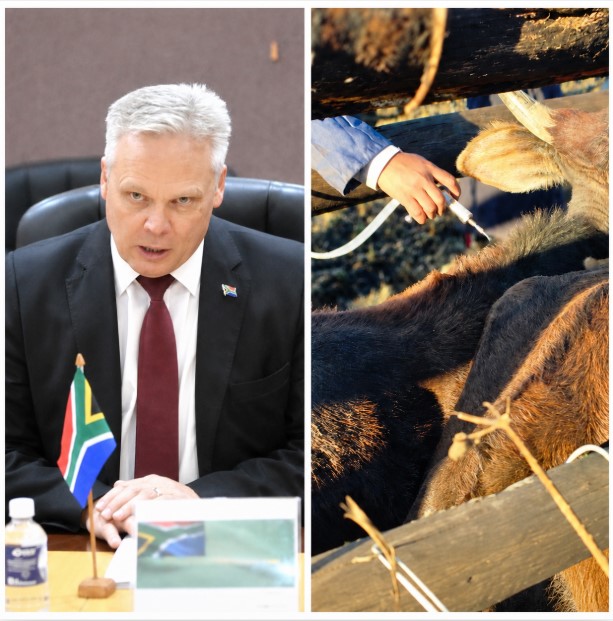
Livestock farmers can now apply online for official authorisation to vaccinate their own animals against foot-and-mouth disease (FMD) as the government expands private-sector participation in efforts to control the outbreak.

Agriculture Minister Willie Aucamp launched the self-vaccination application portal over the weekend, allowing eligible livestock owners and managers to apply for approval to administer FMD vaccines under prescribed legal, biosecurity, traceability and reporting conditions.

“The launch of this system means that the owners and managers of cattle will be able to perform voluntary vaccination of their livestock against FMD,” said Aucamp.

“This step is only the beginning, and I can assure all stakeholders that the Department of Agriculture is committed to enabling the private sector to help tackle this FMD outbreak.”

Livestock owners must register on the department’s FMD Reporting System and complete a three-part authorisation, notification and reporting process.

They must first apply to become an “Authorised Person”, enabling them to administer FMD vaccines in terms of the Animal Diseases Act.

Once approved, they must notify the Provincial Director of Veterinary Services or the relevant State Veterinarian of their intention to vaccinate at least five days before administering the vaccine.

The notification can be submitted through the online system or in writing. Once notice has been given, authorised livestock owners or managers will be able to obtain the required vaccines directly from an authorised veterinarian in their area.

A vaccination report must then be submitted to the local state veterinarian within 14 days of the vaccine being administered.

The report must include details of the animals vaccinated, the vaccine used and the location of the farm where the vaccination took place. It may also be submitted online or in writing.

“All the information gathered through these report back systems will enable government to monitor progress of the vaccination programme,” said Aucamp.

“It will also enable us to efficiently provide up-to-date information on the success of South Africa’s vaccination programme to the World Organisation for Animal Health (WOAH) when we are in a position to apply to WOAH for FMD-Free status with vaccination once again.”

Livestock owners and managers may alternatively use approved digital reporting platforms provided by private-sector stakeholders, including Red Meat Industry Services, the Southern African Agri Initiative and Buffalo Analytics.

Information submitted through third-party platforms will be shared with the Department of Agriculture and uploaded to its system.

The department said livestock owners and managers were responsible for ensuring that their chosen reporting platform had been approved by the Director of Animal Health.

Farmers participating in the voluntary vaccination programme will be responsible for paying for vaccines used on their cloven-hoofed animals.

The government will continue providing vaccines in areas where new FMD outbreaks have been reported and to farmers who cannot afford to purchase vaccines themselves.

Organised agricultural organisations have been encouraged to work with approved vaccine importers to establish how many doses their members require.

The information will help importers determine how many vaccines they need to procure and distribute to veterinarians across the country. Importers have also been encouraged to consult veterinarians about the number of doses required for clients in particular areas.

Foot-and-mouth disease is a highly contagious viral disease affecting cloven-hoofed animals, including cattle, sheep, goats and pigs.

It is not readily transmissible to humans and is not considered a public-health risk. However, it can cause severe production losses and significant economic disruption through livestock movement controls and restrictions on regional and international trade.

South Africa previously had an internationally recognised FMD-free zone where vaccination was not practised, but that status was suspended in January 2019 following an outbreak in the former free zone.

According to the Department of Agriculture’s June 30 technical report, some outbreak events have since been resolved and closed with WOAH, while five wider outbreak events remained open.

SAT1 and SAT2 outbreaks were occurring mainly in northern and eastern parts of the country.

The department has cautioned that an open outbreak may involve current viral circulation or an earlier outbreak that is still undergoing the formal process required for it to be resolved and closed.

Government’s response has included risk-based mass vaccination, quarantine, livestock movement restrictions, biosecurity measures and controlled slaughter in certain circumstances as it works to contain the disease and restore internationally recognised FMD-free status with vaccination.

The online authorisation system follows a settlement that widened private-sector participation in South Africa’s FMD response.

The agreement opened the way for greater private-sector involvement in importing and distributing vaccines and for authorised livestock owners and managers to administer them under government-approved conditions.

“I want to thank all farmers, organised agriculture organisations as well as the Department of Agriculture officials, who have worked tirelessly to get these systems up and running shortly after reaching the settlement,” Aucamp said.

INSIDE POLITICS

More articles

LEAVE A REPLY

Please enter your comment!
Please enter your name here

Inside Education E-edition June 2026

spot_img

Services Seta 2026

spot_img

CATHSSETTA

spot_img

AVBOB STEP 12

spot_img

Inside Metros G20 COJ Edition

spot_img

JOZI MY JOZI

spot_img

QCTO

spot_img

Latest article



