
By Levy Masiteng
The Border Management Authority (BMA) processed 72,906 repatriations through South Africa’s ports of entry between 7 June and 14 July as the government intensified immigration enforcement under its five-point plan, the Inter-Ministerial Committee on Migration said.
The committee also reported 354 migration-related “cases of arrests and prosecutions”, increased action against illegal border crossings and plans to strengthen infrastructure at six major ports of entry.
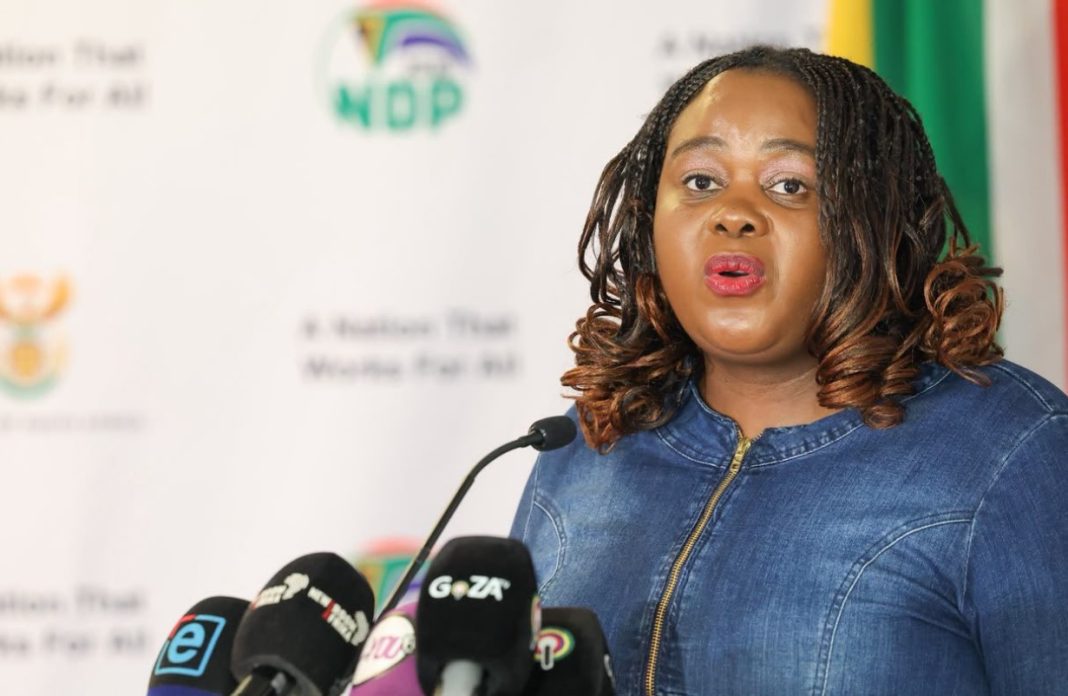
The update was delivered during a media briefing at the Ronnie Mamoepa Press Room at Tshedimosetso House in Hatfield, Pretoria, on Sunday.
Ministers said the government remained committed to the rule of law, constitutional rights and its humanitarian obligations while strengthening the management of irregular migration.
The IMC said that its five-point plan was a coordinated national programme involving all spheres of government, law enforcement agencies, border authorities and municipalities.
It is intended to address irregular migration, improve border management and strengthen immigration legislation.
The committee said 68,138 foreign nationals had been processed between 14 June and 24 July after Malawian nationals began assembling at Sherwood in KwaZulu-Natal.
The majority were repatriated after being processed at the Musina Temporary Repatriation Processing Centre, with Malawian nationals accounting for the largest group, followed by Zimbabweans and Mozambicans.
The government said the Musina centre would be scaled down from a capacity of 20,000 people to 1,500 from 1 August following a sustained decline in the number of people requiring processing.
“We envisage that the phased scaling down of the centre will not negatively impact or compromise both the deportation and repatriation processes we are undertaking,” the IMC said.
It said the government remained legally obligated to manage migration and would retain designated assembly points in municipalities to support future repatriation operations if required.
The committee said law enforcement agencies had intensified operations targeting illegal border crossings, human trafficking, fraudulent documentation syndicates, labour exploitation, illegal mining and businesses employing undocumented migrants.
Authorities had registered 354 migration-related “cases of arrests and prosecutions”, while 69 additional suspects arrested in Jeffreys Bay the previous weekend had appeared in court.
“Government is making it clear that migration management is fundamentally a rule-of-law matter. Criminality will not be tolerated, regardless of who is involved,” the committee said.
The IMC said specialised immigration courts had finalised 28,736 immigration-related matters between April and June, with Gauteng accounting for nearly half of the completed cases.
Acting Police Minister Firoz Cachalia warned against vigilantism, saying immigration enforcement remained the responsibility of the state.
“We have observed that there are still individuals who impersonate Home Affairs officials and target foreign nationals and some businesses for these illegal identity searches and sometimes extortion. We want to urge whoever is involved in this wrong practice to desist from it or face the might of the law,” Cachalia said.
He welcomed the arrest of seven suspected impersonators in Polokwane and condemned attempts to obstruct police operations, referring to recent confrontations during immigration enforcement activities in Bellville.
Cachalia said communities did not have the authority to conduct immigration inspections or identity checks and that South Africa’s immigration laws could be enforced only by authorised state agencies.
International Relations and Cooperation Minister Ronald Lamola said African countries should cooperate to address the causes of irregular migration.
“We welcome the opportunity to engage on migration at the highest level of the African Union to ensure that migration across the continent becomes a choice rather than a necessity,” Lamola said.
Responding to Ghana’s proposal that South Africa’s migration situation be discussed at the African Union, Lamola said countries should work together to address the factors driving irregular migration instead of exchanging accusations.
“We believe that the solution lies in collaboration, not confrontation,” he said.
The IMC said Cabinet would consider proposals for major upgrades to South Africa’s border infrastructure, including technological surveillance systems and the redevelopment of six ports of entry.
The proposed projects involve the Lebombo, Beit Bridge, Oshoek, Ficksburg, Maseru Bridge and Kopfontein ports of entry.
The government said the projects were moving towards contractual and financial close, which could allow construction to begin in early 2027.
It said it remained committed to balancing immigration enforcement with humanitarian assistance, including healthcare, food, sanitation, child-protection services and emergency support for vulnerable migrants while repatriation processes were under way.
The IMC said implementation of the five-point plan was producing measurable progress.
“We are strengthening law enforcement. We are securing our borders. We are working closely with partner countries. We are improving policy and legislation. And we are ensuring that humanitarian considerations remain central to our response.”
“Together, we can build a migration system that protects our national interest, promotes social cohesion and upholds the rule of law,” the committee said.
INSIDE POLITICS





