



By Johnathan Paoli
The Electoral Commission of South Africa (IEC) has officially opened candidate nominations for the 2026 local government elections following the proclamation of 4 November as election day, while making a final appeal for eligible South Africans to register before the voters’ roll closes at midnight on Friday.
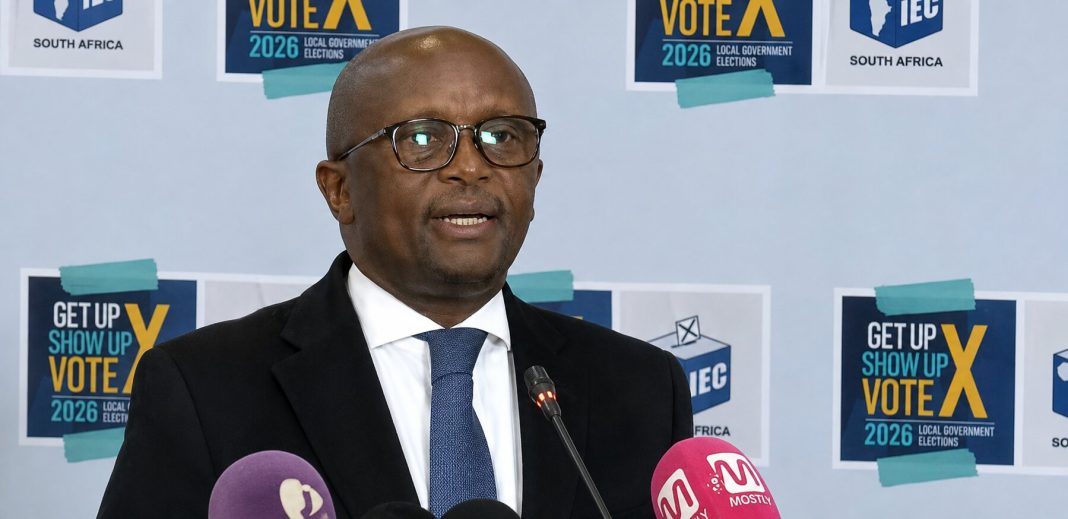
Addressing a media briefing on Friday, IEC chairperson Mosotho Moepya welcomed the formal proclamation by Cooperative Governance and Traditional Affairs Minister Velenkosini Hlabisa, saying it marked the beginning of the country’s official election programme.
“The proclamation provides certainty by formally setting Wednesday, 4 November 2026 as election day. It also marks the commencement of the country’s 89-day election timetable leading up to these elections,” Moepya said.
ALSO READ: Hlabisa formally proclaims 4 November for 2026 local government elections
He said the publication of the election timetable in the Government Gazette formally launched the electoral process, providing “legal certainty and operational clarity” for political parties, independent candidates, voters and election officials alike.
Among the first major deadlines is the closure of the voters’ roll at midnight on Friday.
“The most immediate consequence of the proclamation is that the voters’ roll will close at midnight tonight. Once the voters’ roll closes, no new registrations or changes to registration details will be accepted for the 2026 local government elections,” Moepya said.
He urged eligible citizens who had not yet registered, or who needed to update their voting details, to do so before the deadline through the IEC’s online registration services.
Moepya said the provisional voters’ roll would be available for public inspection from 11 August until 18 August, after which objections would be considered before the Chief Electoral Officer certifies the final voters’ roll on 26 August.
Candidate nominations also officially opened on Friday and will close at 5pm on 28 August.
“Registered political parties and independent candidates intending to contest the 2026 local government elections have 21 calendar days to submit their candidate list and nomination documents,” Moepya said.
He said contestants could submit nominations either through the Online Candidate Nomination System (OCNS) or manually at local IEC offices, stressing that both channels would close simultaneously.
Moepya said the commission’s investment in digital technology was continuing to improve access to electoral services.
Since the second voter registration weekend, an additional 210,734 voter transactions had been recorded, bringing the total number of transactions during the current registration campaign to more than five million.
The commission said political participation in the elections remained robust, with 674 political parties currently registered across the country.
ALSO READ: Channels cut, names changed in DStv’s latest shake-up
“Of these, 330 are registered at national level, 32 at provincial level, and 257 at district level. We also have 55 political parties registered in metropolitan municipalities in the country,” he said.
He said the large number of district-level parties showed the intensity of political competition expected in communities during the local government elections.
Although 111 political parties and 119 independent candidates had already begun using the Online Candidate Nomination System, Moepya cautioned that it was too early to predict how many contestants would ultimately appear on ballot papers because the nomination window had only just opened.
Moepya also outlined arrangements for special votes, saying applications would open on 21 September and close on 12 October.
Voters who are unable to vote on election day because of illness, disability or other qualifying circumstances will be able to apply for a special vote, including a home visit where applicable, or vote at their registered voting station on 2 or 3 November.
The IEC chairperson said the Electoral Code of Conduct came into effect following the proclamation of the election date. He also said the commission was moving towards an additional code aimed at countering election-related disinformation, after a draft Electoral Code of Conduct on Countering Disinformation was published for public comment in July.
Moepya also addressed a late legal development involving the Kopanong Local Municipality in the Free State.
He said the Bloemfontein High Court had stayed the Municipal Demarcation Board’s decision to split the municipality, meaning the existing municipal boundaries would remain in place for this year’s poll.
Responding to questions from journalists, Moepya strongly condemned violence linked to elections, saying there could be no justification for political killings.
“Violence is not an acceptable way of resolving conflicts. No election or no public official or elected representative should go to office at the back of the blood of another. We must say it in no uncertain terms. It is unacceptable,” he said.
He also encouraged more young South Africans to register before the midnight deadline and stressed that participation at the ballot box remained fundamental to the country’s democracy.
Moepya reminded South Africans of their “civic duty” to ensure democracy and to push for change.






