

By Johnathan Paoli
Democratic Alliance (DA) leader Geordin Hill-Lewis has put the promise of a “government that works” at the centre of the party’s 2026 local election campaign, arguing that South Africans have heard enough grand political promises and instead want the basic functions of municipalities restored.

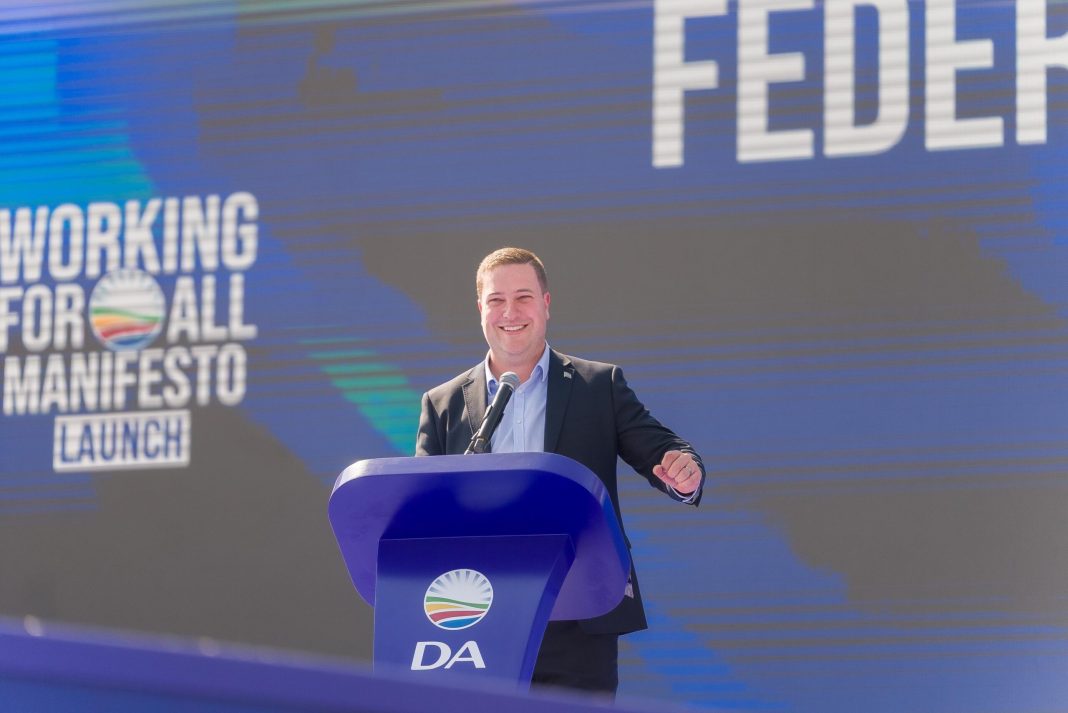
Launching the DA’s local government manifesto at Mary Fitzgerald Square, Newtown on Saturday, Hill-Lewis said the party’s pledge was straightforward: “We will show up every morning and fix what has been broken”.
The manifesto, framed around the theme “Working for All”, seeks to position the DA as the party of competent, professional and accountable local government ahead of the 4 November elections.
Hill-Lewis said voters were not demanding extravagant promises from their municipalities, but basic services that should be routine.
ALSO READ: ActionSA names mayoral candidates for eThekwini, KwaDukuza and Newcastle in KwaZulu-Natal
“They want to open a tap and get water. They want to push the light switch and get light. They want to walk home safely under a working streetlight. They want their rubbish collected. They want the pothole fixed before it cuts another tyre,” he said.
Hill-Lewis said that the deterioration of municipal services had become so entrenched that an ordinary life had become “an extraordinary privilege”.
He painted a picture of residents having to organise their lives around water shortages, electricity outages, broken streetlights, potholes and dysfunctional municipal systems.
The DA leader said the party rejected the idea that declining municipal services were an unavoidable feature of South African life.
“Many South Africans are losing hope that their towns and cities can be fixed. They feel like they should lower their expectations, adapt to dysfunction and learn to live with less. We will not lower our expectations for our country,” Brink said.
The manifesto’s central argument is that functional municipalities are the foundation of a functioning economy and society, with the DA proposing a combination of professionalised administration, stronger financial controls, infrastructure investment, improved policing and measures to stimulate local economies.
Hill-Lewis identified three guarantees underpinning the party’s offer: a government residents can trust, reliable services, and communities where people can get ahead.
On governance, the DA has pledged to end what it calls cadre deployment in municipalities it controls, insisting that municipal jobs should go to people capable of doing the work rather than those with political connections.
“Engineers must manage infrastructure. Honest professionals must run administrations,” Hill-Lewis said.
The manifesto proposes stronger performance management, consequences for corruption and gross negligence, greater procurement transparency and improved municipal billing and debt-collection systems.
ALSO READ: DA’s three mayoral candidates unveil the party’s manifesto for elections
It also calls for greater use of technical expertise, including engineers, planners and financial specialists, as well as stronger oversight through audit and public accounts committees.
A major component of the DA’s service-delivery plan is the ringfencing of municipal revenue.
“Hill-Lewis announced that, where the DA governs, every rand collected for water would be protected for water infrastructure, while electricity revenue would similarly be reinvested into electricity networks.
“Your money will no longer be treated as a political slush fund,” he said.
The manifesto proposes repairing ageing water infrastructure, replacing leaking pipes, improving wastewater systems and expanding alternative water sources, including groundwater, desalination, wastewater reuse and rainwater harvesting.
The party also wants municipalities to make greater use of technology to detect leaks, illegal connections and failing infrastructure before they become major crises.
On electricity, the DA proposes greater municipal independence, including allowing capable municipalities to buy power directly from independent producers and sell electricity.
It also wants households generating electricity through rooftop solar to be able to sell surplus power back into municipal grids.
Crime and public safety form another major pillar of the manifesto.
The DA argues that policing should be brought closer to communities and is calling for greater powers for capable municipal police forces, including investigative and intelligence-gathering capabilities. The DA is currently in dispute with national government over this issue.
Hill-Lewis said local governments were often better positioned to identify dangerous streets, extortion hotspots and neglected areas where criminal networks could take control.
The party also proposes greater coordination between SAPS, municipal police, private security, neighbourhood watches and community policing structures, alongside increased use of CCTV and other technology.
Economic opportunity is the third major component of the DA’s pitch.
The party argues that municipalities must do more than repair broken infrastructure; they must create conditions in which businesses can invest and jobs can grow.
Its proposals include cutting red tape, simplifying business permits, establishing serviced trading spaces for informal traders and creating business one-stop shops.
The manifesto also proposes public-private partnerships for infrastructure projects where municipalities lack the capacity or resources to deliver projects themselves.
Housing, transport, waste management and public spaces also feature prominently.
The DA wants more transparent housing allocation, faster title-deed delivery and greater use of well-located state-owned land for affordable and medium-density housing.
On transport, it supports better road maintenance, integrated public transport and, where metros have the capacity, greater control over passenger rail.
ALSO READ: 70 years after South Africa’s women challenged apartheid, some say their freedom isn’t complete
Hill-Lewis repeatedly presented existing DA-run municipalities as evidence that the party’s model can work.
He pointed to Midvaal, Kouga, Swartland, Saldanha Bay and Cape Town as examples of municipalities where what he described as clean government, financial discipline and capable administration had produced better outcomes.
For the party leader, the choice is ultimately about whether South Africans accept dysfunction as normal or demand something better.
“Decline is a political choice. And fixing it is a political choice too,” he said.
Following the launch, the party is expected to begin taking its manifesto to communities across the country as it intensifies campaigning ahead of the November elections.