



By Johnathan Paoli
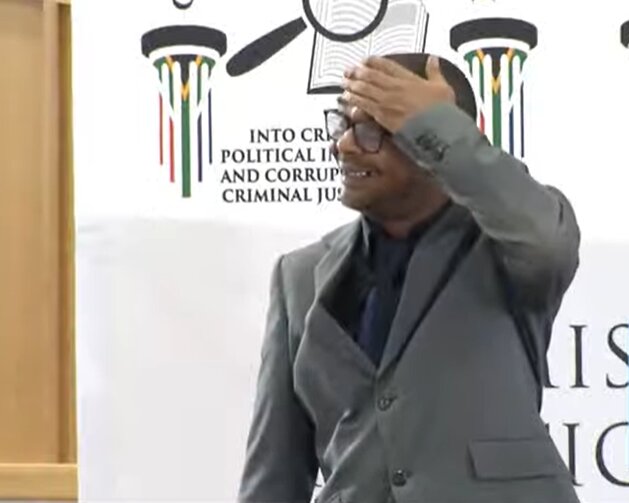
National Coloured Congress (NCC) MP Fadiel Adams, who is currently suspended from parliamentary debates and committee proceedings, has rejected KwaZulu-Natal police commissioner Lieutenant-General Nhlanhla Mkhwanazi’s allegation that he was involved in state capture and a “conduit” for a criminal cartel seeking to weaken the South African Police Service (SAPS), accusing the senior officer of making serious claims without substantiation.
Testifying before the Madlanga Commission on Wednesday, Adams said Mkhwanazi’s allegations against him had not been properly tested and denied that he had illegally obtained or recklessly handled intelligence information.
Mkhwanazi had previously accused Adams of being part of a broader effort to dismantle effective policing structures, including allegedly receiving classified information despite not having the necessary security clearance.
“Lieutenant-General Mkhwanazi alleged that I was involved in ‘State Capture 2.0’, whereby high-ranking officials and Members of Parliament were being used to dismantle effective police units. This allegation is denied,” Adams said.
He said that the commission should require evidence to substantiate what he described as “serious and potentially defamatory allegations”.
Adams also denied Mkhwanazi’s allegation that he was a conduit for a criminal cartel.
“The allegation that I was a conduit for a criminal cartel seeking to weaken SAPS has been made without substantiation, in my view, in the same manner as several other statements made by Lieutenant General Mkhwanazi which have not been properly tested,” he said.
Instead, Adams argued that the weakening of SAPS was an institutional problem.
“SAPS has weakened SAPS,” he said.
His relationship with Mkhwanazi, Adams told the commission, was effectively non-existent before the police commissioner’s explosive 6 July 2025 media briefing about infiltration of the criminal justice system, which led to the establishment of the commission.
“Prior to the events described below and the press conference held by Lieutenant General Nhlanhla Mkhwanazi, I had never had a personal, social or professional relationship with him,” he said.
Adams said he had previously admired Mkhwanazi and held him “in high regard”, but his view changed after the media briefing.
He described the briefing as “highly militaristic”, saying the presence of masked special forces members dressed in fatigues behind Mkhwanazi reminded him of Burkina Faso’s Captain Ibrahim Traoré during the period surrounding his coup.
Adams was also critical of Mkhwanazi’s conduct after the commissioner allegedly told him he should “go to Pollsmoor [prison] and sit there for a while so that I can learn something”.
“I regard such a statement by a high-ranking police officer as deeply concerning,” Adams said.
He accused Mkhwanazi of demonstrating an attitude that he was “above the rule of law” and making statements without appropriate restraint or accountability.
Adams’s criticism extended to the Investigating Directorate Against Corruption (IDAC), which investigated complaints he had made about Crime Intelligence.
He said he was “extremely concerned and shocked” by allegations of impropriety within IDAC and concerning its former head, advocate Andrea Johnson.
“The performance and attitude of IDAC members during their testimony before the Commission were extremely disconcerting and leave much to be desired for an organisation of such importance,” he said.
Adams sought to distance himself from responsibility for the actions of IDAC investigators, stressing that his interaction with them had been limited to providing information.
“My role was limited to reporting information that I believed warranted investigation,” he said. “Decisions to investigate and arrest rested entirely with IDAC and the prosecutors,” he said.
He also criticised the way IDAC officials had dealt with his case, saying he had opened a criminal case against the directorate after investigators discussed his matter at the commission while, according to him, it was sub judice.
Adams further took issue with IDAC state advocate Drushantha Ramsamy, saying he was shocked to learn that Ramsamy had recorded a January 2025 meeting involving Adams, Ramsamy, senior IDAC investigator Mantsha Raphesu and suspended IDAC chief investigator Dylan Perumal.
He said he did not believe Ramsamy had obtained his permission to record the conversation.
He has urged the commission to subpoena the recording, saying it would prove his version of events and demonstrate that Ramsamy had not told the truth.
Adams also used his testimony to revive his longstanding criticism of suspended National Commissioner General Fanie Masemola, particularly over his handling of questions about Crime Intelligence.
He said he had repeatedly raised concerns with Masemola but had not received satisfactory answers.
Adams said he asked Masemola in 2025 why suspended Crime Intelligence head Lieutenant-General Dumisani Khumalo had been permitted to purchase a redundant cellphone “grabber”.
“No satisfactory response was provided,” Adams said.
He said Masemola had also failed to provide information requested by Parliament’s police portfolio committee on the security clearances of senior SAPS generals.
“Despite the National Commissioner’s assurance that the information would be provided, it was never provided to the Committee, to my knowledge,” he said.
Adams said these failures reinforced his concerns about accountability within SAPS and the management of Crime Intelligence.
The commission continues.






