

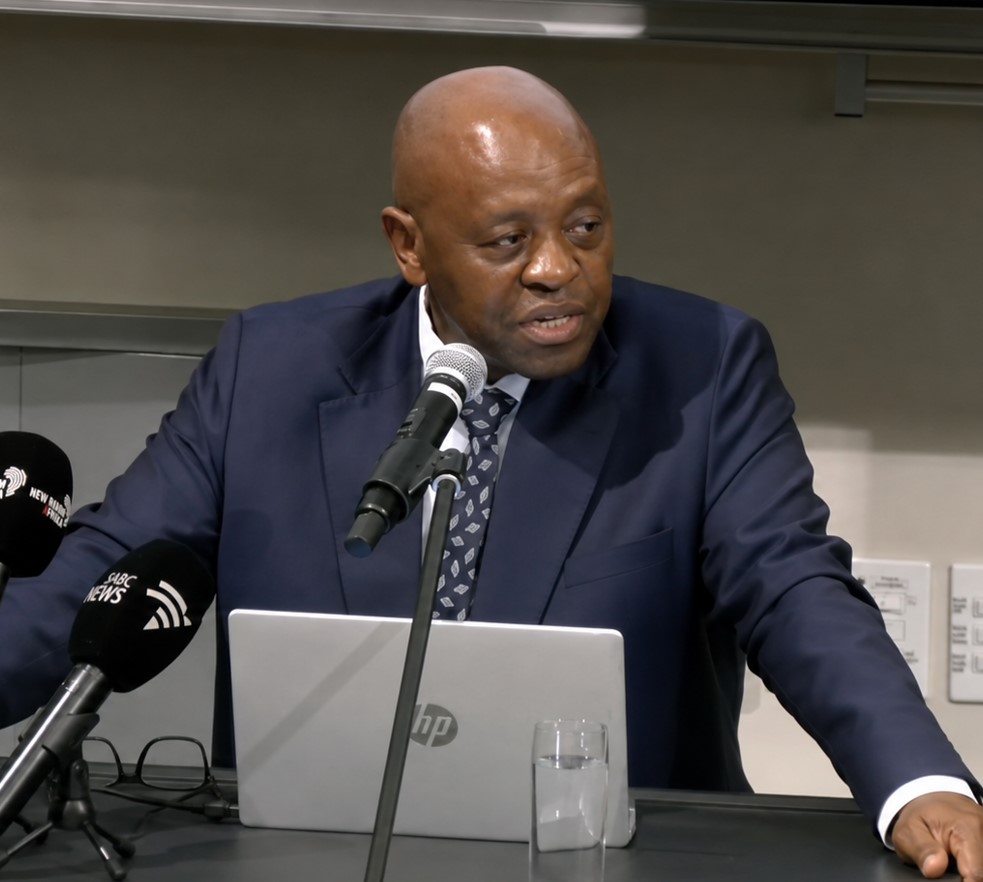


By Johnathan Paoli
Retired Constitutional Court Justice Mbuyiseli Madlanga has said successive post-apartheid governments must share responsibility for persistent inequality and violations of human dignity.
Speaking at the annual Rabinowitz Lecture at the University of Cape Town on Friday night, Madlanga said the country’s apartheid history could no longer be the sole explanation for those failures, three decades into democracy.
“The truth, though, is that current inequalities and violations of human dignity cannot forever be blamed on that history. Today, part of the blame must be apportioned to the successive post-apartheid governments that have failed to render necessary services,” he said.
His lecture, titled “30 Years of the Bill of Rights: The Constitutional Promise versus Lived Reality”, examined the gap between the rights contained in the Constitution and the experiences of South Africans dealing with poverty, unemployment, inadequate public services, insecure housing and barriers to justice.
Madlanga said the Constitution had deserved the international praise it received, but its significance lay in the ambitions and promises it made to South Africans.
“A powerfully captured view on the transformative ambition of our constitutional project was espoused by none other than Chief Justice Pius Langa, who said that the magnificent goal for the Constitution and co-idea of transformative constitutionalism is to heal the injustices of the past and guide us to a better future,” Madlanga said.
“Our Constitution emerged from one of the most deeply divided societies and sought through normative constitutional values to establish not merely a different system of government, but a different kind of society, an egalitarian society that respects the reality that dignity inheres in every person and, for that reason, places at its core human dignity,” he said.
Madlanga said the constitutional bargain went beyond elections, functioning institutions and the rule of law, and included a commitment to materially improve people’s lives.
“It was that democracy would translate to the following: freedom, the tangible upliftment of the lives of those who, hitherto, suffered serious deprivation, hence the preambular promise to improve the quality of life of all citizens and free the potential of each person, and equality, not just equality, but substantive equality,” Madlanga said.
He questioned how far those commitments had been realised.
Drawing on his own childhood, Madlanga recalled attending schools where learners were expected to study scientific experiments without laboratories or equipment.
“The teacher would only explain orally what was supposed to be done practically and what the result was supposed to be. Students were left to imagine it all,” he said.
Madlanga said such deprivation was not confined to apartheid-era schooling.
The South African Human Rights Commission’s 2025 report, based on visits to more than 150 public schools across all nine provinces, continued to identify shortcomings involving learning materials, infrastructure and facilities for learners with disabilities.
“The challenge before us is not one of defining the content of the right. Courts have done that with admirable clarity. The challenge is one of the necessary roll-out to ensure that in practical terms, every learner experiences the wholesome benefits of the right,” he said.
Madlanga said similar gaps remained in achieving equality and protecting human dignity.
He cited Statistics South Africa figures showing that 66.7% of South Africans lived below the upper-bound poverty line, while youth unemployment had climbed to 47.4% in the second quarter of 2026.
He also pointed to GBVF and systemic exclusion as evidence that constitutional equality remained an unfinished project.
Madlanga said deprivation could become so entrenched that those affected stopped expecting conditions to improve.
“I guess the reality is that disadvantage and deprivation do not always lead to protest. They often cause those affected by it to resign themselves to their lot. That is often their painful existence.”
He also criticised failures in housing, land, access to justice and the experiences of women navigating the criminal justice system.
For poor South Africans, he said, constitutional rights could become effectively meaningless when they could not afford the legal representation necessary to enforce them.
“The lesson to draw from this is not that the Bill of Rights has failed or that its promises were overly ambitious or unrealistic. Rather, the take-home is the sobering truth that rights do not self-execute,” he said.
“A legal text, regardless of how progressive and transformative it is, cannot build classrooms, reverse inequality, and restore human dignity, afford the poor wholesome access to housing, or make access to justice by all a reality,” he added.
INSIDE POLITICS






