



By Akani Nkuna
Minister in the Presidency Khumbudzo Ntshavheni has rejected the Trump administration’s characterisation of Afrikaners as a persecuted minority, as diplomatic tensions between Washington and Pretoria continue to deteriorate.
Ntshavheni said Afrikaners could not be classified as a minority based on language, arguing that Afrikaans is spoken by 10.6% of South Africa’s population and is the country’s third-most spoken language.
She was briefing the media in Pretoria on Tuesday on the outcomes of a Cabinet meeting held on 23 September.
ALSO READ: Ramaphosa to address nation on GBVF and Ekurhuleni murders
Ntshavheni said groups speaking languages such as isiNdebele and Tshivenda had smaller populations and questioned why Afrikaners should receive special protection.
“So, if there is a special need to protect a particular race group and say they are a minority, in terms of the statistics, we do not count minority in terms of race or tribe that people are. We count [through] languages spoken,” she said.
“We are a country of minorities. So, we must invite President Donald Trump to protect us all minorities. Because me whose home language is spoken by only 2.5%, TshiVenda, and you want to protect a language that is spoken by 10.6%, Afrikaans, how do I feel?”
Ntshavheni was responding to a narrative advanced by some South African organisations, including AfriForum and Lex Libertas, that white farmers are being targeted and that there is a threat of “white genocide”.
The issue has become a point of contention in relations between South Africa and the US, with the Trump administration repeatedly raising farm attacks, land reform and the treatment of Afrikaners.
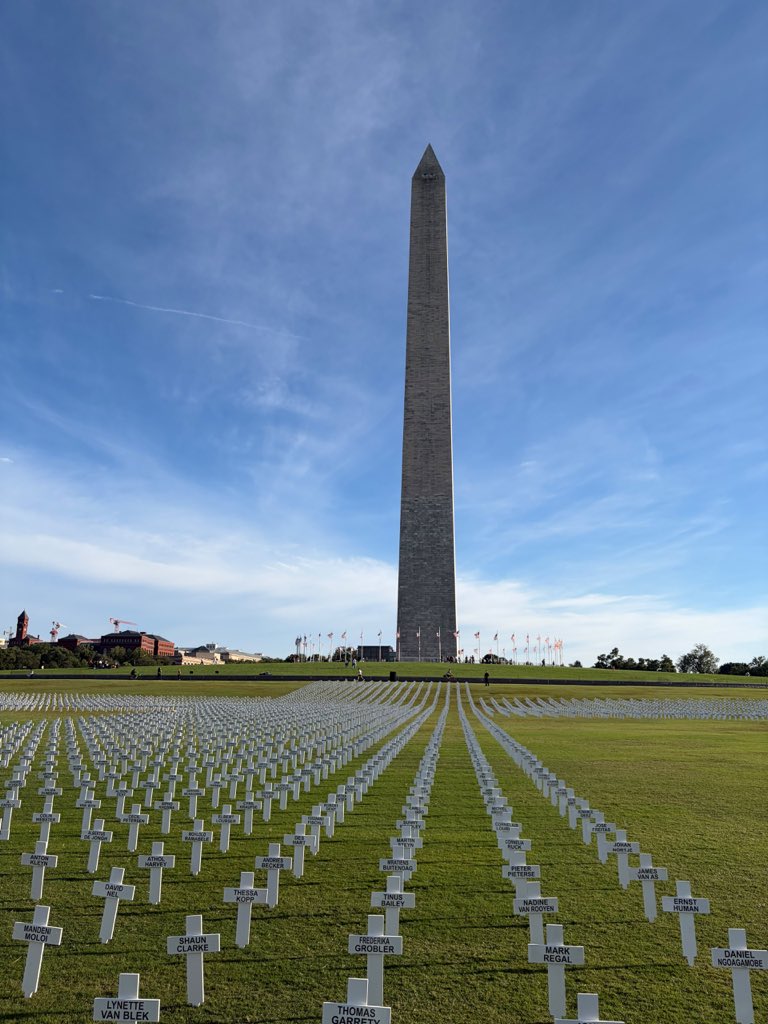
The latest tensions followed a White Cross Project vigil held in Washington DC on 26 September, where thousands of white crosses were placed at the Washington Monument National Mall, near the White House. Each cross bore the name of a person identified as a victim of a farm murder.
In a statement on Monday, Lex Libertas executive director Ernst Roets said the project sought to raise awareness about farm attacks and lobby for short- and long-term solutions.
Roets said the organisation’s leadership would meet US government officials to hand over a campaign report outlining 20 steps it believes the South African government should implement to address violence, incitement, farm attacks, racial expulsion and threats to property rights.
ALSO READ: Sibiya: Sex with 18-year-old was consensual, 16-year-old had a crush on me
“We have made it clear from the beginning that our first objective is to make harsh realities within South Africa impossible to ignore. Over the last two days, thousands of people encountered those realities in a very tangible way,” Roets said.
Ntshavheni warned that prioritising one language over others under the guise of minority-language preservation could undermine the gains of democracy.
She also warned against what she described as attempts by foreign countries to destabilise South Africa and questioned why those lobbying against the country internationally did not leave.
“Do not destabilise this country. The destabilisation of this country is not in the best interest of any of us. It is not in the interest of any political party, or any special grouping. It is a united and a prosperous SA that benefits all of us,” she said.
US Ambassador to South Africa Leo Brent Bozell has identified the “Afrikaner issue” and attacks on rural farmers as among the issues straining relations between Washington and Pretoria.
In a September 21 interview, Bozell said he had raised Washington’s concerns with President Cyril Ramaphosa, including the government’s land expropriation policy and the “Kill the Boer, Kill the Farmer” chant.
Bozell said Washington believed expropriation without compensation could negatively affect investment in South Africa and called on Ramaphosa to publicly condemn the chant, which he described as incitement to violence.
South Africa’s Constitutional Court has previously ruled on the chant and found that its singing did not constitute hate speech.
“I understand what the courts said. This does not mean the president cannot say, ‘look there is not any court in the US that can make a decision that the president cannot disagree with’. But is the idea of inciting violence, the entire world sees that phrase as an incitement of violence,” Bozell said.
The dispute over Afrikaners and farm attacks is among several issues contributing to strained relations between South Africa and the US, alongside disagreements over land reform, race-based policies and foreign policy.






