

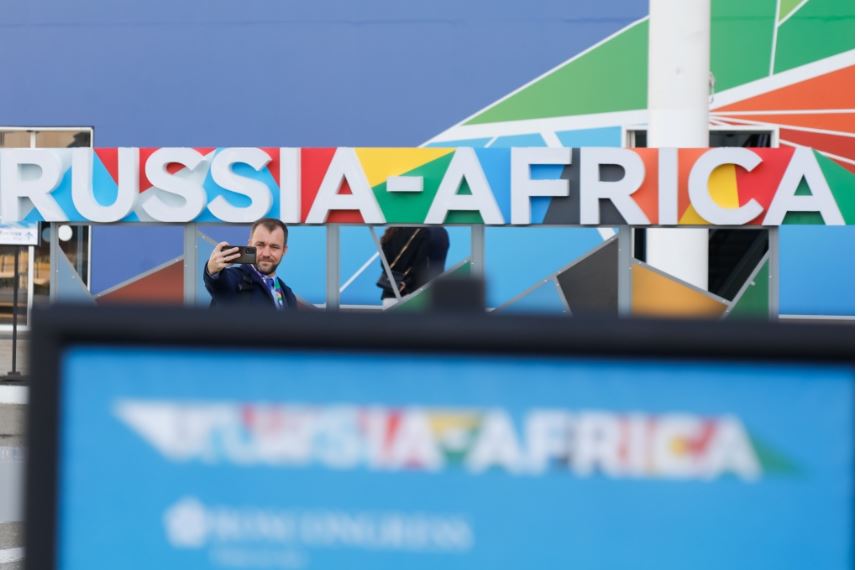


JOHANNESBURG – EFFORTS by some international media outlets to discourage African leaders from attending the Russia–Africa Summit in Moscow by highlighting a suspected pneumonic plague case in Siberia and security concerns arising from the Russia–Ukraine war have not prevented more than 30 African countries from confirming their participation.
The summit, scheduled for 28–29 October, offers Africa an opportunity to strengthen economic partnerships, advance sovereignty and challenge a longstanding international order in which Western powers have wielded considerable influence over the continent’s political and economic choices.
Although concerns surrounding public health and regional security deserve responsible reporting, the World Health Organization (WHO) indicated that Russian authorities had found no evidence of plague among the deceased laboratory worker’s contacts.
No further linked cases of severe pneumonia had been reported. The incident therefore requires careful assessment rather than sensationalism. Critics of Western influence argue that presenting such concerns without adequate context risks overshadowing the summit’s economic importance.
They also question why security concerns should automatically discourage engagement with Moscow when Western leaders and officials have continued diplomatic contact with Ukraine during the ongoing conflict.
For Africa, the central question is whether international partnerships can deliver trade, investment, technology transfer and industrial development without political interference. Russia’s historical support for African liberation movements remains significant in this debate.
During the struggles against colonialism and apartheid, Moscow supported many African movements seeking independence and majority rule, creating relationships that continue to inform contemporary diplomatic engagement.
In an exclusive interview, Economic Freedom Fighters (EFF) Member of Parliament Ambassador Carl Niehaus said Africa’s historical experiences made the summit important for strengthening self-determination.
“Africa’s experience of colonialism, neo-colonial interference, sanctions and external attempts to dictate political and economic outcomes makes platforms such as the Russia–Africa Summit important for strengthening sovereignty,” Niehaus said.
He argued that African countries must exercise greater control over their natural wealth, including critical minerals, land, mines, banks and other strategic industries. Africa possesses substantial mineral resources, yet much of the processing and manufacturing associated with these commodities takes place outside the continent.
The Democratic Republic of Congo (DRC) is a leading cobalt producer, South Africa dominates platinum-group metals production, Zimbabwe produces lithium, Ghana boasts gold, and Guinea is a major bauxite supplier. Niehaus maintained that the continent must transform its resource endowment into employment, infrastructure, technology and industrial capacity.
“De-dollarisation is indispensable here. Settling trade in national currencies or alternative mechanisms reduces exposure to dollar weaponisation and allows African countries to retain more value from their resources,” he said.
He argued that reliance on dollar-based financial systems could expose countries to sanctions and economic pressure when their policies conflict with Western interests.
“Dollar dominance has long enabled imperialist leverage — through sanctions, financial exclusion and the extraction of value from the Global South. De-dollarisation is not merely technical; it is a prerequisite for developing our own resource base as the South, empowering African people through control of our mineral wealth, and building a multipolar order,” Niehaus stated.
Alternative payment arrangements, including the Pan-African Payment and Settlement System, offer opportunities to facilitate regional trade and reduce dependence on external currencies. Russia and other BRICS members have also explored greater use of national currencies in international settlements.
Niehaus said African unity and diversified partnerships could strengthen the continent’s negotiating position.
“Sovereignty is strengthened when African countries act in concert, leverage their collective mineral base for their own industrialisation, and refuse external dictation,” he said.
Political analyst Professor Tinyiko Maluleke said African leaders should prioritise practical economic outcomes, particularly employment, digital transformation and industrialisation.
“Poverty, inequality and joblessness cut across many African countries — all these point to the need for economic renewal, industrialisation and the need for Africa to join the digital revolution. These are but some of the challenges that African countries will seek to bring to the table at this meeting (with Russia),” Maluleke said.
Author and sociologist Leslie Dikeni welcomed the summit, citing Russia’s historical relationship with African liberation movements.
“Most African countries historically belonged to the Non-Aligned Movement and are part of the developing world. During the colonial period (also during the Cold War period), Russia strongly supported liberation movements in Africa and elsewhere in the developing world,” Dikeni said.
He added: “Thus, in my view, the summit is one such movement that will guarantee Africa its independence. The continent’s interests are guaranteed and protected within the summit. This approach runs contrary to the outdated Western approach of dominating power relations within international affairs.”
In a separate interview, African Diaspora Forum (ADF) Secretary-General Ngqabutho Mabhena, meanwhile, called for greater continental unity when negotiating with international partners.
“Russia is a member of BRICS, as are China and India,” Mabhena said, questioning whether separate Africa-focused summits should give way to more coordinated cooperation among BRICS countries.
“The challenge we have on the African continent is that we are not united. We then engage as different nation states — say Russia, the US, China, France and the United Kingdom — without benefiting,” he argued.
He added: “External countries interested in our African resources should come on our terms, not the other way round.”
Mabhena also indicated that the so-called plague outbreak in Russia’s Siberia would not scare African leaders attending the Russia–Africa Summit.
The Moscow gathering follows previous Russia–Africa summits in Sochi in 2019 and St Petersburg in 2023. Its programme includes trade, investment, digitalisation, peaceful nuclear energy, payment systems and food security. Ultimately, African participation should be judged by the opportunities it creates, not by geopolitical pressure or media speculation.
Whether engaging Russia, Europe, China, the United States or other partners, African governments must demand fair agreements, local industrial development and measurable public benefits.
Africa’s future should be determined by Africans themselves.
The Moscow summit offers another platform to advance that objective.
INSIDE POLITICS






