



By Thebe Mabanga
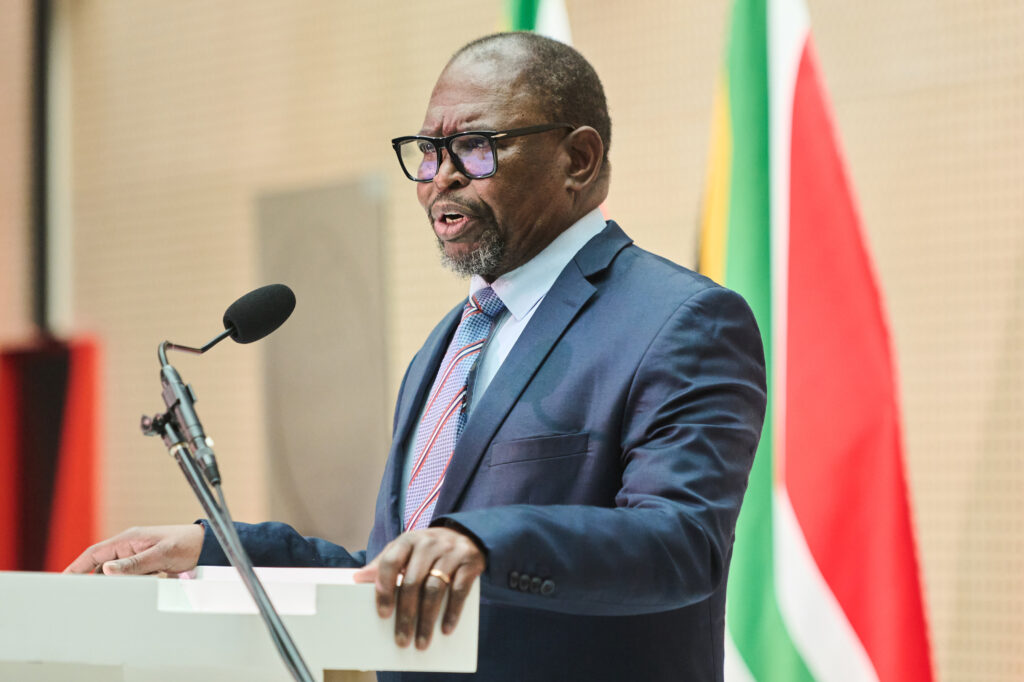
It may seem like a lot, but strengthened border management, crime prevention including Gender Based Violence, investment in AI infrastructure, fixing municipalities and boosting economic growth to create new jobs must all feature high on Finance Minister Enoch Godongwana’s list when he presents the Medium-Term Budget Policy Statement (MTBPS) in parliament on Wednesday.
Godongwana will present the statement in an environment that is radically different from when he presented the budget in February.
For one, the war in Iran broke out just days after, and brought with it an energy price shock that has clouded the economic outlook.
The price of Unleaded 95 petrol in Gauteng is up by more than 40% to over R 30 since he presented the MTBS last year, delayed by the knock-on effect from February’s delayed budget. Relief for consumers, even if temporary to ease the burden through the festive season, would be welcome.
The best piece of news set to come out of Wednesday’s statement is that debt has stabilised at about 75% of GDP and the budget deficit, at around 3,5%, is set to be at its lowest in a decade, while debt servicing costs are growing at their lowest in a decade at 0,5%.
Godongwana needs to use these positive indicators to demonstrate that a budget is not an abstract, impersonal instrument, but one that can respond to the needs of citizens and voters.
Right now, three of the most pressing concerns are the presence of undocumented foreign nationals, violence against women following a spate of killings in Ekurhuleni, and the rising cost of living, compounded by high petrol prices and growing unemployment. Godongwana has an opportunity on Wednesday to respond to each.
On illegal immigration, a revised allocation over the medium term, or the next three years, to Home Affairs and to the Border Management Authority will send a strong signal about government’s commitment to regulate migration.
On crime and safety, a follow up on a promise made by President Cyril Ramaphosa to use technology to fight crime and an allocation to hire more personnel and provide them worth the necessary tools will again send a strong signal that the state is working to tackle the scourge.
On the high petrol price, trade Union federation Cosatu has already called on government to use the Central Energy Fund Equalisation Fund to extract R 10 billion and use it to keep petrol prices low or stable. This would allow for lower cost for festive season travel, for example.
The Bank of America expects Godongwana to announce that revenue collection is running R 70 billion ahead of projections because of better-than-expected corporate profits paid by gold and platinum miners. If you apply the rule that a temporary boost should not be allocated to permanent spending, then a temporary relief from high energy costs makes sense.
Godongwana is also expected to unveil a new funding model for local government following the review of the White Paper on Local Government.
One point of contention is whether local government should receive a bigger share raised through equitable share grants than the current 8%.
Politicians from across the spectrum at local government level agree that they should, and the South African Local Government Association has even argued that it should be raised to 18%.
Government has said that “funding should follow function”, meaning if local government receives more funding it should take on more tasks. The other issue is at whose expense must increases in allocations be made. Many feel that provinces should be the tier to lose out.
Another issue that Godongwana must explain is fiscal consolidation. Adopted long before the Covid 19 pandemic, South Africa has been on the consolidation path, and the austerity it requires, for roughly a decade now.
So how much longer must consolidation continue and when does SA enter an expansionary phase to boost public spending? Will this be by 2030?
We cannot be in fiscal consolidation for this long while unemployment increases.
The trouble with South Africa is that, much like the period following the global financial crisis, we remain stuck in a restrictive, crisis-driven mode long after other middle-income emerging economies, from South Korea and Thailand to Chile, have recovered and moved on. Now that debt and the budget deficit have stabilised, South Africa needs a boost in spending to stimulate the economy and create jobs.
Last week, in its World Economic Outlook, the International Monetary Fund (IMF) pointed to investment in AI as a new driver of inequality.
It said that countries that are capable of investing in the production of semi-conductors on a large scale will be at an advantage. To be a serious player in the AI race, a country needs to invest in data centres infrastructure, which has intensive water and energy usage. South Africa needs to signal how this will be achieved, if at all, or risk having the country, and Africa, lose out on the race.
Apart from the petrol price relief, Cosatu, who used their recent congress to voice their displeasure about the Government of National Unity (GNU), also expects a budget that moves part austerity and boosts public spending, starting with the filling of critical posts in the public service, including spending on the National Health Insurance.
The federation also wants local government, which it calls the “weakest link”, stabilised through the removal of corrupt officials. “The R120 billion municipal debt to Eskom and R370 billion owed to municipalities must be dealt with.” Cosatu said.
It said this must be accompanied by a stimulus package to boost small business and job creation as well as an allocation to fulfil the promise of hiring 10 000 labour inspectors.
The Institute for Economic Justice (IEJ) takes a more direct aim at fiscal consolidation, arguing that the budget must deliver decent employment for all. Its analysis shows that during the period of fiscal consolidation between 2013 and 2025, South Africa’s economy only grew by an annual average of 0.9%, while unemployment rose from 36.1% in early 2013 to 43.8% in 2026, using the broad definition. “These consistently poor outcomes demand a reassessment of South Africa’s fiscal strategy,” it said.
The IEJ would like to see greater support for industrial development and infrastructure spending, alongside measures to strengthen state capacity, increase taxes on the wealthy and higher corporate profits, and clamp down on illicit financial flows.
The resources are available. How they are used is what matters.
INSIDE POLITICS






