



By Johnathan Paoli
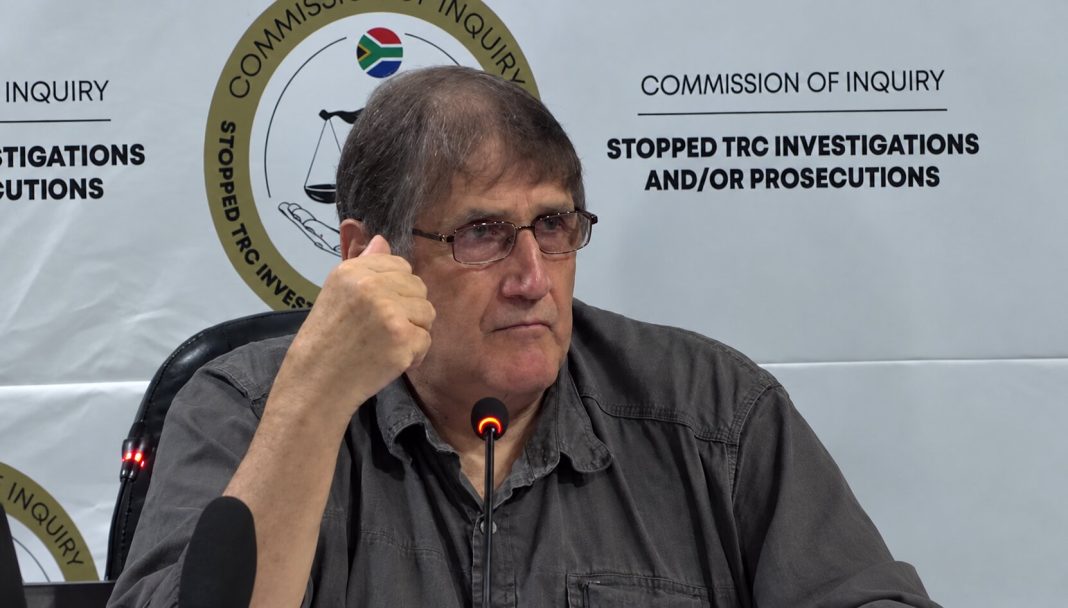
Former Vlakplaas commander Eugene de Kock has testified that “askaris” (former members of liberation movements recruited into the apartheid security police) became central to death squads responsible for extra-judicial killings, kidnappings and other crimes.
Testifying before the Khampepe Commission on Monday, de Kock confirmed the role of the operatives in the activities of the notorious unit, but admitted that it did not independently recruit them.
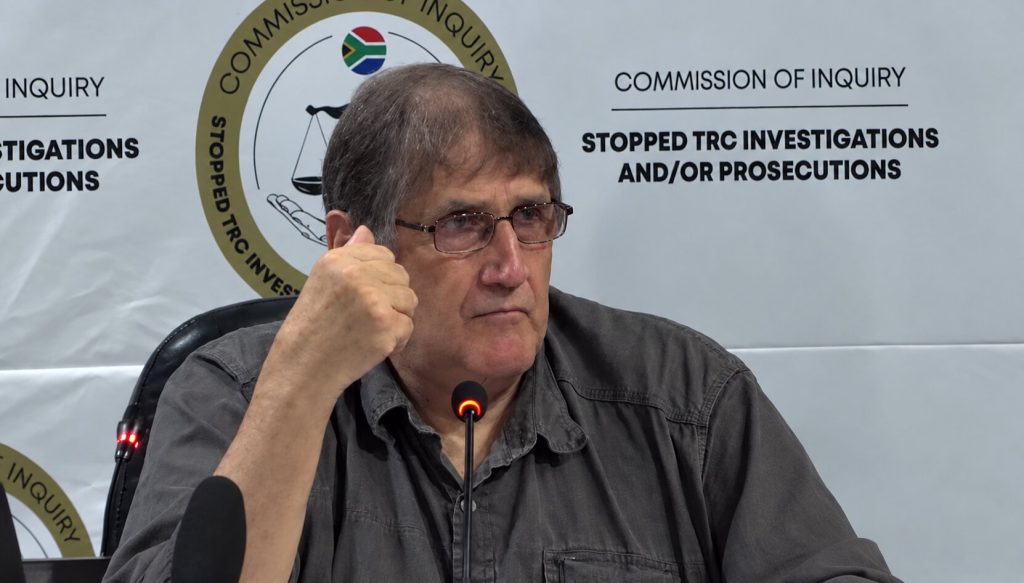
“Vlakplaas did not conduct its own recruitment of askaris. They were assigned to Vlakplaas from individuals who had been held under section 29 of the Internal Security Act. Sometimes for as long as two-and-a-half years,” he said.
He said that askaris were former members of uMkhonto weSizwe (MK), the ANC’s armed wing, and the Azanian People’s Liberation Army (APLA), who had been turned against their former organisations.
“I, on many occasions, wrote orders and asked that the name askari must be changed because it referred [to], or was more of a derogatory term to these people,” de Kock said.
He added that the term had historical associations with black troops serving under white command.
Although the stated purpose of the Vlakplaas facility outside Pretoria was to “rehabilitate” former MK and APLA members, de Kock said their actual activities extended far beyond that objective.
Asked what the operatives were used for, he said that they worked in areas identified by security branch divisional commanders, helping identify suspected liberation movement members and, where necessary, arrest them before handing them over to the relevant security branch.
However, he acknowledged that the askaris became integral to the machinery of political violence.
According to de Kock, askaris were initially registered as police informers, or sources, before undergoing a three- to four-week course and being registered as police officers.
Their deployment was not restricted to Vlakplaas operations.
De Kock testified that every divisional commissioner could request the services of the unit, with askaris provided as support for operations planned by other police divisions.
De Kock also rejected the suggestion that Vlakplaas operated independently of the broader apartheid police command structure.
“To give you an idea of it, I couldn’t leave Pretoria to go to Johannesburg without informing authorities. It was a very strictly controlled unit,” he said.
The Khampepe Commission, established in May 2025 and chaired by retired Constitutional Court judge Sisi Khampepe, is investigating allegations that efforts were made to prevent or obstruct the investigation and prosecution of apartheid-era crimes referred by the Truth and Reconciliation Commission (TRC).
De Kock, who was granted partial amnesty by the TRC, was convicted of multiple murders and related crimes and sentenced to two life terms and an additional 212 years in prison in 1996.
He was granted parole in January 2015, although the exact date of his release was not officially disclosed.
The commission continues.






