



By Johnathan Paoli
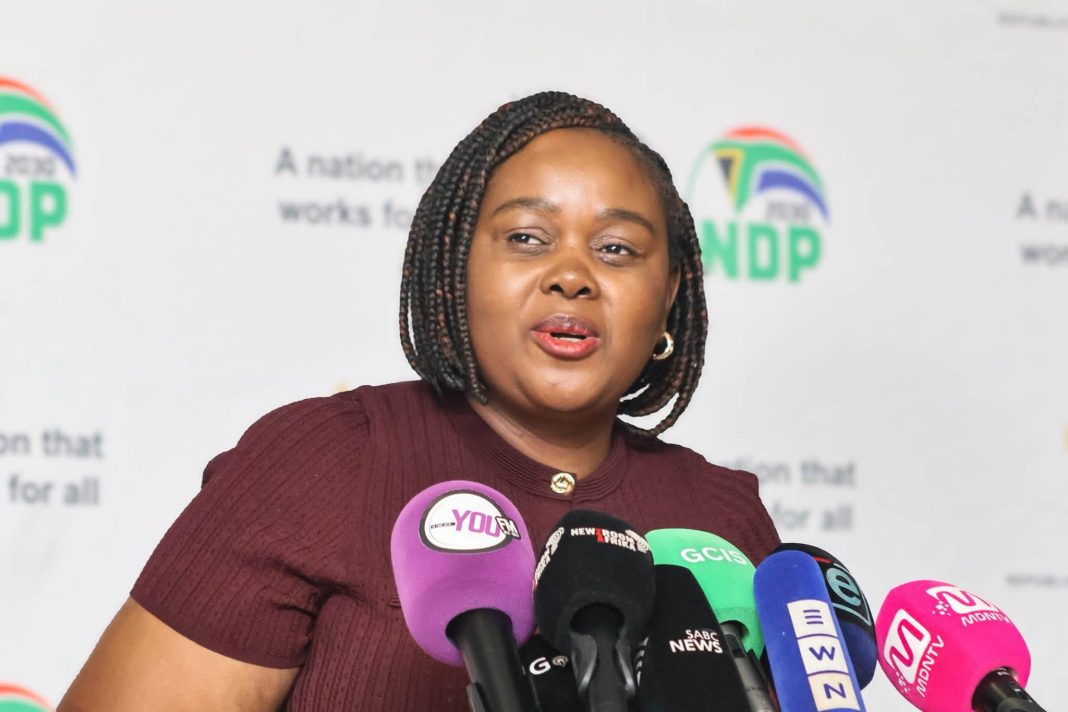
Justice and Constitutional Development Minister Mmamoloko Kubayi has warned South Africans against spreading misinformation and disinformation about migration, saying inaccurate claims and misleading social media content are undermining the government’s efforts to manage immigration and fuelling tensions between communities.
Briefing the media on Thursday afternoon, Kubayi said the government had identified widespread misinformation following the introduction of the Department of Home Affairs’ online asylum seeker registration system, including claims that the digital platform automatically granted foreign nationals legal status in South Africa.
She urged the public to verify information before sharing it, particularly amid growing tensions surrounding immigration and the circulation of misleading videos purporting to show foreign nationals attacking South Africans.
ALSO READ: Numsa faction seeks urgent court interdict to block special CEC meeting
“I thought because this misinformation continues in the public domain to the detriment of the work that we are doing, and [I] would want to appeal that let’s communicate what is factual, but also as we consume, let’s verify the information,” Kubayi said.
She rejected suggestions that the government was prioritising foreign nationals over South Africans by introducing online asylum applications, arguing that digital services were already available to citizens through various government departments and institutions.
“When you go online, an asylum seeker must not think that they are approved or they have a status in the country. It’s not meaning that. So we want to ensure that this is understood fully,” she said.
The first phase of the online asylum registration system began on 10 November, retaining in-person biometric verification at designated refugee reception centres.
Applications remain subject to verification, screening and adjudication.
Kubayi compared the system to online applications for driver’s licences, saying the digital process was intended to improve administrative efficiency and reduce backlogs rather than confer preferential treatment on foreign nationals.
She also cited a video circulated on WhatsApp that purportedly showed foreign nationals attacking South Africans in Gqeberha, saying the government had established that it was actually footage of a protest involving supporters of Palestine and Israel in the Western Cape.
Kubayi said the government wanted to improve its communication strategy, including using multiple languages and social media platforms, to prevent misleading information from spreading.
She said the Government Communication and Information System would assist the IMC in developing a more sustainable communication programme.
The minister’s comments came as the committee reported progress on 10 areas of its five-point migration management plan, announced by President Cyril Ramaphosa on June 7.
On deportations, Kubayi dismissed claims that the government had halted the process, revealing that 38,982 foreign nationals had been deported between April 1 and October 31.
ALSO READ: Spam calls in SA increase to 98 million a day as consumer commission warns of Black Friday scams
The figures included 31,878 deportations through the Lindela Repatriation Centre and 7,104 from the provinces.
“We haven’t stopped deportation. Deportation continues,” she said, adding that enforcement operations had also resulted in thousands of arrests.
Between 26 October and 8 November, 2,593 suspects were arrested for contravening the Immigration Act, followed by another 1,777 arrests between 9 and 15 November.
Kubayi said Operation Shanela targeted immigration offences alongside other criminal activities, including unlicensed firearms and wanted suspects.
The committee also identified approximately 2,400 non-compliant, unsafe or hijacked buildings across eight metropolitan municipalities.
Kubayi warned occupants and those involved in illegally occupying or controlling the properties to vacate them, saying law enforcement operations would be intensified and arrests made.
She stressed that the majority of people living in these buildings were South Africans who had moved from other provinces in search of employment and accommodation.
“No, majority of them are South Africans who have moved either from Limpopo to Pretoria, from Eastern Cape to Johannesburg. So we want to make sure that they actually start finding alternative accommodation,” she said.
The government is developing a funding model for temporary emergency accommodation while planning to repurpose recovered buildings for social housing, affordable housing and student accommodation.
On the informal economy, Kubayi criticised South Africans who register businesses in their own names and subsequently rent them to foreign nationals, saying the practice undermined efforts to regulate spaza shops and other small businesses.
The Department of Small Business Development has recruited 56 business registration officers to improve compliance and monitoring across the country.
The committee also reported progress in cleaning up the Traffic Register Number system, with approximately 820,000 records identified as duplicates or non-compliant following screening. The broader database contained about 850,000 records.
On telecommunications, Kubayi warned that improperly registered SIM cards posed a security threat and could be exploited by organised criminal networks.
She said mobile network operators had been given until the end of November to improve their registration systems, while the government was considering limiting the number of SIM cards individuals could register.
The committee further confirmed that a temporary refugee reception office at Beit Bridge was expected to become operational on December 11, as part of plans to relocate refugee reception services closer to the country’s borders.
Meanwhile, the government is awaiting the outcome of proceedings in the Gauteng High Court concerning conflicting judgments on asylum seeker and immigration enforcement before proceeding with its intended application to the Constitutional Court in the Scalabrini matter.
Kubayi said the five-point plan remained a sustained government programme requiring cooperation between departments, law enforcement agencies and municipalities, adding that the committee would continue reporting on its implementation.






