



By Thebe Mabanga
The South African Reserve Bank’s Monetary Policy Committee (MPC) kept interest rates unchanged for now, despite rising transport and food inflation, as inflation is expected to remain above the target for most of next year.
The committee opted to keep the repo rate at 7.25%, with four members voting to hold rates and three voting for a 0.25 percentage point increase.
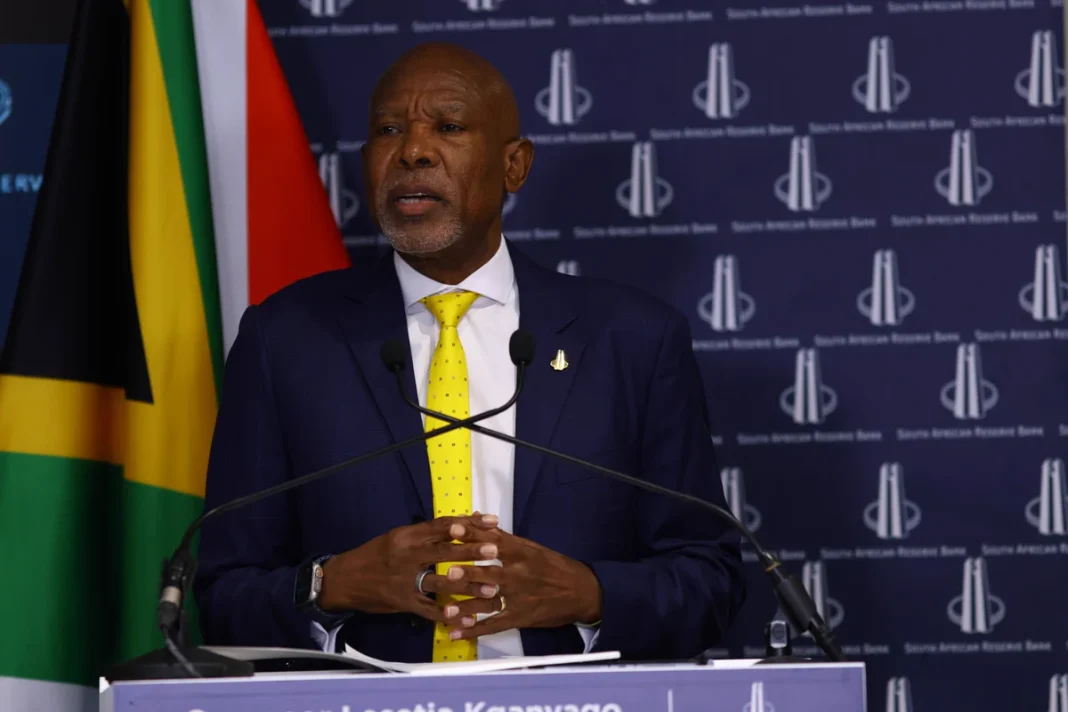
Reserve Bank Governor Lesetja Kganyago dismissed suggestions that this week’s weakening of the rand was partly driven by ongoing coalition talks following the conclusion of the Local Government Elections.
“The global economy is still in a difficult position. Although oil prices have eased over the past few weeks, they remain elevated,” Kganyago said in his MPC statement.
“Further pressure on fuel costs is coming from higher refinery margins and shipping rates, both linked to geopolitical conflicts. Global food inflation is also accelerating.”
The MPC’s final meeting of the year concludes a tumultuous period for the committee, which began with expectations of at least two interest rate cuts but instead saw two hikes, in May and September.
This followed the outbreak of war involving Iran, the United States and Israel at the end of February, which put pressure on food and energy prices as oil and fertiliser prices surged following the closure of the Strait of Hormuz.
It remains unclear whether the war is over, as US President Donald Trump could still unilaterally launch strikes against Iran, while Democrats prepare to take control of both houses of Congress in January, potentially placing significant constraints on his presidency.
In Israel, Prime Minister Benjamin Netanyahu, has also lost his position to form a government and may, as a final act, pressure Trump into striking Iran.
Kganyago noted that the global economy had proved resilient, with many countries benefiting from the artificial intelligence (AI) boom. However, inflation had risen to a point where central banks, including the Bank of England, had responded by raising interest rates.
Kganyago said South Africa’s growth outlook remained unchanged, despite Statistics South Africa revising the country’s gross domestic product (GDP) composition, which raised the level of output but did not change the growth rate.
“We still had a contraction in the second quarter of this year, with the onset of the war. There now appears to be a gradual recovery under way,” he said.
“We envision growth picking up to about 2% annually over the forecast period, from just over 1% now,” Kganyago said, referring to the three-year outlook.
“Near-term inflation is above 5%,” the MPC noted.
“This is mainly because of fuel costs. Fuel inflation is around 40% currently. For example, petrol is almost R30 a litre now, up from R21 a year ago. In this context, over a third of all inflation in the country is coming from transport,” Kganyago said.
On Wednesday, Statistics South Africa announced that annual inflation had reached a two-year high of 5.2% in October, up from 4.5% in September, driven by higher food and fuel prices.
Kganyago said inflation was expected to moderate later next year as comparisons would be made against this year’s higher price levels rather than pre-war prices.
He also dismissed suggestions that the rand, which breached R17 to the dollar for the first time since March this year, had weakened partly because of uncertainty surrounding ongoing coalition negotiations. Instead, Kganyago pointed to longer-standing factors, including money flowing out of the United States in search of better returns in emerging markets.
He also cited the rise in gold prices, which reached record levels of $4,000 an ounce over the past two years, lifting other metal prices and benefiting the rand. That momentum was interrupted by the outbreak of war and the subsequent rise in oil prices.
Domestically, he pointed to the lower inflation target and improving government debt metrics as factors supporting the rand.
“Any investor concerned about the outcome of an election in some far-flung corner of the country is analysing the wrong thing,” Kganyago said.
INSIDE POLITICS






