THEBE MABANGA
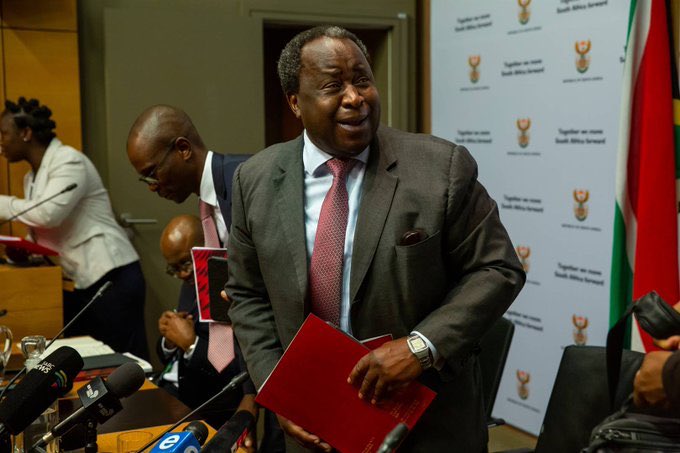
FINANCE Minister Tito Mboweni will lay out spending plans at a mid-term budget on Wednesday before Parliament in what has been described as a defining moment for the South African economy.
But let’s take a few steps back.
In 1996, when he was presenting the country’s budget, then Finance Minister Chris Liebenberg tapped into the mood at the time when South Africa had just won the Rugby World Cup a year earlier, and soccer’s African Cup of Nations months earlier, and a cricket team that was riding high before match-fixing took away the game’s innocence.
Liebenberg used a sports metaphor to tell the country that it’s time to “start putting points on the scoreboard”.
But his overriding message was that the country, two years into its tenure as a democracy and banishing apartheid, cannot afford to fail again.
In the period since, South Africa has stated into the abyss a few times and threatened to fall at the precipice.
This include events such as the Dot.Com bubble and the Great Recession as well as a presidential tenure, president Jacob Zuma’s to be specific, that was characterised by mismanagement and, lack of courage to take necessary action and using the cushion of the public purse to keep tepid economic growth and job growth going long enough to avoid social unrest.
Now it’s time for Mboweni to use president Cyril Ramaphosa’s backing to do what the economy, not anyone constituency, needs.
In 1996, as part of adopting the Growth Employment And Redistribution (GEAR), South Africa adopted a new public finance framework that introduced the Medium Term Expenditure Framework (MTEF) and the Medium Budget Policy Statement (MTBPS) as budgeting tools.
These were designed to stabilise public finances.
There has never been a critical time to present the MTBPS than this Wednesday’s.
In 2008, former Finance Minister Trevor Manuel had to inspire confidence when the Great Financial Crisis had just started.
In 2009, Pravin Gordhan must have felt he inherited a poisoned chalice when he presented his maiden MTBPS, and announced that the country will use the fiscal space caused by reduced public debt to counter the effects of the recession.
Now more than ever, Mboweni must do what the economy needs and ask losers to bear the pain in the short term.
The first thing the economy needs is investment in infrastructure and unlocking more private sector investment.
Public sector investment has stalled over the past five years and now needs to be revived.
Mboweni must once and for all address the controversial Public Sector Wage Bill.
The civil service was used to sustain employment growth at a time when the private sector was shedding jobs.
But that growth includes the SABC growing its headcount by 700 employees under its former COO Hlaudi Motsoeneng when an instruction to stop growing employee numbers was issued by the board.
Is it time to recover from the hangover?
Does the civil service need to be trimmed?
By natural attrition or retrenchments?
A clear announcement needs to be made.
The government has responded to the immediate crisis of COVID-19 through grants.
Do these need to be sustained? At what cost? At least until the end of the financial year I’m March.
Government must also decide if South Africa needs a national carrier, the South African Airways, and whether the initial R10 billion is justified, and if so, at what expense.
Mboweni has shown through his Twitter pronouncements that he is willing to differ with ANC colleagues on policy matters.
He must now show that he can make unpopular decisions and defend them, especially for those to whom they are unpalatable.
He was appointed for this moment.
He must now show his mettle.
(COMPILED BY INSIDE POLITICS STAFF)