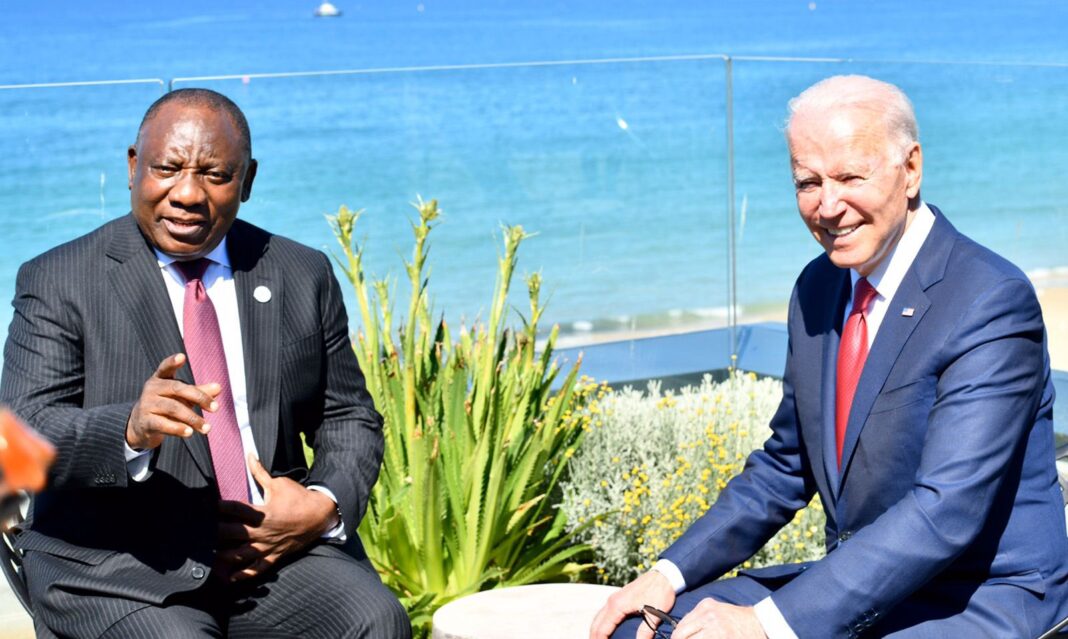
PRESIDENT Cyril Ramaphosa has welcomed the decision by world leaders of the major industrial nations to pledge one billion COVID-19 vaccine doses to poor countries as a “big step towards vaccinating the entire world.”
This comes after G7 leaders pledged to supply the vaccines to poor countries either directly or through the World Health Organization’s Covax scheme – including 100 million from the United Kingdom (UK).
Addressing the media at the conclusion of the G7 Summit held at the weekend in the United Kingdom, Ramaphosa said vaccine nationalism must come to an end.
“Vaccine nationalism should come to an end. We are pleased that the G7 countries have committed to support less developed nations in the form of making vaccines available to the African continent,” said Ramaphosa.
“We also had support from the developed countries that poor countries should start manufacturing vaccines in the form of licensing.”
The National Institute for Communicable Diseases (NICD), a division of the National Health Laboratory Service, reported on Sunday that 7,657 new COVID-19 cases have been identified in South Africa, representing a 17.2 percent positivity rate.
This brings the total number of laboratory-confirmed cases to 1,747,082
Ramaphosa said he was pleased that rich nations have also pledged to support poorer nations to produce their own vaccines and stop making it the preserve of G7 countries.
He added that rich nations also pledged to support India and South Africa in their efforts to ask the World Trade Organization (WTO) to allow all countries to choose to neither grant nor enforce patents and other intellectual property (IP) related to COVID-19 drugs, vaccines, diagnostics and other technologies for the duration of the pandemic, until global herd immunity is achieved.
“We got the commitment that TRIPS negotiations should continue at the World Trade Organization. There’s already been progress in the form of negotiations with the EU and this is a tremendous progress,” said Ramaphosa.
“There has been agreement that this should be finalized. I would like to believe we are almost there. The tax-based negotiations are also going well. We want to vaccinate the entire world. We must make vaccines available to all and put barriers and blockages aside. We are in a war situation. We cannot vaccinate the north and leave the less developed economies behind.”
Elsewhere in their communique, G7 leaders also pledged to:
- improve early warning systems to prepare for future health crises
- phase out coal-fired power stations without carbon capture technology and raise $100bn (£70bn) to help poorer countries cut emissions
- support a green revolution that creates jobs, cuts emissions and seeks to limit the rise in global temperatures to 1.5 degrees
- reinvigorate their economies “with plans that create jobs, invest in infrastructure, drive innovation, support people, and level up so that no place or person, irrespective of age, ethnicity or gender is left behind”
- “build back better” by establishing a clean, green growth fund for infrastructure developments in developing countries
- respond to China’s impact on world trade and challenge practices which “undermine the fair and transparent operation of the global economy”
- call on China to respect human rights, especially in relation to Xinjiang, where it has been accused of abuses against Uyghur Muslims
- get 40 million more girls into education by 2026.
- Inside Politics