



PHUTI MOSOMANE
MINISTER of Finance Enoch Godongwana says the R350 Social Relief of Distress Grant will continue until March next year, but opposition parties are not impressed.
Godongwana delivered the 2023 Budget Speech at a sitting of the National Assembly held at the Cape Town City Hall.
The finance minister said R66bn has been allocated to Social Development over the medium-term, with R36bn to fund the extension of the COVID-19 Social Relief of Distress Grant until 31 March 2024.
He said R30bn will be used for inflation-linked increases for other social grants.
The old age and disability grants will increase by R90 on 1 April 2023 and a further R10 on 1 October 2023, a total increase to R2090.
He said the child support grant has risen from R480 to R510 on 1 October 2023, while the foster care grant increases from R1070 to R1130 over the same period.
“R23bn and R22bn will be allocated to health and basic education respectively, to cover the shortfall in compensation budgets and to improve services,” said Godongwana.
“R8bn is allocated for basic services through the local government equitable share.”
Over the medium-term, more than 60% of non-interest expenditure will go to the social wage, while spending on buildings and other fixed structures – such as roads and dams – will increase from R62bn in the current year to R104.2bn in 2025/26.
Although some commentators believe this is part of electioneering on the part of the ANC ahead of the 2024 general elections, opposition parties in Parliament believe that Godongwana missed a golden opportunity to increase the SRD grant in order to alleviate overburdened consumers.
SECTION 27 senior researcher and budget analyst Daniel McLaren told Inside Politics that the extension of the SRD grant is not in any way electioneering, but a necessary intervention to assist those struggling to find work.
“The extension of the grant has become essential in light of the massive rise in the level of unemployment which is a pandemic- 40% of adults eligible for work and unable to find work just for one hour in a day in a 30 days period which is expanded unemployment.”
“60% of youth are unemployed, this therefore provides a lifeline. Stopping the grant will damage both the livelihoods and the township economy,” McLaren said.
On other grants, McLaren said the government is still not increasing the grants alongside the CPI inflation.
“If you consider the fact that the bulk of the money spent by beneficiaries is on food and transport costs. Research has shown that 50% of beneficiaries spent their grants on food and transport- and these are two biggest drivers of inflation with more than 10%. It shows that the real values of these grants are eroded. But we do welcome the increases although far from the inflationary rate and the food poverty line,” he said.
McLaren said the 2023 budget spending on health and education are far below the CPI inflation rate, meaning additional funding cut for another year for these crucial sectors in terms of transforming the economy.
“We are calling on Parliament to apply maximum scrutiny on those funding cuts,” McLaren said.
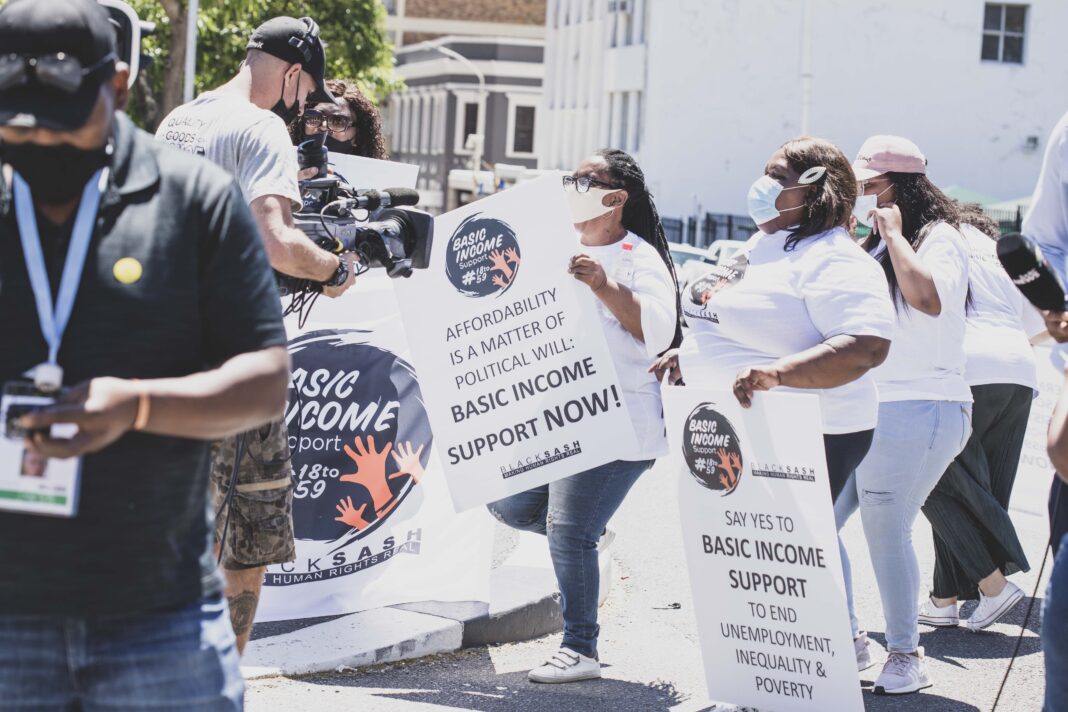
Good Party MP Brett Herron said the government missed an opportunity to not only increase the SRD grant, but to convert it into a basic income grant.
“We feel this is a budget for the rich- the failure to increase the Social Relief of Distress (SRD) grant from R350 to at least alongside the poverty line R600 per month. This is a massive failure. We have not had any increase in this since it was introduced three years ago,” Herron said.
Herron said the idea that the R350 grant is a temporary grant until 2024 is incorrect.
“Once you give people a small bit of income, there is no way that you can come and remove just like that and we believe this should be converted to a basic income grant. We are not happy about this failure to assist those in need,” said Herron.
COPE MP Willy Madisha said he was disappointed with the 2023 budget, and criticised government for only increasing the older persons’ grant with just R90.
“I must indicate that for the 14 years that I have been in Parliament, this is the most useless budget speech. This is extremely unfortunate. It failed to assist ordinary people alleviate poverty,” said Madisha.
“The Minister of Finance says he will give old people R90, how is this going to help ordinary people? We thought he would prioritise joblessness. He said nothing as you know there are more than 700 000 people who are seeking employment with qualifications. We know that 70% of young people do not work, Minister of Finance said nothing.”
EFF leader Julius Malema said the red berets reject the budget as it represents the “super-rich”.
He further said it was unfortunate that the government was not able to create employment so that the budget allocated for the SRD grants could be allocated to other key service delivery spending.
Malema said the EFF rejects the social grant increases announced by the Minister of Finance, because such small increases will not make any difference to the 18 million beneficiaries that are deep in poverty without a way out.
“South Africa should double all grants with immediate effect, as that is the only way we can beat inflation for poor households,” said Malema.
“We are not happy at all. We cannot be celebrating that each year we spend about R30bn on SRD grants. We should not be celebrating that; we should be saying as a country that we have reduced the money spent on the RD grant because so many jobs were created and as a result people have been removed. It’s clear this government has run out of ideas.”
Malema said the EFF totally rejects the 2023 budget.
“We believe it is not aiming at resolving the challenges facing the country. There is no clear strategy on how they are going to finance the electricity crisis that we are faced with; the tax reward to those who can install solar panels shows an elite approach to budget. Majority of our people do not fall within the tax brackets as the relief comes in that form,” he said.
Meanwhile, FF Plus leader Dr Pieter Groenewald said the budget showed that the country was in serious trouble.
“We must not be misled; South Africa is in trouble. The reason I say this is because if you look at the government debt, it will increase up to R5.8 trillion. The debt servicing cost is R366bn alone, and we believe this is not sustainable,” said Groenewald.
But, Head of ANC’s Economic transformation Committee and the Minister of Human Settlements, Mmamoloko Kubayi, said Godongwana presented a good and fairly balanced budget against difficult economic conditions globally.
“It was a good budget, balanced in terms of being pro-growth. We are aware that households are under a lot of pressure hence the SRD has been extended, and other support grants increased,” said Kubayi.
“But there is a long-term plan in terms of ensuring sustained economic growth and job creation. We are affected by a lot of disasters and the minister has responded to that.”
Godongwana earlier said the country’s debt-service costs are projected to average R366.8bn annually over the medium term, reaching R397.1bn in 2025/26.
These are resources that could otherwise be used to address pressing social needs or to invest in the future of ordinary South Africans.
ACDP MP Steven Swart said his party believes that the amount of money used to service the debt could be used to alleviate poverty and provide basic service to the people.
UDM Chief Whip, Nqabayomzi Kwankwa, said the 2023 budget is a confirmation that the government is broke.
He said over the medium-term, more than 60% of non-interest expenditure goes to the social wage, while spending on buildings and other fixed structures – such as roads and dams – will increase from R62bn in the current year to R104.2bn in 2025/26.
“We are increasing allocations to key frontline departments above existing baselines, moving toward a change in the composition of spending from consumption to investment, maintaining a large social security safety net, while striving for sustainable levels of debt,” said Kwankwa.
“This is not an austerity budget. It is a budget that makes tough trade-offs in the interests of the country’s short- and long-term prosperity. The 2023 Budget allocates additional funding totalling R227bn over the medium term.”
INSIDE POLITICS






