
- Advertisement -

Mashatile applauds Unisa for having the highest number of registered and qualified teachers

- Advertisement -

Must read

PHUTI MOSOMANE

Deputy President Paul Mashatile applauded the Unisa’s College of Education (CEDU) for having the highest teacher registration and qualifications with more than 100 000 registered undergraduate students. 

Mashatile was giving an address at Unisa’s 150th  birthday anniversary on Monday in Pretoria during celebrations also attended by former President and Unisa Chancellor Thabo Mbeki, Unisa Chairperson of the Council J Maboa, and Principal and Vice-Chancellor Prof P LenkaBula.

Other dignitaries included Minister of Higher Education, Science, and Innovation, Blade Nzimande and Minister of Human Settlements Mmamoloko Kubayi-Ngubane, and Deputy Minister of Higher Education, Science, and Innovation Buti Manamela. 

Mashatile urged the university to work for the next 150 years, to resolve existential challenges such as continued lack of access to quality education, inequality in education, high dropout rates, poor literacy and numeracy skills. 

“Therefore, as we look ahead to the next 150 years, we will continue to invest in the resolution of the aforementioned issues, as well as in the improvement of the delivery of quality education, in order to construct education cities, generate much-needed economic skills, and guarantee our nation’s global competitiveness,” said.

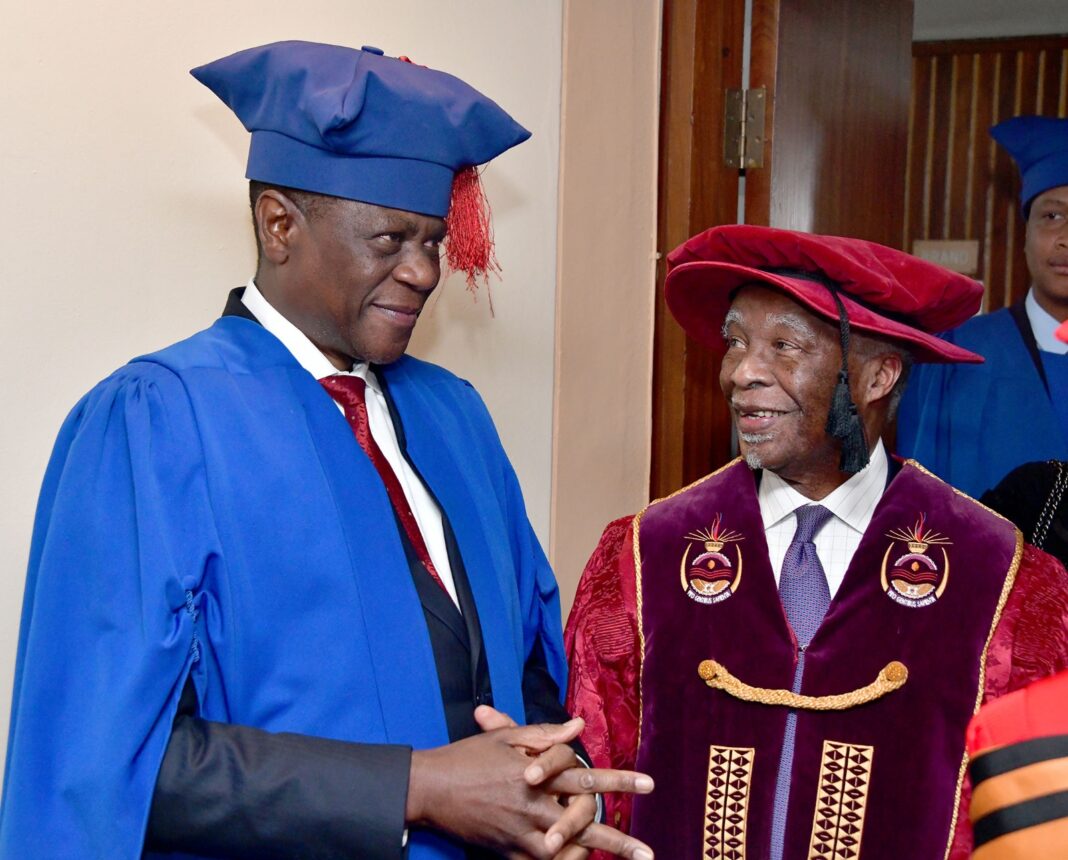
Deputy President Paul Mashatile with former President Thabo Mbeki.

Mashatile said to create a competitive nation, South African must first invest in the development of its human capital by providing opportunities for the youth to acquire marketable skills.

He said the government expects universities and colleges to develop programs focusing on practical skills that can be immediately used in the economy.

“We are comforted by the fact that some of CEDU’s educational initiatives to empower teachers include a focus on their qualification improvement through aligned academic and professional programmes and engagement with districts of the Department of Basic Education to enable teachers to further their education,” he said. 

“We also encourage teachers to be part of various Engaged Scholarship (ES) projects and register for Short Learning Programmes (SLP) to advance their skills.”

In an effort to improve the quality of education, introduction of a new curriculum that focuses on giving students practical and relevant skills that they need in the twenty-first century is critical, Mashatile said. 

As an esteemed institution of higher education, Unisa has continuously prioritised African leadership and development in its mission and vision. 

Mashatile said throughout its 150 years of history, the university has been a key driver in developing the next generation of African leaders and stimulating socio-economic advancement on the continent.

Recognising Africa’s unique challenges and abundant opportunities, Unisa has actively worked to equip individuals with the information, skills, and mind-set necessary to lead and drive intellectualism. 

This university has played a critical role in establishing African leadership and development agendas through its unique curriculum, research projects, and community participation, he added.

Mashatile said it was important for the new curriculum to be focused on  entrepreneurship and encourage critical thinking, innovative technologies and creative problem-solving skills. 

“These are all key skills required for South Africa to develop a highly-skilled and dynamic workforce for its growing economy,” he said.

Mashatile said while the government acknowledges the strides that have been made towards transforming education in South Africa, the task ahead is still considerable. 

In celebrating the 150 years, Mashatile urged Unisa to continue working towards closing the education gap and ensuring that every child has the same opportunities. 

“The transformation of education is a vital part of our country’s development. We must continue to work together to give every child the chance to fulfill their potential and become active and healthy citizens who contribute to the growth of our nation,” he said.

INSIDE POLITICS 

More articles

LEAVE A REPLY

Please enter your comment!
Please enter your name here

AVBOB STEP 12

Inside Education Quarterly Print Edition

Inside Metros G20 COJ Edition

JOZI MY JOZI

QCTO

Latest article



