
- Advertisement -

Lamola tables R7.09bn Budget to realign diplomacy with SA’s growth vision

- Advertisement -

Must read

By Johnathan Paoli

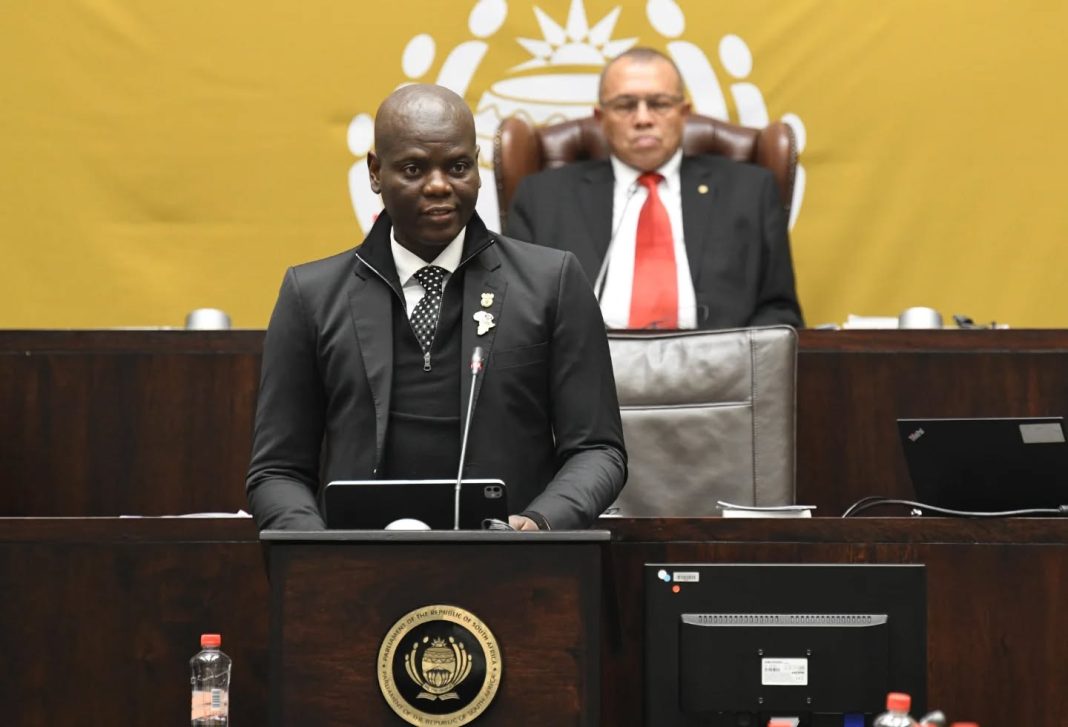
Minister of International Relations and Cooperation Ronald Lamola presented the department’s R7.09 billion Budget Vote for 2025/26 to Parliament on Thursday.

The department’s budget rises from R7 billion in 2024/25 to R7.09 billion in 2025/26, reaching R7.5 billion by 2027/28.

Broadly speaking, Lamola introduced a budget aimed at realigning diplomacy with inclusive economic growth and advancing the continent’s long-term prosperity.

Grounded in ‘Ubuntu’ and South Africa’s constitutional values, Lamola’s budget also emphasised a strategic vision that positions diplomacy as crucial for national development, peacebuilding, and advancing global justice efforts.

“We continue to make progress in our international relations work. This budget enables diplomacy that delivers, because just peace is the non-negotiable foundation for humanity’s future,” he said.

Central to Lamola’s speech was a renewed focus on economic diplomacy as a lever for job creation, industrialisation, and regional integration.

South Africa aims to align foreign missions with trade and investment objectives, including increased access to markets in Asia, Latin America, and the continent itself through the African Continental Free Trade Area.

He cited the successful reopening of agricultural exports to countries like Vietnam, Thailand and Japan, and growing cooperation with China, India, and Brazil.

The R3.5 billion port upgrade in Durban and R2.9 billion in renewable energy infrastructure, financed through the BRICS New Development Bank, were cited as tangible returns on diplomatic efforts.

As the first African country to lead the G20, South Africa has prioritised climate justice, debt relief, and the reform of global financial institutions.

Lamola said South Africa would advocate for a fairer international financial system that supports the Global South.

“Our foreign policy is not abstract, it is measured in schools built, jobs created and peace sustained,” he said.

On Gaza, Ukraine and Sudan, Lamola reaffirmed South Africa’s commitment to international law, human rights, and humanitarian diplomacy.

He criticised Israel’s war in Gaza, backed ICJ and ICC action, and called on global partners to impose sanctions and arms embargoes.

He also stressed continued support for displaced civilians in Sudan and Ukraine, noting South Africa’s humanitarian efforts in cooperation with countries like Qatar and Canada.

Deputy Minister Alvin Botes echoed Lamola’s call for moral leadership, describing South Africa’s foreign policy as a “compass for the world as it should be.”

He reaffirmed solidarity with Cuba, Venezuela, Palestine, and the Western Sahara.

Botes highlighted enhanced ties with Latin America through agreements with Brazil, Chile, Uruguay, and Peru.

He praised over 158 Cuban doctors serving in South Africa and announced future diplomatic youth initiatives, including the launch of a Youth Peace Mediators Mentoring Programme across 15 countries.

DA MP Louise Powell dismissed the budget as wasteful and ideologically misguided.

She criticised the R834 million allocated to international memberships and the R171 million for the African Renaissance Fund, calling them expensive “patronage vehicles.”

She urged DIRCO to reprioritise economic diplomacy and adopt a streamlined, performance-driven approach.

“DIRCO is a shadow of its former self,” Powell said, calling for the closure of embassies that lack economic value and a foreign service based on merit, not cadre deployment.

EFF MP Nqobile Mhlongo accused DIRCO of failing to counter Western imperialism and ignoring pan-African development.

“This budget is an austerity measure,” she said, demanding prioritisation of the ICJ genocide case against Israel and an end to alliances with Western powers.

MKP’s Wesley Douglas called the budget a “superficial increase” that excludes the poor and black-owned SMMEs.

He criticised its elite focus and lack of support for grassroots economic empowerment, while opposing what he saw as foreign alignment with NATO and the West.

IFP Chief Whip Mkhuleko Hadebe supported the budget but urged tighter fiscal discipline, mission rationalisation, and focused peacekeeping.

He backed non-alignment, called for measurable trade gains, and insisted diplomacy must translate into local development.

“The budget must yield dividends for ordinary South Africans,” Hadebe said, advocating stronger partnerships in youth, energy, and technology sectors.

ActionSA MP Malebo Kobe acknowledged slight improvements in target-setting but decried overspending on non-performing embassies, including R27.2 million on a non-operational mission in Tel Aviv.

She slammed the Department’s “G7-style spending” and demanded cost-effective diplomacy aligned with domestic priorities.

“We are not hostile. We want smart, strategic, and transparent diplomacy,” Kobe said.

Rise Mzansi leader Songezo Zibi supported the budget, warning against creeping authoritarianism globally and the decline of democracy.

He called for structured commercial diplomacy and solidarity with Black and brown communities in the US.

“We must speak up for those who once spoke up for us,” Zibi declared.

Closing the debate, Lamola rejected accusations of inefficiency and ideological bias.

He defended South Africa’s missions for their support to citizens abroad, including rescuing South Africans in Equatorial Guinea, Sudan, and Myanmar.

He accused the DA of hypocrisy and reaffirmed that South Africa’s foreign policy remains non-aligned but principled, led by the GNU’s statement of intent and Agenda 2063.

INSIDE POLITICS

More articles

LEAVE A REPLY

Please enter your comment!
Please enter your name here

AVBOB STEP 12

Inside Education Quarterly Print Edition

Inside Metros G20 COJ Edition

JOZI MY JOZI

QCTO

Latest article



