
By Johnathan Paoli
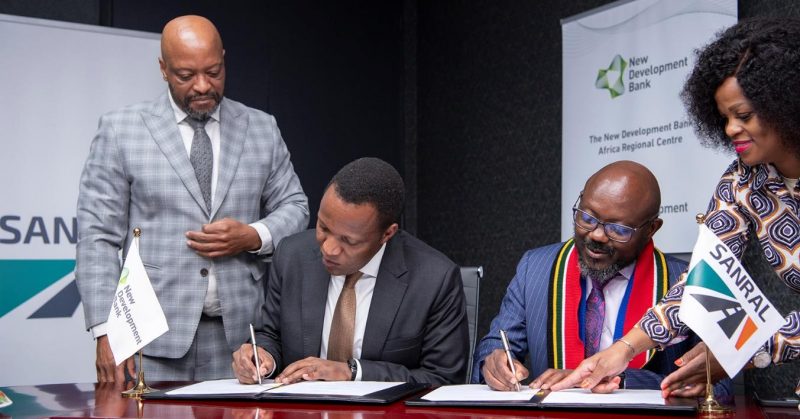
The South African National Roads Agency SOC Limited (SANRAL) has successfully secured a R7 billion loan from the New Development Bank (NDB) to fund critical infrastructure upgrades in its toll portfolio, the state-owned company announced on Monday via the Stock Exchange News Service (SENS).
Speaking at the official signing ceremony of the loan agreement in Sandton, Johannesburg, SANRAL board member Mahesh Fakir said that the roads agency was looking forward to the positive impact that will emanate from the long overdue funding.
He also said that the funding will greatly assist the roads agency to carry out its mandate.
“This loan agreement comes against the backdrop where the South African Government under President Cyril Ramaphosa will be spending almost a trillion rand in the next three years on the development of our country’s infrastructure,” said Fakir.
“We are proud to be able to say that we are going to spend these funds on our road infrastructure projects, with key road works such as upgrading our national roads, widening carriageways, building extra lanes, as well as many other aspects that relate to road infrastructure.”
Fakir also said that key projects that will be funded through the NDB loan include the N3 Paradise Valley to Marianhill Toll Plaza, N3 Marianhill Toll Plaza to Key Ridge, N1 Zandkraal to Scottland, and the N1 Scottland to Winburg South project.
These four projects represent over R12.7 billion in investment, with more than R3.8 billion reserved for SMMEs and targeted enterprises, close to R1 billion in labour-driven economic inclusion, and far-reaching logistical, safety, and mobility enhancements for South Africa’s most important trade routes.
The projects are expected to create an estimated 6 600 job opportunities for local communities that live alongside them.
“As part of our ongoing efforts to support our government’s drive to achieve higher levels of economic growth, SANRAL will continue to implement strategic projects across the country and undertake massive investment in new infrastructure projects, while also upgrading and maintaining the national roads infrastructure projects that fall within its ambit,” said SANRAL’s Chief Executive Officer (CEO), Reginald Demana.
“The loan agreement will support and allow SANRAL to continue paving the way to progress for the South African economy and society in general. SANRAL is looking forward to the positive impact that will emanate from the long overdue funding that will greatly assist the entity carry out its mandate.”
Demana also added that the loan will become effective as soon as the standard conditions precedent have been met.
The balance of the borrowing limit (pegged at R16.5 billion) approved by National Treasury not utilised by the NDB loan will be used to raise funding in the domestic market, including, but not limited to bonds, and syndicated and bi-lateral loans, he said.
According to Monale Ratsoma, the NDB’s Vice President and Chief Financial Officer (CFO), new economic opportunities will be provided for ordinary South Africans through the loan agreement with SANRAL.
“We are here together as partners that share a common vision for South Africa’s future. As the NDB, we are fully behind the mandate of SANRAL to improve people’s lives and enable much needed commerce through the provision of quality road infrastructure. The NDB is also proud that the financing offered is denominated in local currency,” said Ratsoma.
“This will provide the necessary cushioning against currency fluctuations, which often tend to reduce the benefits of the support offered and increase overall risk to the fiscus and corporate balance sheets if not adequately hedged. As the NDB, we have a deliberate focus in providing local currency financing to our partners.”
A central focus of the loan is the rehabilitation and expansion of the N2/N3 corridor in KwaZulu-Natal, crucial for linking the Port of Durban with Gauteng, South Africa’s economic hub.
This corridor plays a pivotal role in the North-South transport network, facilitating regional trade flows and supporting economic activities across Southern African countries.
Additionally, upgrades to the N1, a major long-distance route connecting Cape Town to Johannesburg and extending to Zimbabwe’s border, are also planned. Enhancing these corridors is expected to improve logistics efficiency and safety for millions of commuters daily.
Nedbank Corporate and Investment Banking facilitated the transaction as the debt sponsor, highlighting collaborative efforts in infrastructure development.
According to SANRAL, the R7 billion injection is projected to yield significant socio-economic benefits, including job creation, support for small businesses, and enhanced investor confidence.
“This funding is long overdue and will greatly assist us in fulfilling our mandate,” the roads agency said, expressing optimism about the positive impacts of the loan on infrastructure development.
Ramaphosa, in his recent State of the Nation Address (SONA), reaffirmed the government’s commitment to securing R100 billion in infrastructure financing through engagements with local and international financial institutions and investors.
A new project preparation bid window aims to accelerate investment readiness, complemented by revised public-private partnership regulations to leverage private sector expertise and funding.
Over the next three years, the South African government plans to allocate R940 billion to infrastructure projects, including substantial spending by State-Owned Enterprises (SOEs).
This investment will revitalize roads, bridges, dams, waterways, ports, airports, and power infrastructure, driving economic growth and recovery nationwide.
INSIDE POLITICS



