
By Johnathan Paoli
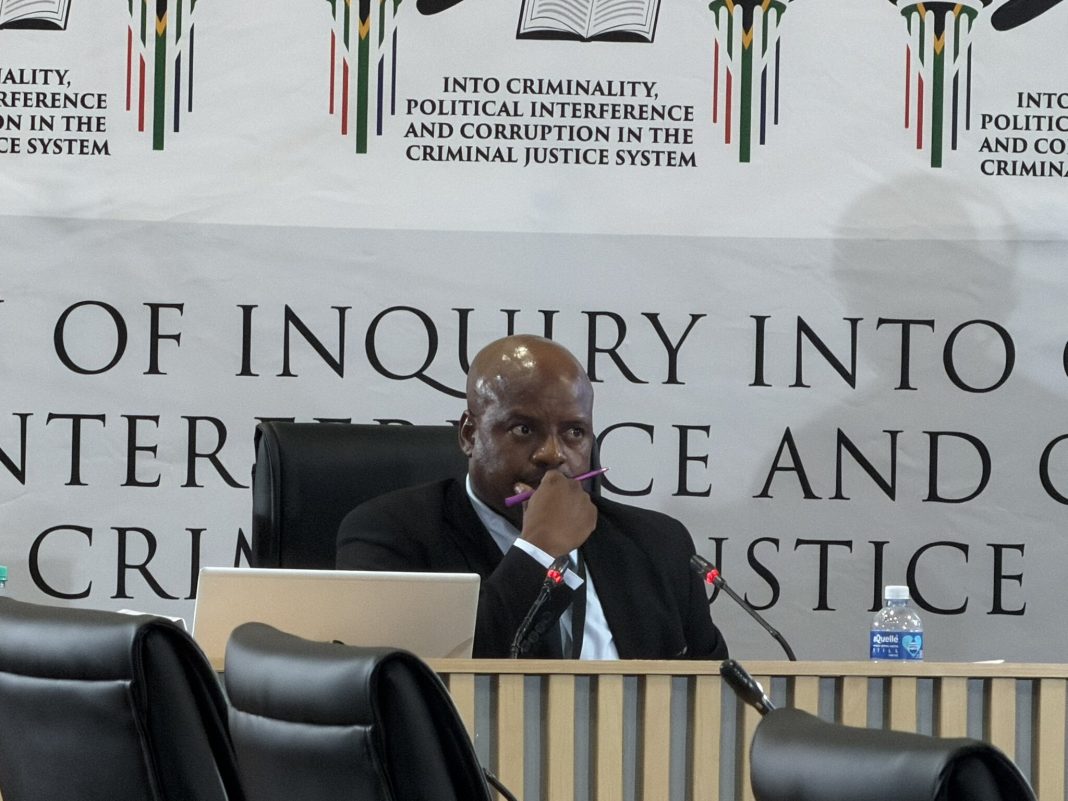
Suspended Ekurhuleni Metro Police Department (EMPD) Deputy Police Chief Julius Mkhwanazi has told the Madlanga Commission of Inquiry that he had no authority to approve the fitting of blue lights on private vehicles, despite being confronted with audio evidence showing a request from Medicare24 CEO Mike van Wyk to do exactly that.
Leading his testimony on Thursday afternoon, the commission played a voice note in which Van Wyk asks Mkhwanazi whether he could install blue and red lights, as well as EMPD markings, on his personal bakkie.
“I bought myself a new bakkie…Would I be able to put blue and red lights in? I don’t want to drive off something and then I get arrested for impersonating a police officer. Can we put EMPD at the back of the bakkie? Will you find out for me please?” Van Wyk said in the recording.
Mkhwanazi confirmed the message had been sent to his phone, but claimed he could not recall whether he had responded or what advice he gave.
He said that blue and red lights are reserved for emergency services and not private individuals.
However, evidence leader advocate Mahlape Sello pointed to a draft memorandum of understanding (MOU) between the EMPD and Medicare24, which included a provision that the metro police would “assist in registration of vehicles and permit use of blue and red lights to respond on behalf of EMPD”.
Commissioner Sesi Baloyi challenged Mkhwanazi directly, accusing him of being evasive, and said that he had been involved in drafting an MOU that allowed the use of blue lights by Van Wyk and his associate attempted-murder accused Vusimusi “Cat” Matlala.
“Can we just stop playing around here? You were involved with Mike van Wyk in preparing a memorandum. That memorandum makes provision for them to use blue lights. So, according to you, it was proper to have in the memorandum that they will be using blue lights. So, stop saying to us, no, the city doesn’t do that. Well, you did it. You had it in the memorandum,” Baloyi said.
Mkhwanazi disputed this, maintaining that no such agreement existed and that he did not have the legal authority to grant such permissions.
“If I were to do that, I would be sending myself to jail,” he said.
The commission also heard that Van Wyk had sent another audio message raising concerns that “the man who pays us” could be arrested for using blue lights.
Mkhwanazi denied knowledge of any such individual using emergency lighting unlawfully, suggesting instead that Van Wyk may have been trying to prompt him into discussing the issue.
“Maybe he thought I could do magic. In fact, he confirmed it in one of the interviews,” Mkhwanazi said.
Baloyi pushed back, arguing that the repeated references to blue lights in both the MOU and the audio messages indicated that Mkhwanazi had been engaged in discussions around their use.
Mkhwanazi responded that while the memorandum may have referenced blue and red lights in general terms, there was “nothing in writing about a car being fitted with blue lights”, reiterating that he lacked the authority to approve such installations.
The commission’s focus shifted to allegations that Mkhwanazi facilitated the issuing of “peace officer” appointment cards to private security personnel linked to Van Wyk, including those from Anubis Protection Services.
Mkhwanazi acknowledged that he had discussions with Van Wyk about appointment cards and a proposed system of “peace officers” drawn from private security.
He explained that the concept was modelled on a reservist-style system used in Cape Town, where civilians could be trained and issued with limited law enforcement powers.
According to Mkhwanazi, these peace officers would primarily assist with by-law enforcement and traffic-related functions, operating under the supervision of EMPD structures.
Mkhwanazi said he assigned Ndumiso Gcwabe, EMPD head of Security and Laws Control, to speak to Van Wyk regarding the peace officer cards.
However, evidence leader Sello highlighted that under the Criminal Procedure Act, only the Minister has the authority to designate individuals as peace officers, and such status carries significant powers, including arrest without a warrant and conducting searches and seizures.
Mkhwanazi acknowledged these legal provisions but insisted that his understanding of “peace officers” in this context was more limited and operational in nature.
He said that the initiative was intended to support policing efforts during strained operational periods, including the Covid-19 pandemic.
The commission also heard that Van Wyk had expressed concern in a voice note that, although he and Matlala had been issued appointment cards, they could face legal problems if they were not formally registered within EMPD systems.
Despite repeated questioning, Mkhwanazi maintained that he had not authorised any unlawful activities and had acted within what he believed to be a collaborative framework aimed at bolstering policing capacity.
Commission chairperson Mbuyiseli Madlanga announced that Mkhwanazi would return to the commission at a still to be determined date in order to complete his testimony.
The commission adjourned, with newly suspended Tshwane CFO Gareth Mnisi expected in the hot seat tomorrow.
INSIDE POLITICS



