By Johnathan Paoli
President Cyril Ramaphosa says government is making steady progress in implementing the recommendations of the Judicial Commission of Inquiry into State Capture, describing recent reforms as crucial to restoring accountability, rebuilding public trust, and protecting state resources from future abuse.
On Monday, the Presidency released the latest progress report outlining the implementation of measures stemming from Ramaphosa’s formal response to the commission’s recommendations.
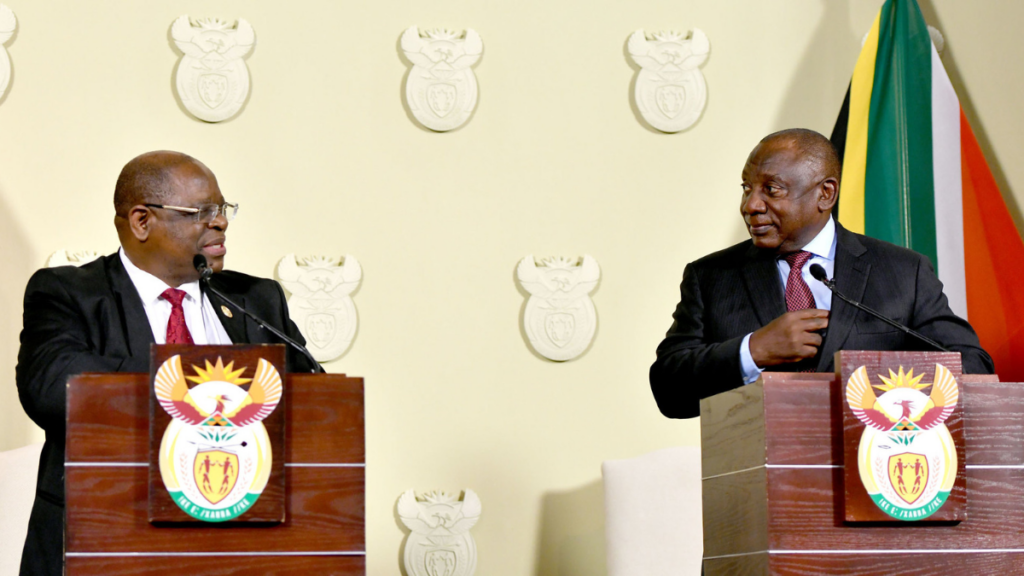
The latest report comes amid sharp criticism from former Chief Justice Raymond Zondo, who accused Ramaphosa of undermining the State Capture Commission’s work by appointing individuals with serious findings against them to Cabinet positions.
Zondo said the president was effectively “promoting” those implicated in state capture, despite having formally accepted the commission’s findings.
However, Ramaphosa argued that he remains committed to the implementation of the State Capture recommendations.
“We remain committed to the full implementation of the State Capture Commission’s recommendations and to rebuilding public trust in our institutions,” said Ramaphosa on Monday.
“We have recovered nearly R11 billion in stolen public funds, strengthened our law enforcement capacity and implemented comprehensive reforms across government. Progress has been substantial, but our work is far from complete.”
The latest report, covering progress up to the end of the fourth quarter of the 2024/25 financial year, outlines government’s implementation of 60 specific actions detailed in Ramaphosa’s October 2022 response to the Zondo Commission.
According to the Presidency, 48% of these actions have been completed or are substantially complete, 23% are on track, and 29% are experiencing delays but remain under active attention.
Ramaphosa has submitted the report to the Speaker of the National Assembly and the Chairperson of the National Council of Provinces.
“This demonstrates our unwavering commitment to accountability and systemic reform,” he said.
A major focus of the report is progress in the criminal justice system.
The National Prosecuting Authority (NPA), through its Integrated Task Force, is pursuing 218 criminal investigation recommendations stemming from the State Capture inquiry.
By March 2025, 21% of these cases had either been finalised or enrolled for trial, with the remainder under investigation or in pre-trial preparation.
High-profile trials expected in the 2025–2026 period include the Free State asbestos removal case, SA Express corruption matters, Bosasa-linked prosecutions, and several Transnet-related contract fraud cases.
Four state capture-related prosecutions have already resulted in guilty verdicts.
Efforts to recover stolen public funds have also gained momentum.
Nearly R11 billion has been recovered to date — a sharp increase from the R2.9 billion reported in October 2022.
This includes R2.9 billion recovered by the Special Investigating Unit (SIU) and R8 billion by the NPA’s Asset Forfeiture Unit (AFU). An additional R10.6 billion in assets remains under restraint or preservation orders.
Major recoveries include settlements with global consulting and technology firms: ABB (R2.55 billion), McKinsey (R1.12 billion), and SAP (R1.16 billion).
Among the most significant institutional reforms is the establishment of the Investigating Directorate Against Corruption (IDAC), made permanent through the NPA Amendment Act of 2024.
Launched in August 2024, IDAC now operates with expanded powers and greater independence.
The General Laws Amendment Act of 2022 also strengthened South Africa’s anti-money laundering regime, contributing to a 40% increase in compliance between 2023 and 2024.
On public procurement, the Public Procurement Act of 2024 has overhauled systems to improve oversight and close long-standing corruption loopholes.
In the intelligence sector, the General Intelligence Laws Amendment Act (March 2025) dissolved the controversial State Security Agency and established two separate entities — the South African Intelligence Service (for foreign intelligence) and the South African Intelligence Agency (for domestic affairs) — effectively restoring the pre-2009 structure and enhancing parliamentary oversight.
The public service is also undergoing professionalisation.
Under the National Framework for Public Sector Professionalisation, lifestyle audits for senior officials and supply chain managers have been rolled out in 138 departments.
In the private sector, the Companies and Intellectual Property Commission (CIPC) has completed reviews of 10 companies implicated in state capture, with six investigations still ongoing.
The National Treasury has blacklisted Bain & Co. for 10 years, and professional bodies have imposed sanctions — including the disbarment and R6.1 million fine of a chartered accountant linked to corrupt dealings.
Several new laws have been enacted to close legal gaps exposed by state capture.
These include the Electoral Matters Amendment Act of 2024, which criminalises donations made in exchange for influence or government contracts.
Secondly, the Judicial Matters Amendment Act of 2023 has introduced corporate liability for failing to prevent corruption.
Thirdly, the Companies Second Amendment Act of 2024 has extended the time limits for prosecuting company directors.
Lastly, the General Intelligence Laws Amendment Act of 2025 has restructured the state’s intelligence services.
Additionally, the Presidency has identified several priorities to sustain momentum.
These include accelerating high-profile prosecutions, finalising the Whistleblower Protection Bill, and completing the National State Enterprises Bill.
Government also plans to amend the SARS Act in line with the Nugent Commission’s recommendations and to finalise broader reforms to the country’s anti-corruption framework.
INSIDE POLITICS