
By Johnathan Paoli
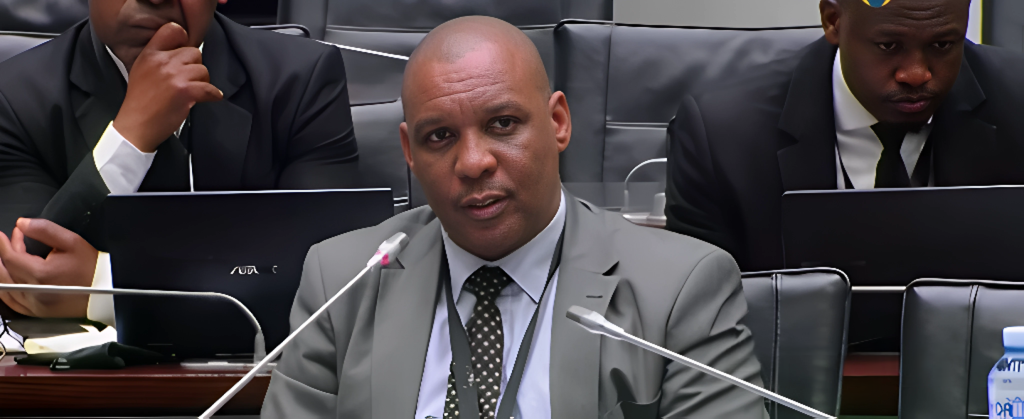
Parliament’s ad hoc committee probing allegations of underworld infiltration and political interference in the criminal justice system, heard late on Wednesday that private citizen and forensic investigator Paul O’ Sullivan allegedly wielded “state capture” level influence within SAPS.
The claims were made by Cedrick Nkabinde, the former chief of staff for suspended police minister Senzo Mchunu.
The afternoon session opened lightly, but the tone quickly grew serious as MPs shifted to unresolved questions about the IPID-era disputes between Nkabinde, former Independent Police Investigative Directorate (IPID) head Robert McBride, and O’Sullivan.
African National Congress (ANC) MP Thokozile Sokanyile led the interrogation into Nkabinde’s 2018 suspension from the Independent Police Investigative Directorate.
Nkabinde reiterated that his relationship with McBride deteriorated after he raised what he referred to as several unethical conduct matters, alleging that McBride had been colluding with O’Sullivan.
According to Nkabinde, McBride responded by suspending him and pushed ahead with disciplinary action despite interventions from then police minister Bheki Cele and the Public Protector, both of whom urged McBride to halt the process.
“I had no protection. I was sure I would be dismissed by the disciplinary hearing, whether I was right or wrong,” Nkabinde said, explaining why he eventually accepted a settlement to resign in exchange for the withdrawal of charges. He insisted the outcome was premeditated.
Democratic Alliance MP Ian Cameron pressed Nkabinde hard on this point, saying that the settlement instead suggested he feared being exposed, particularly given McBride’s claim that Nkabinde wanted the settlement to avoid scrutiny over supposed dealings with Crime Intelligence.
Nkabinde rejected this outright, accusing McBride and O’Sullivan of working together to drive him out.
Cameron accused him of running from accountability by not fully clearing his name.
The session escalated when uMkhonto weSizwe Party MP Sibonelo Nomvalo revisited events following Nkabinde’s IPID exit.
Nkabinde testified that he later ranked top in interviews for a SAPS post, only to discover that O’Sullivan had written to then-national police commissioner Khehla Sitole urging him not to appoint him.
Nkabinde said O’Sullivan copied him in on the email.
“He has no official role, but he is in charge. Not only IPID, he is running SAPS and the NPA. This is the real state capture,” Nkabinde told the committee.
He alleged that two National Prosecuting Agency dockets relating to O’Sullivan were gathering dust and had been removed from a prosecutor.
Nomvalo expressed disbelief that a private citizen could exert such influence.
Nkabinde insisted this was precisely the problem, claiming O’Sullivan sometimes arrived at IPID offices and would interview witnesses.
Asked who inside SAPS empowered O’Sullivan, Nkabinde said he did not know, but that his own pending appointment had been leaked to O’Sullivan.
Nkabinde further alleged that O’Sullivan was involved in efforts to block the appointment of former acting national commissioner General Khomotso Phahlane around 2017.
“They were plotting to remove Phahlane,” he said, describing it as yet another example of outside interference in police leadership battles.
He said that his own report to authorities was never properly addressed, even though Cele later relied on it to remove McBride.
The only reason he eventually returned to government service, Nkabinde said, was that the chief of staff post under Mchunu was a political appointment.
Cameron later questioned Nkabinde about alleged contradictions between his version of events and testimony given by both Mchunu and KZN Police Commissioner Nhlanhla Mkhwanazi.
Nkabinde refused to concede discrepancies, despite multiple MPs pointing out clashes in the records.
The committee resumes at 11am on Thursday, with the testimony of SAPS divisional commissioner for supply chain management, lieutenant-general Molefe Fani.
INSIDE POLITICS





