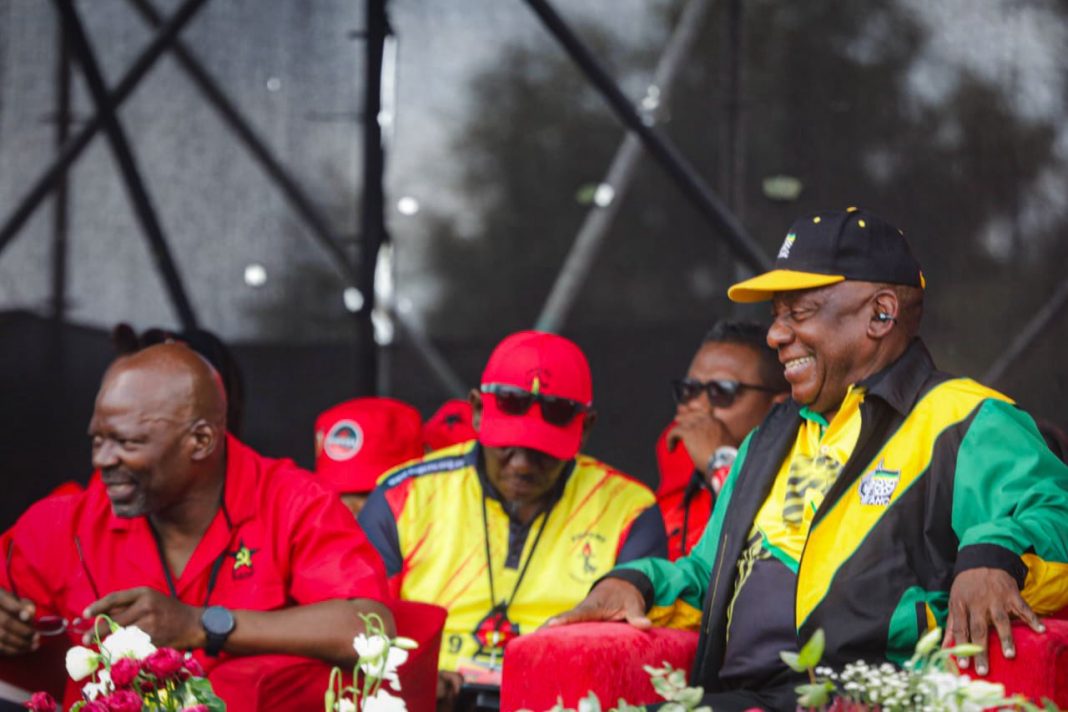
By Thebe Mabanga
As the ANC convenes its National General Council (NGC) this week in Boksburg, the former governing party, now doing so as part of a hobbled, unwieldy coalition that is the Government of National Unity (GNU), they must be grateful that they have been saved by the South African economy.
They must also recognize that President Cyril Ramaphosa will not, and cannot, resign, even if he wished to.
Since the formation of the GNU in July 2024, the South African economy has performed better than expected in many respects and has now created a mood of fragile, courteous optimism as the country enters the festive season.
The Gross Domestic Product (GDP) growth has been low but mostly positive.
The latest reading shows that for the third quarter of 2025; GDP grew by 0.5% to maintain a positive trajectory for the year.
Inflation is at its lowest it has been over the past few years, and the lowest it has been since the SA adopted an inflation target in February 2000.
Government has just adopted a new lower inflation target of 3%.
Interest rates are falling at an incremental but frustratingly slow pace, but are falling, nonetheless.
The recent mid-term budget policy statement showed rude fiscal health with stabilising debt, revenue overshooting by R19 billion from the February target and country achieving a surplus over the medium term.
Lastly, jobs that are critical but downplayed, the real measures of economic health have shown a steady uptick with 128 000 added in the third quarter, following quarters of positive growth, although unemployment remains stubbornly high above 30%
The performance of Eskom, Transnet, and the Passenger Rail Agency of South Africa (PRASA) has also been crucial, as together they address the country’s electricity, logistics, and passenger rail challenges—vital for middle- and low-income earners commuting to increasingly scarce factory jobs and growing service-sector roles such as cashiers.
After being positively welcomed by financial markets, the GNU has now survived a misguided attempt to increase VAT, seen the country’s first ratings upgrade in 16 years, and has withstood United States President Donald Trump’s unilateral tariffs.
The mood is light and festive for those who have an income, while those who do not are cushioned by grants.
But for now, things are holding steady, and the ANC, or rather the Cyril Ramaphosa faction, will pat itself on the back for an economy well managed.
Yet the economist, Duma Gqubule, warns or rather wishes that things can quickly turn.
He points out that we have had falling GDP per capita for 18 years, and when GNU parties get confronted about the unemployment crisis by their voters, they will opt to leave the arrangement.
The mood can quickly turn sour within a year if jobs are eroded and money becomes tight again, as it was at the outset of the Russia-Ukraine war, which caused a spike in oil and grain prices.
The question that the ANC must confront is how long it can keep Ramaphosa as President of the party and the country.
Those wishing that Ramaphosa must step down had better think again because he will not, or rather cannot, do so now.
Ramaphosa has to stay at the helm at least until the ANC’s electoral conference in December 2027 and certainly past the Local Government Elections late next year or early the year after.
He will argue that he remains the ANC’s best option to front the campaign as he is popular with voters, not just ANC members.
As the sociologist Johny Steinberg has noted, Ramaphosa looks like a President who “wishes his tenure was at an end”.
His wife, a First Lady of grace with no public activity or profile, probably wishes they could pack it all in and enjoy their wealth on one of their many properties, although probably not Phala Phala, now tainted with scandal.
The reports that Ramaphosa sought to resign over the money in stuffed sofas saga, but was talked out of it by associates, have never been refuted and seem true.
But Ramaphosa has to see through the GNU project, if not to its end, then as close as possible.
If he loses control of the 2027 elective conference outcome, it could signal the party’s collapse.
But if he prevails, either he or his anointed successor—now thought to include National Assembly speaker Thoko Didiza—will lead the coalition into the 2029 elections.
Should an ANC faction succeed in ousting Ramaphosa as early as this NGC, markets will withdraw their support and funds, the rand will weaken, inflation will go up, as will interest rates, jobs will evaporate, and the mood will turn sour quickly, tossing the ANC out of power firmly and probably for good.
ANC General Secretary Fikile Mbalula has done everything in his power to keep a lid on proceedings this week, stressing that there is no room to discuss leadership changes.
But Mbalula must recognise that he cannot sit over a simmering pot forever.
If delegates want succession debated, they can move it from the corners to the Conference floor.
He would do well to remember that at the 2005 NGC, one delegate—the late Police Minister and ambassador to France Nathi Mthethwa—raised his hand to defeat a motion that sought to freeze Jacob Zuma out as party deputy president, changing the course of the party—and South Africa’s—recent history.
For now, Ramaphosa, Mbalula, and their supporters can thank the economy for keeping them afloat.
INSIDE POLITICS