
- Advertisement -

DIRCO says US ‘misdirected’ in Chinese army simulator claims

- Advertisement -

Must read

By Johnathan Paoli

The Test Flying Academy of South Africa (TFASA) and the Department of International Relations and Cooperation (DIRCO) have rejected allegations by the United States that advanced military flight simulators produced in South Africa were illegally exported to the China’s People’s Liberation Army (PLA), with DIRCO dismissing the claims as “misdirected”.

DIRCO spokesperson Chrispin Phiri told Inside Politics that Washington had confused a private institution with the South African government, adding that a TFASA report outlined the true nature of the circumstances.

“The US has misdirected its concerns with a private entity. Moreover the response of the said company is instructive on the facts. We stand ready to reiterate this through diplomatic channels,” Phiri said.

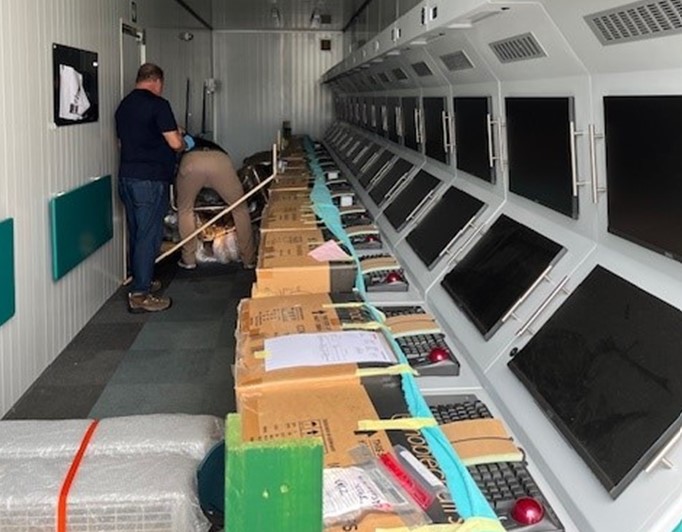
The denials follow a US Department of Justice announcement this week that it had filed a civil forfeiture action seeking permanent seizure of two mission crew trainers (MCTs) that prosecutors say were destined for the PLA.

In court papers filed in the US District Court for the District of Columbia, prosecutors described the trainers as containerised “mobile classrooms” meant to support training linked to airborne warning and control systems and anti-submarine warfare.

The US says the systems were built using US-origin software and sensitive Western defence technical data, in violation of US export-control laws, including the Arms Export Control Act and the International Traffic in Arms Regulations.

The Justice Department said the project was internally codenamed “Project Elgar” and was intended to enhance China’s ability to detect and track US submarines.

Court papers allege the trainers were modelled on the US Navy’s P-8 Poseidon maritime patrol aircraft.

“TFASA masquerades as a civilian flight-training academy when in fact it is a significant enabler of the Chinese air and naval forces and a pipeline for transferring NATO aviation expertise, operational knowledge, and restricted technology directly to the People’s Liberation Army,” said United States Assistant Attorney General for National Security, John Eisenberg.

“The National Security Division will continue to act decisively to preserve the US military’s qualitative edge by preventing US technology from falling into the hands of our adversaries,” he said.

According to Roman Rozhavsky, the Assistant Director of the FBI’s Counterintelligence and Espionage Division, TFASA “illegally exported US military flight simulator technology and recruited former NATO pilots for the purpose of training China’s military, jeopardising US national security and placing the lives of American service members at risk”.

FBI Acting Assistant Director in Charge, Vanessa Tibbits, said: “TFASA’s continued attempts to leverage our nation’s military expertise and software gravely threaten United States’ national security interests and the lives of American service members around the globe.”

The allegations have further heightened tensions between Washington and Pretoria, already strained by South Africa’s ties with US adversaries including China, Russia and Iran.

Underlying frictions stem from Pretoria’s participation in the BRICS bloc and its perceived alignment against Western interests, including South Africa’s refusal to condemn Russia’s invasion of Ukraine and its legal actions against Israel at the International Court of Justice.

US officials have increasingly viewed South Africa as prioritising partnerships with authoritarian regimes over democratic alliances.

The TFASA dispute follows closely on joint naval exercises hosted by South Africa earlier this month, dubbed “Will for Peace 2026,” which were led by China and involved warships from Russia and Iran.

Iran’s alleged full participation in the drills, held near Cape Town despite reports that President Cyril Ramaphosa had instructed the defence ministry to limit or exclude Iranian as the US applied pressure, prompted a domestic probe in South Africa and rebukes from Washington.

The US Embassy in Pretoria this week criticised “hypocritical” South Africa for allowing Iran’s participation in the drills at a time when the Islamic Republic is killing protesting citizens, with Reuters reporting the death toll on Sunday to be at least 5000.

Washington has been scrutinising TFASA for years.

In June 2023, the US Commerce Department added TFASA and related entities to its Entity List for “providing training to Chinese military pilots using Western and NATO sources,” saying the activity was contrary to US national security and foreign policy interests.

TFASA has denied any wrongdoing.

“The company rejects any suggestion that NATO expertise was transferred, or that any US military technology, defence technical data, or other restricted information was exported in breach of applicable laws,” TFASA said in a statement.

“The containers in question were basic mobile classroom units and did not comprise or represent any form of tactical simulators, advanced systems, or any classified, sensitive, or mission-specific, tailored military training capabilities; they were limited to non-sensitive, procedural and instructional use, using publicly available and commercially licensed inputs, and were designed as mission crew training (MCT) systems aimed at supporting crew resource management (CRM) functions within maritime patrol aviation environments,” it said.

“Prior to shipment, the company was aware that the programme and related exports could be subject to heightened international attention and differing policy views. The containers and associated software were therefore reviewed, inspected, and vetted for export by the appropriate authorities.

“That process confirmed that the units contained no sensitive or restricted tactical simulation capabilities or technologies, and no classified or export-controlled information. The shipment proceeded lawfully and in good faith, with the expectation that the contents would withstand scrutiny by any competent external authority.

“The company has at all times acted transparently and without any intent to conceal the nature or purpose of the equipment,” TFASA said.

It said it had made available an “independent, fact-based investigation that was conducted last year and concluded in mid-2025”.

“The report sets out a factual, evidence-based account of the events, the contents of the containers, the software and equipment involved, and the actions taken by all parties. This report addresses the specific allegations relating to the contents of the containers and the software referenced in recent media coverage.

“The company makes this report publicly available in the interest of transparency and invites stakeholders and media to refer to it as the factual record responding to the allegations referenced,” TFASA said.

The TFASA report can be read here.

INSIDE POLITICS

More articles

LEAVE A REPLY

Please enter your comment!
Please enter your name here

AVBOB STEP 12

Inside Education Quarterly Print Edition

Inside Metros G20 COJ Edition

JOZI MY JOZI

QCTO

Latest article



