
By Thapelo Molefe
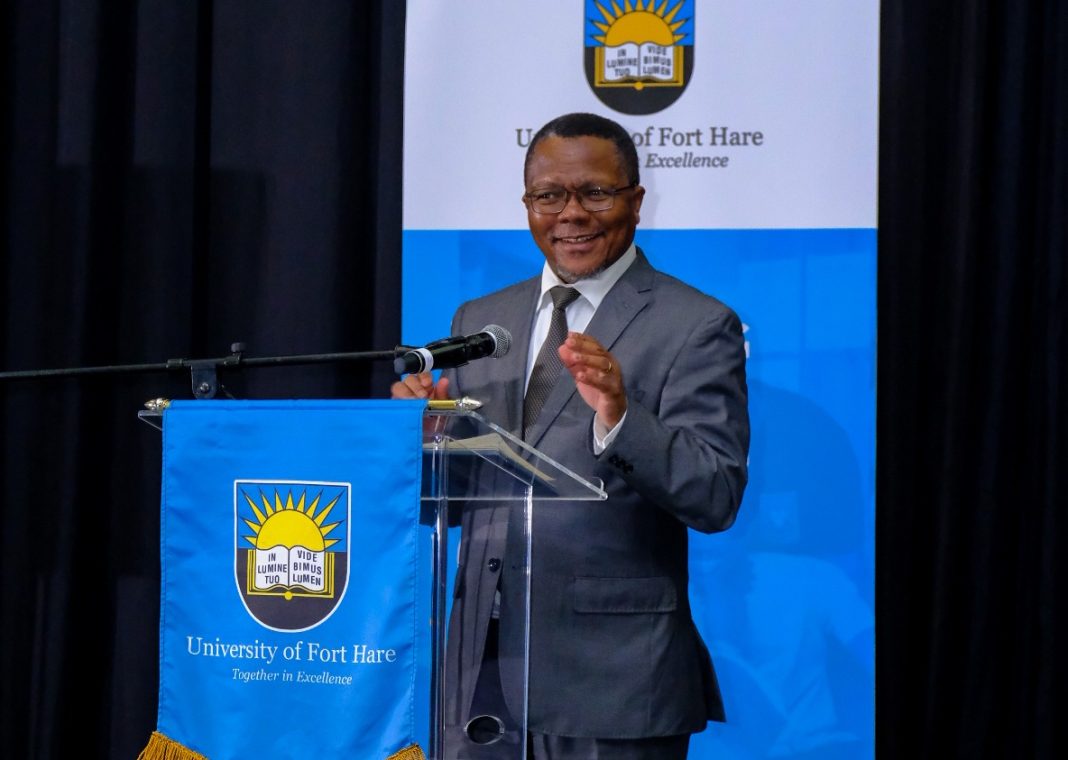
University of Fort Hare (UFH) Vice-Chancellor Sakhela Buhlungu has described his nearly decade-long tenure at the historic institution as a constant battle against corrupt forces, likening it to having a noose around his neck that he must repeatedly loosen just to breathe.
“Every time I must find a way to loosen the noose on my neck,” Buhlungu said while speaking to Ann Bernstein, the founding director of advocacy group, the Centre for Development and Enterprise (CDE), during a CDE-broadcast event.
Buhlungu was expected to testify on 16 February in the murder trial of his former bodyguard Mboneli Vesele, one of several people killed in what he described as a years-long campaign of violence orchestrated by forces determined to loot the institution.
His interview revealed a web of corruption that stretches from campus security to the highest levels of provincial politics: a security company that orchestrated attacks on the people it was paid to protect, university employees complicit in murder, and a degree mill that allegedly produced fraudulent qualifications for politicians and government officials.
The corrupt forces at Fort Hare, according to Buhlungu, operated with murderous efficiency.
It began with the assassination of the university’s fleet and transport manager, Petrus Roets, in March 2022. Roets had been blocking irregular activities and stopping inflated invoices. He was killed for it.
“When he was killed, we panicked as an institution,” Buhlungu recalled.
Management brought in a private security company to protect senior staff.
Then shots were fired at the homes of Buhlungu and his deputy vice-chancellor.
More security officers were deployed.
In January 2023, Vesele was shot and killed. Still more officers were brought in from the private security company. The university was being milked. And murdered.
The security company, it emerged, was working with a university employee to orchestrate the intimidation and killings.
Each attack generated demand for more protection services.
Each deployment meant more money flowing to the corrupt network.
“It turns out that the company that was providing the protection was in cahoots with one of our employees here to intimidate and even shoot people and kill them so that we can get more services from that company,” Buhlungu said.
The conspiracy reached its most sinister depth when investigators discovered that money paid to the security company was used to transport and accommodate Vesele’s assassin.
“It was a racket. You shoot and intimidate, and then you bring more officers,” Buhlungu said. “That’s what they did.”
While one corrupt network profited from violence, another was selling academic credentials to politicians.
Professor Edwin Ijeoma, the institution’s former public administration faculty dean, ran what Buhlungu described as a degree factory. His clients were politicians and officials who wanted qualifications without doing the work.
Ijeoma’s own credentials were fraudulent, according to Buhlungu. He obtained a PhD without completing an undergraduate degree in his home country, lacked legal South African citizenship, and allegedly used a forged master’s qualification from a bogus institution to secure admission to his doctoral programme at the University of Pretoria.
At Fort Hare, he built a corruption machine.
Ijeoma employed touts who approached potential clients in government offices with a simple proposition: “Do you want to do a degree? We can make a plan for you.”
Those who agreed were assigned ghostwriters from what Buhlungu described as a “small battalion.”
The ghostwriters produced proposals and dissertations.
Candidates presented work they never wrote, submitted it for examination, and graduated with credentials they had not earned.
“Hypothetically, anyone could then go and say, listen, I need a master’s degree,” Buhlungu explained.
“And before you knew it, the dissertation would be there, submitted, examined, and passed.”
The scheme operated for years, producing an unknown number of fraudulent graduates who now occupy positions of power across government.
Ijeoma was fired once incontrovertible evidence emerged. He also lost a citizenship appeal after it emerged he had married a South African woman while already married in his home country. Yet he faces no criminal prosecution.
“He’s walking the streets of the country. He’s not in jail. Don’t ask me,” Buhlungu said.
The corrupt forces at Fort Hare appear to enjoy protection at the highest levels.
Eastern Cape Premier Oscar Mabuyane was deregistered from his master’s programme at Fort Hare in 2021 after the university investigated Ijeoma’s dealings.
When the Special Investigating Unit attempted to probe Mabuyane’s qualification further, the High Court in Bhisho blocked the investigation.
Judges ruled that the SIU had acted outside its mandate, declaring the probe “ultra vires” and ordering the unit to pay costs on a punitive scale.
The SIU has identified 33 politically connected individuals facing findings of academic fraud. President Cyril Ramaphosa has indicated those matters will be finalised before the end of the current financial year.
But the court ruling blocking the Mabuyane investigation raised questions about whether powerful figures will ever face consequences.
Buhlungu said he has employed unconventional methods to fight the corrupt forces besieging the institution.
When a captured university council blocked reforms early in his tenure, he approached then-Higher Education Minister Naledi Pandor to place Fort Hare under administration.
“Many people look at us and say, ah, that university has been under administration,” Buhlungu said. “Little do they know that we invited that administration to survive another day.”
When fraud became overwhelming, he invited the SIU to investigate, opening the university’s records to scrutiny.
“We basically opened the doors for them to get information, to do the investigation,” he said. “Through that process, we managed to unveil tonnes and tonnes and tonnes of fraudulent activities.”
He described his approach using a medical metaphor.
“It’s that metaphor of the heart surgeon and the blood. We have to say to the SIU, operate on this body, cut it open, fix the heart, and then get it breathing again.”
Justice required intervention from President Ramaphosa himself.
A 19-member unit of the Political Killings Task Team (PKTT) was dispatched to Fort Hare.
The unit cracked cases local law enforcement had failed to solve.
Three people now face trial for Roets’ murder. Eight are being prosecuted for Vesele’s killing. Approximately 17 individuals and six companies linked to the security racket are before the Commercial Crimes Court in East London.
“Basically, all those people were arrested thanks to that unit of the PKTT,” Buhlungu said.
But the corrupt forces have not been defeated.
Those who torched seven university buildings during violent protests in October 2025 remain free. Police stood outside the campus with a water truck while flames consumed building after building, Buhlungu claimed, offering the excuse that they feared a repeat of Marikana if they used live ammunition.
“This time around, there’s nothing. There is absolutely nothing,” Buhlungu said of the arson investigation.
Buhlungu alleged the October violence was orchestrated by powerful interests seeking to remove him before the SIU releases its findings.
“If you want to abort the SIU processes, what do you do? You get rid of the VC,” he said.
“If you want the people who have been fired for all sorts of things to come back, what do you do? You push the VC out.”
Despite the corruption and violence, Buhlungu insisted progress has been made.
The proportion of academic staff holding doctoral degrees has risen from 48% to 65%. Research output is growing. The university has acquired seven research chairs, five in the last three years.
“There’s the story of the resurgent Fort Hare,” Buhlungu said. “Bold, assertive, confident. That’s Fort Hare that keeps me here.”
His contract extends one year beyond his 65th birthday. His tenure is drawing to a close amid sustained calls from students, alumni and the university convocation for his removal.
He expressed confidence that foundations have been laid for whoever succeeds him, but issued a warning about the corrupt forces that will remain.
“The new vice-chancellor and the new people will have solid foundations on which to build,” he said, “provided they have a backbone.”
INSIDE POLITICS



