
By Johnathan Paoli
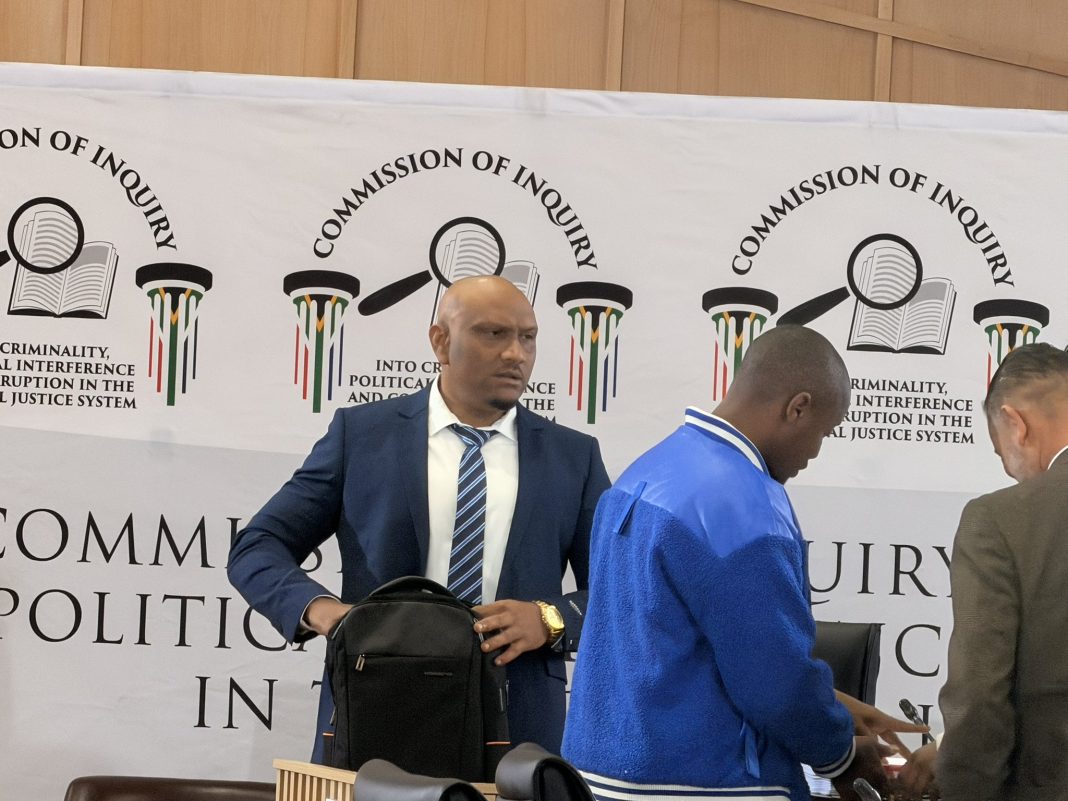
Colonel Gavin Jacob, commander of the Durban Hawks’ Serious Organised Crime Investigation Unit, on Wednesday strongly denied any wrongdoing in the handling of a 541kg cocaine consignment that was later stolen from Hawks offices in Port Shepstone, accusing investigators of constructing a “false narrative” to implicate him despite a lack of evidence.
Testifying before the Madlanga Commission of Inquiry, Jacob said none of his actions during the June 2021 seizure operation or the subsequent handling of the drugs amounted to criminal conduct.
“I believe that in the absence of any evidence pertaining to the actual theft of the drugs, a false narrative of what transpired was created. The investigation seems to have been directed towards this false narrative,” Jacob told the commission.
He further alleged bias by members of the team investigating the theft.
“The intimidation of witnesses shows clear biasedness from the team investigating the theft of the drugs,” he said.
Jacob said he and other Hawks officials had provided Major-General Hendrik Flynn with fresh information relating to the theft as recently as April 2026, arguing that investigators had ample opportunity to eliminate him as a suspect.
“Flynn withheld pertinent information from the commission. This was by design. There is no evidence to support his theory,” Jacob said.
The inquiry is examining the circumstances surrounding a 541kg cocaine consignment, estimated to be worth about R200 million, discovered in a shipping container at Durban harbour in June 2021.
The drugs were later transported and stored at Hawks offices in Port Shepstone, where they were stolen during a break-in in November 2021.
Jacob repeatedly denied any involvement in the theft.
“I bore no knowledge, neither am I involved in the theft of the drugs. I was questioned and polygraphed with regards to this incident. I passed the polygraph test,” he said.
Commission chairperson Justice Mbuyiseli Madlanga questioned Jacob about concerns previously raised before the commission regarding the reliability and interpretation of polygraph examinations. Jacob responded that he nevertheless felt vindicated by the results.
Earlier in his testimony, Jacob described the seizure as the largest cocaine bust of his career.
“I have coordinated drug operations, managed drug projects, dismantled clandestine laboratories and been involved in several drug seizures at the port and container depots. Prior to the drug seizure on 22 June 2021, I had not conducted a larger seizure,” he said.
Jacob told the commission the operation involved what is commonly known as a “rip-on/rip-off” smuggling method, in which narcotics are secretly inserted into legitimate cargo containers before being removed by criminal syndicates after arrival.
“This is a modus operandi whereby the drugs are loaded at the port of origin in a legitimate container. In essence, the drugs piggyback on this legitimate cargo and are usually found in canvas bags placed at the entrance of the container,” he said.
He added that investigations of this nature rarely result in arrests and that no forensic evidence had ever been recovered in similar cases.
Proceedings also focused on decisions taken at the scene, including the controversial decision not to cordon off the depot where the container was opened.
Jacob defended the move.
“Had the depot been a crime scene that warranted cordoning off or retrieving evidence from it, I would have done so immediately,” he said.
He acknowledged shortcomings in the handling of exhibits, including the fact that the drugs were never physically weighed before being booked into evidence. The widely reported figure of 541kg was therefore based on estimates rather than an actual measurement.
Jacob also conceded that the cocaine was not immediately sealed in official exhibit bags because suitable bags were unavailable at Isipingo police station.
“The non-availability of exhibit bags was the reason these exhibits were not sealed in bags as per National Instruction 8/2017,” he said.
He admitted that he had failed to contact nearby police stations to determine whether exhibit bags could be sourced elsewhere, agreeing with commissioners that compliance should have taken precedence over convenience.
However, Jacob maintained that despite procedural shortcomings, the integrity of the evidence remained intact.
“None of my actions at the crime scene or at Isipingo SAPS amounted to criminal conduct. The non-acceptance of exhibits by the FSL was the reason that they were not forwarded within seven days. None of my actions were a deliberate attempt to ensure that the drugs were stolen,” he said.
Flynn previously told the commission that the cocaine consignment had been mishandled from the outset, with key crime scene protocols not followed.
He testified that the chain of events leading to the theft of the cocaine in November 2021 was “by design, not coincidence”, citing the storage facility’s lack of a functioning alarm system, expired armed-response security contracts and a history of previous break-ins.
The commission continues.
INSIDE POLITICS





