



By Simon Nare
Former intelligence minister Ronnie Kasrils has denied involvement in alleged secret high-level talks between the ANC and apartheid-era generals that may have delayed or frustrated investigations and prosecutions of atrocities committed by apartheid forces and ANC operatives.
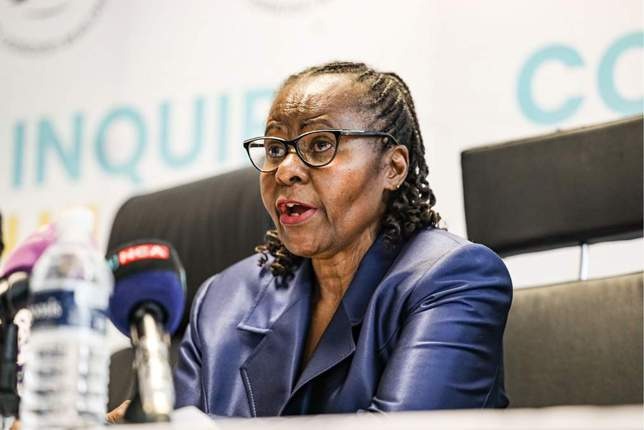
Testifying before the Truth and Reconciliation Commission (TRC) cases inquiry, chaired by retired Constitutional Court Justice Sisi Khampepe, Kasrils rejected the allegations, saying he was not a member of the security cluster during the period in which the alleged talks took place.
Kasrils was responding to repeated allegations by Lukhanyo Calata, a member of the Calata Group, which represents families of victims and took the government to court to compel it to establish the inquiry.
Calata, whose father, Fort Calata, was one of the Cradock Four, has alleged that Kasrils participated in secret high-level meetings between apartheid-era generals and a group of ANC leaders between 1999 and 2004.
ALSO READ: Heavy police presence remains in Durban as March and March prepares for biker convoy
In his rebuttal testimony on Thursday, Kasrils said he could not have been involved in the discussions because he was not part of the security cluster at the time.
He said Lindiwe Sisulu had served as intelligence minister after replacing Joe Nhlanhla in 2001, remaining in the position until 2004, when Calata alleged that the talks ended.
“There is no way to confuse Minister Sisulu with me. I was at the time the minister of water affairs and forestry and did not belong to the security cluster. The alleged high-level talks I knew nothing about. If there were such talks, I did not participate in anything of that nature,” Kasrils testified.
The former minister also denied allegations by Jacob van der Merwe, who told the inquiry that Kasrils had contacted his mother to discuss the disappearance of his father, a civilian farmer who was allegedly shot and killed by uMkhonto we Sizwe operatives in 1978.
Van der Merwe alleged that Kasrils had contacted his mother outside the TRC process to discuss the incident. Kasrils denied the allegation, describing it as unfounded.
He said he was based in Angola in 1978, teaching politics to ANC members in the organisation’s camps, and was not involved in the liberation movement’s combat operations.
“I have no knowledge of Mrs Van der Merwe’s allegations. I deny that I approached Mrs Van der Merwe or any of her relatives or any other person, whether telephonically or in person, regarding the incident described. I deny any involvement in alleged threats against Mrs Van der Merwe,” he testified.
According to Van der Merwe, his mother later received a threatening telephone call. Kasrils denied any involvement in the call.
“I never engaged in the conduct I am being accused of by Mrs Van der Merwe and have no knowledge of his father’s matter. I would never engage in such conduct. I have sympathy for Mr Van der Merwe for the loss of his father, but I wish to caution that this does not license him to make untrue statements against me and my family,” he said.
Kasrils subsequently submitted a statement to the inquiry, asking Khampepe and the commissioners to reject what he described as “these unfounded and malicious statements”.
He said he had never heard of the incident while he was in Angola when it allegedly occurred, or when he became deputy defence minister in 1997.
Kasrils was also questioned about testimony by former ANC national executive committee member Smuts Ngonyama, who said the party supported the idea of an amnesty law at its 51st national conference.
According to the commission’s records, Ngonyama said the ANC was generally opposed to trials modelled on the Nuremberg proceedings because they would come at the expense of nation-building.
ALSO READ: Malatsi issues directive to cut red tape, reduce broadband costs
Kasrils confirmed that the ANC had discussed legal mechanisms to address outstanding TRC cases but denied that the discussions involved efforts to halt prosecutions.
“I confirm that the ANC discussed legal mechanisms to deal with the unfinished business of TRC cases. I further confirm that the ANC was against any Nuremberg-style trials. This was for the noble goal of nation-building. At no time during our discussion did the issue of stopping prosecutions of TRC cases ever come up for discussion,” he said.
The Nuremberg trials were a series of military tribunals held in Germany between 1945 and 1949 by the Allied powers — the United States, Britain, France and the Soviet Union — to prosecute Nazi leaders for crimes committed during World War II, including the Holocaust.






