

By Levy Masiteng
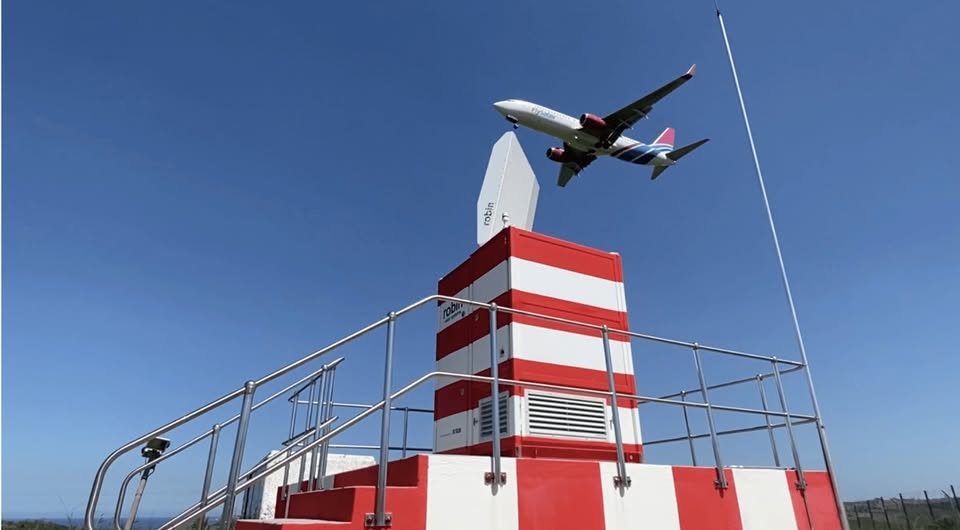
King Shaka International Airport (KSIA) has upgraded its bird-monitoring capabilities with the Robin Radar Systems MAX bird detection radar, a full 3D avian radar system capable of tracking bird movements in real time.
The MAX system replaces and upgrades bird-radar capability that has existed at King Shaka since the airport opened in 2010. The original system had deteriorated after years without adequate maintenance, with replacement considered more feasible than repairing the equipment.

The new technology can simultaneously track more than 3 000 birds within a 15km instrumented range, providing detailed information on their flight paths, altitude, speed and flock behaviour.
The upgrade formed part of a collaboration between ACSA, HENSOLDT South Africa, Robin Radar Systems and UKZN, with the technology expected to strengthen aviation safety while also providing researchers with an opportunity to study bird movements around the airport.
ALSO READ: Ntuzuma Mall, R32m ICT hub drives new investment and jobs
According to UKZN, the radar is particularly significant because KSIA is located close to the internationally renowned Mount Moreland Barn Swallow roost, which hosts an estimated three million Barn Swallows during the summer migration season, although numbers fluctuate during the season.
The migratory birds, known in isiZulu as inkonjane yaseYurobhu (swallow from Europe), travel thousands of kilometres each year between Europe and southern Africa.
Their spectacular seasonal arrival is a major natural phenomenon in KwaZulu-Natal, but their flight paths can intersect with aircraft operations around the airport. The Mount Moreland roost is situated close to the airport’s runway and the potential aviation risk posed by large concentrations of birds was one of the reasons bird-radar technology was introduced at King Shaka when the airport opened.

“This technology provides our wildlife management teams unprecedented visibility of bird activity around the airport, enabling proactive decision-making that strengthens aviation safety while protecting local biodiversity,” ACSA Regional General Manager Nkosinathi Myataza said.
Unlike traditional monitoring methods, which rely heavily on human observations and can be affected by daylight and weather conditions, the radar can monitor birds continuously, day and night, throughout the year.
For an airport environment, this means wildlife management teams can receive detailed information about where birds are flying, how high they are flying and how large flocks are moving, allowing them to make more informed decisions when bird activity poses a potential risk to aircraft.
ALSO READ: New retail development breaks ground in Rosslyn
“This project builds on that expertise, combining operational safety with environmental responsibility in a way that reflects the evolving priorities of the aviation sector,” HENSOLDT South Africa Head of Air Traffic Management and Services Christiaan Pelser said.
However, the technology is not being deployed solely to keep aircraft safe.
UKZN said it is also opening a new window into the behaviour of one of KwaZulu-Natal’s most remarkable migratory species.
UKZN’s Discipline of Biological Sciences is working with the project partners to study bird movements around the airport, migration arrival and departure patterns and habitat use in the surrounding area.
The research team is led by Professor Colleen Downs, National Research Foundation South African Research Chairs Initiative Chair in Ecosystem and Biodiversity in KwaZulu-Natal and the Eastern Cape. She is working alongside Postdoctoral Fellow Dr Cameron Cormac and MSc candidate Matthew Wilkinson.
“The researchers are gathering field observations, identifying bird species and comparing those observations with radar detections. They are also helping populate the radar’s species database, which will allow airport officials and scientists to better understand which species are being detected and how they use the surrounding environment,” the statement reads.
UKZN said the ability to monitor large numbers of birds simultaneously is particularly important for studying the Barn Swallow.
“While GPS tracking can provide detailed information about individual birds, it is not practical to track thousands or millions of birds in this way.”
“Radar can track large flocks, revealing their size, flight paths, altitudes, speeds, and more,” Robin Radar Systems Civil Aviation Team Lead and Project Manager Alex Coccia said.
According to the university, the continuous data generated by the system could help researchers establish when migratory birds arrive and leave the region, how flocks move around the airport, which habitats they use and what environmental conditions influence their behaviour.
That information could also help ACSA develop evidence-based habitat management strategies that balance the protection of birds with the need to maintain safe aircraft operations.
Project partners say King Shaka is one of only two airports in Africa operating this generation of purpose-built bird-detection radar and the first airport in South Africa to deploy Robin Radar Systems’ MAX system.
“Though the MAX radar serves as an effective tool to bolster safety and empower bird control teams, its goals in this project are also very much centred around conservation,” Coccia said.