By Charmaine Ndlela
Justice and Constitutional Development Minister Mmamoloko Kubayi has defended government’s approach to migration, saying South Africa’s policy is rooted in the Constitution, the rule of law and the protection of human rights.
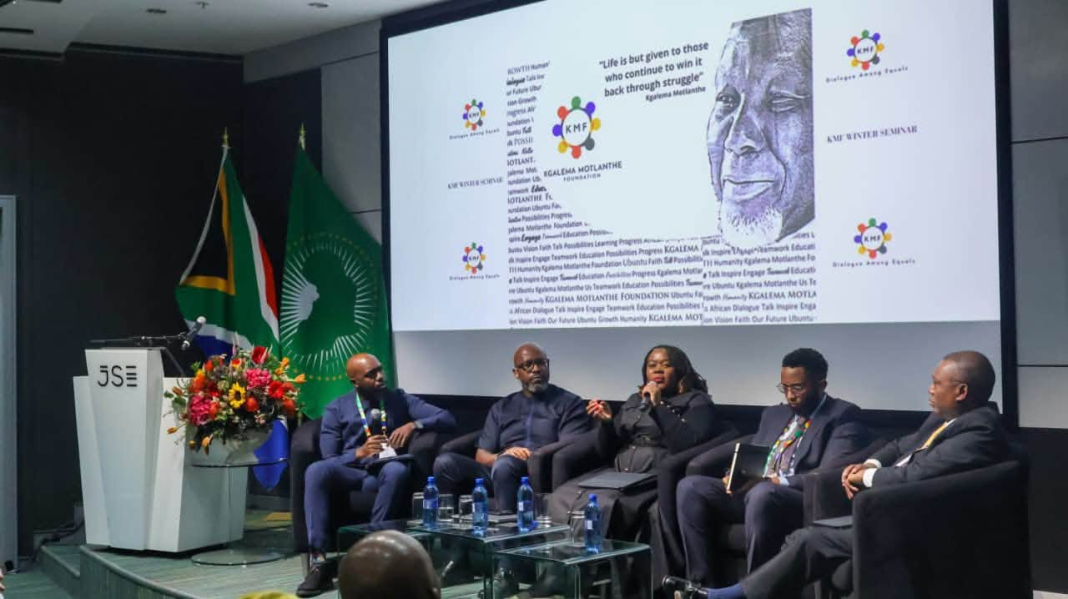
Speaking at the Kgalema Motlanthe Foundation Winter Seminar in Johannesburg on Thursday, Kubayi said the work of the Inter-Ministerial Committee (IMC) on Migration is guided by the Constitution, domestic legislation and South Africa’s international obligations.
“Our approach is grounded in the Constitution because constitutional democracy and its values guide what we do. The Constitution remains the supreme law of our country and places an obligation on all of us to protect human rights while ensuring that South Africa is governed by the rule of law,” she said.
Kubayi rejected the perception that government is opposed to migration, stressing that South Africa continues to welcome people who enter the country legally.
“Our borders are open to people who come legally with the required documentation. The challenge we are dealing with is illegal migration, not legal migration,” she said.
Using the Beitbridge Border Post as an example, Kubayi said government processes thousands of arrivals and departures daily, illustrating the scale of lawful cross-border movement.
According to the IMC’s latest update on migration engagements, the Border Management Authority processed 6,709 Malawian nationals for repatriation between 12 and 24 June 2026, transporting them in 112 buses, while 1,521 Zimbabwean nationals were repatriated in 26 buses.
A total of 8,230 foreign nationals were processed for repatriation through Beitbridge during the period.
The IMC also said that more than 7,400 undocumented immigrants had been arrested in the past month for contravening the Immigration Act.
Since 1 January 2026, law enforcement operations across the country have resulted in the arrest of more than 40,000 undocumented immigrants.
Kubayi said that while about 13,000 Malawian nationals left South Africa on one day, roughly 8,000 entered legally using valid travel documents.
“There is nothing wrong with those arriving legally. The law requires us to allow them to enter. The problem is those who are in the country illegally,” she said.
She said South Africa has already deported more than 60,000 undocumented foreign nationals this year, adding that updated national figures would be released once verified.
Kubayi warned that immigration enforcement remains the responsibility of the state and not private individuals or community groups.
“There cannot be a country without laws. Those who take the law into their own hands will also face the consequences because law enforcement belongs to the state,” she said.
She acknowledged that public frustration over crime, unemployment and deteriorating living conditions had intensified tensions around migration, but argued that government must address the underlying socio-economic conditions driving the debate.
Kubayi said government is developing a three-year programme, estimated to cost about R10 billion, to modernise South Africa’s borders through upgraded fencing, surveillance technology, drones and improved infrastructure to combat illegal migration, vehicle theft, smuggling and other cross-border crimes.
She also cautioned against the growing politicisation of migration ahead of next year’s local government elections.
“Our assessment is that migration will continue to be used as an election issue because some political actors have turned it into an electioneering campaign. But the work of the IMC goes beyond elections. Our responsibility is to fix the weaknesses in the migration system once and for all,” she said.
Kubayi said government is reviewing refugee and asylum policies to ensure they remain practical and humane, while calling for a national dialogue on migration, identity and South Africa’s place on the African continent.
“There is no country that can survive in isolation. South Africans work across Africa just as people from other countries work here. We need an honest conversation about the South Africa we want to build,” she said.
Head of the European Union Delegation to South Africa Ambassador Sandra Kramer said decisions about who enters a country should remain the responsibility of democratic institutions rather than criminal syndicates.
“Decisions on who comes into your country should be taken by democratic institutions, not by smugglers and traffickers,” Kramer said, adding that peaceful coexistence requires stronger community integration and a better understanding of the factors driving migration.
United Nations Resident Coordinator in South Africa, Nelson Muffuh, said effective migration governance must balance border management with the protection of human rights.
“I don’t see a contradiction between effective migration management and protecting rights while ensuring that the state has the monopoly on enforcing the law and preventing vigilantism,” Muffuh said.
He added that successful integration requires governments to work closely with host communities rather than focusing solely on migrants and refugees.
“You don’t simply move people into communities without engaging those communities. If services are provided to one group, everyone should benefit. That is how shared prosperity is built,” he said.
RiskRecon director Ambassador Kingsley Makhubela argued that South Africa’s migration debate reflects a broader crisis of state capacity rather than migration itself.
He said the international debate was not about allowing undocumented migrants to remain indefinitely, but about ensuring migration is managed through legitimate democratic institutions.
“The discourse around the world is not that South Africa should continue having people within its borders who have no documents and cannot be identified. The issue is the manner in which non-state actors have taken over responsibilities that belong to the state,” Makhubela said.
He warned that institutional weaknesses, particularly within the criminal justice system, have allowed private individuals and community groups to assume functions that belong to government.
“There is some level of atrophy that has filtered into state institutions, particularly within the justice system. It is the private sector and private actors taking over the responsibility of the state that is creating a huge problem,” he said.
Makhubela said this had resulted in situations where members of the public identify suspected undocumented migrants and law enforcement simply acts on those allegations, undermining confidence in the rule of law.
“It creates serious credibility problems for the country. We need to rebuild institutional capacity where weaknesses have emerged, and that requires resources, expertise and political commitment,” he said.
He questioned whether South Africa’s political leadership had the will to remove migration from electoral politics.
“This question of migration has been integrated into the electoral politics of the country. It is increasingly used as an excuse for failures of the state to provide basic services,” he said.
Makhubela argued that migration has become a convenient political campaign issue that diverts attention from deeper governance failures.
“The President has cautioned against politicising migration, but the question is whether there is political willingness to stop doing so. Once migration becomes an electoral issue, it becomes extremely difficult to remove from political discourse because it becomes a vehicle for winning votes,” he said.
He called on civil society to become more vocal in rejecting xenophobia and anti-immigrant rhetoric.
“We need a movement that says, ‘Not in my name.’ We cannot allow stereotypes against migrants, whether documented or undocumented, to become normalised,” he said.
Makhubela also criticised what he described as weak political leadership, saying those in power could not continue protesting against problems they had the authority to resolve.
“This is the only country where you see people in power demonstrating. If those in government are demonstrating, then who is governing? Those are the leadership challenges we must confront,” he said.
He also warned of emerging regional security threats, including secessionist and irredentist movements driven by ethnic identity, saying they require decisive political leadership.
INSIDE POLITICS