By Johnathan Paoli
EFF leader Julius Malema has called on the youth of South Africa to channel grief into revolutionary action, in the struggle for justice, transformation and economic freedom for the poor and marginalised.
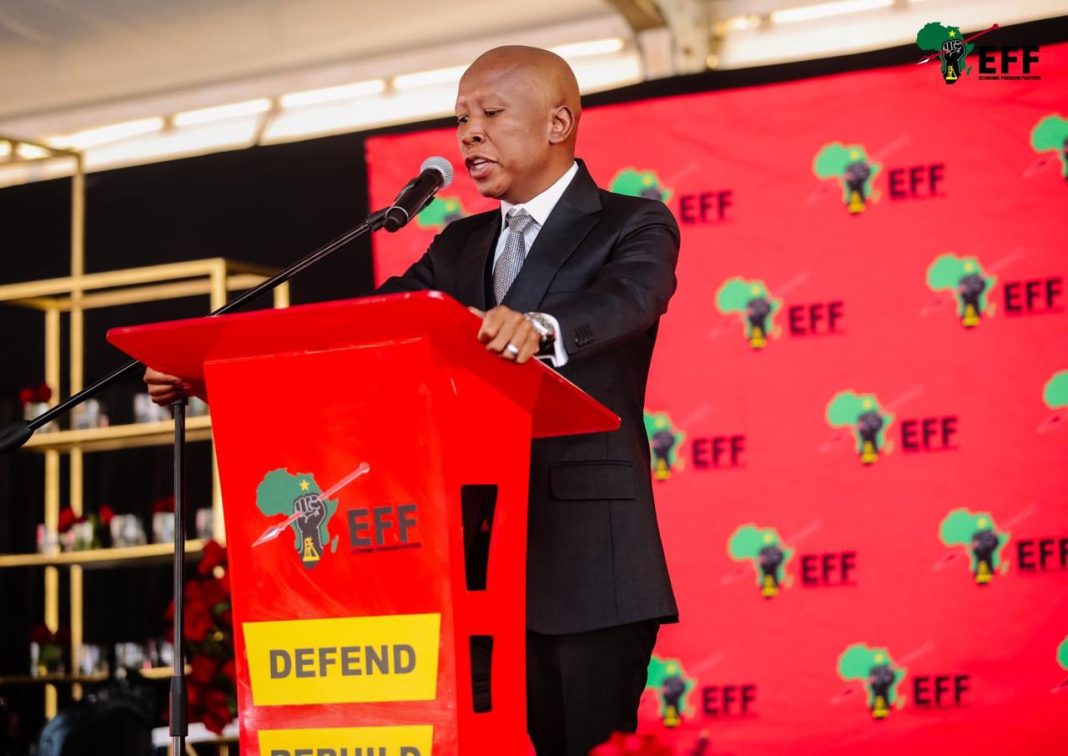
Speaking during a mass funeral service, held at Cecil Emmett Hall in Vryheid, for what the party has called the “June 16 Battalion”, Malema described it as not merely a traffic tragedy, but a symbol of broader systemic failures.
“We must stop normalising premature death in Black communities. These young people were not born to die in road accidents. They were born to build, to create and to lead,” he said.
The 10 deceased, all young activists returning from Durban’s Youth Day rally last week, lost their lives when the bus carrying them collided with a truck on the R34 near Ulundi in northern KwaZulu-Natal.
At least 30 other passengers sustained injuries in the horrific incident.
Malema recounted the chilling realisation that ten young lives never returned from the “roll call” on June 17 2025.
The CIC used the platform to spotlight persistent socio-economic challenges facing South Africa’s youth, namely unemployment, educational inequality and the daily struggles of survival under poverty.
With 45.1% youth unemployment, he said, the country is failing an entire generation.
Criticising a government that provides prison inmates with meals and education while youth remain hungry and undereducated, Malema demanded systemic reform.
He reiterated the EFF’s call for a Permanent Unemployment Grant to restore dignity to millions without jobs.
He denounced wasteful spending, citing the R700 million allocated to a “useless national dialogue,” and argued that the state had the financial capacity to fund youth-focused social programmes.
“There is no shortage of money, only shortage of political will,” Malema said.
The speech moved beyond local politics, linking the tragedy to global struggles for justice.
Malema extended solidarity to the people of Palestine, condemning the Israeli government and its allies for what he called genocide.
He also voiced support for Iran and hailed Captain Ibrahim Traoré of Burkina Faso as a symbol of young African leadership resisting Western imperialism.
Malema called Traoré, who came to power amid anti-colonial sentiment, a modern-day revolutionary in the mould of Thomas Sankara.
Malema announced that the EFF would build houses equipped with boreholes for each of the ten victims’ families as a gesture intended to restore dignity and create a permanent relationship between the party and the bereaved.
He urged young people to rise, organise, and take leadership, reminding mourners that the deceased died not on a holiday or leisure trip, but while returning from a political rally rooted in the fight for economic justice.
He called on all ground forces to pick up the spear and continue the fight for land, dignity, and a decolonised future.
“Let this funeral not be the end. Let it be the beginning of our refusal to accept a country where the youth are treated as waste,” Malema concluded.
EFF’s Treasurer-General, Omphile Maotwe on firmed that seven of the ten casualties would be buried in a mass ceremony, while one victim would be laid to rest in Zimbabwe and two families opted for private funerals, including the driver’s, who lost their child in the accident.
Deputy Transport Minister and EFF member Mkhuleko Hlengwa announced that the Road Traffic Management Corporation has concluded its investigation into the crash, though no official cause has been confirmed.
EFF MP Naledi Chirwa gave a heartfelt eulogy, reading obituaries and honouring the personal contributions of each young activist.
Regional authorities report that the R34 between Ulundi and Vryheid, a route notorious for accidents, will face renewed scrutiny as many urge for improved road safety measures and stronger enforcement of driving standards on this busy road.
INSIDE POLITICS