
By Johnathan Paoli
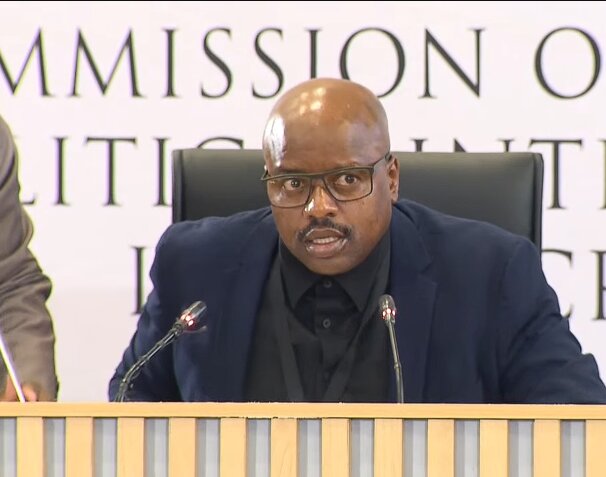
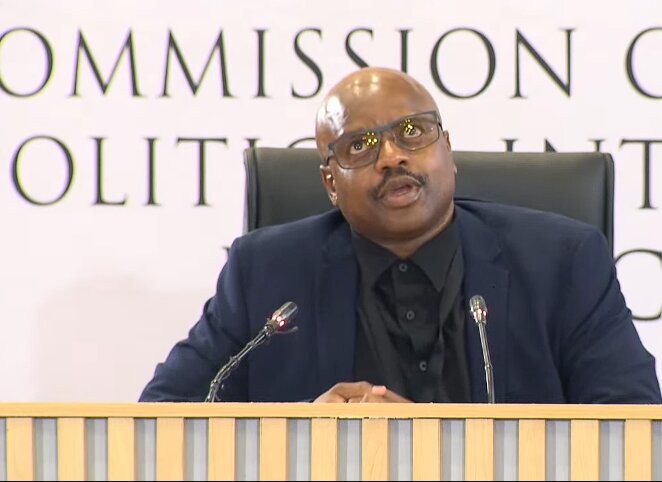
Suspended Ekurhuleni Metro Police deputy chief Julius Mkhwanazi has conceded that a police clearance certificate submitted for controversial businessman Vusimusi “Cat” Matlala was fraudulent, but denied that the EMPD had the expertise to detect whether SAPS documents were genuine.
Mkhwanazi testified at the Madlanga Commission on Wednesday that the certificate was forwarded to him by businessman Mike van Wyk as part of a proposed “peace officers” programme involving private volunteers who would assist the metro police with limited municipal policing functions.
The certificate was submitted after prospective members of the proposed programme were required to undergo criminal record screening.
ALSO READ: SAPS, private security unite to avoid 2021 unrest scenario on 30 June
“You remember I said that we wanted to establish the Peace Corps. People must check fingerprints first. You can’t take a person with criminal records to be peace corps,” Mkhwanazi said.
Asked whether he accepted Matlala’s certificate, Mkhwanazi said he did, but only as part of a broader group of applications meant to ensure that proposed peace officers would be suitable.
However, he repeatedly told the commission that neither he nor the EMPD possessed the expertise to determine whether SAPS clearance certificates were genuine.
Evidence leader Advocate Mahlape Sello then referred him to a SAPS affidavit concluding that Matlala’s clearance certificate was fraudulent because the enquiry and transaction numbers did not correspond with any genuine police clearance certificate issued by SAPS.
Despite conceding that the certificate was fraudulent, Mkhwanazi maintained that the EMPD had followed its internal procedures by forwarding the document to officials responsible for recruitment and fingerprint verification.
The commission also examined a proposal for joint EMPD and Anubis Protection Services identification cards, which Mkhwanazi denied approving despite WhatsApp evidence showing that such cards were proposed and discussed with Van Wyk.
Mkhwanazi testified that the EMPD had always maintained a policy against issuing joint identification with private companies.
ALSO READ: All or nothing for Bafana in South Korea World Cup decider
“As EMPD we don’t do these cards. We don’t have such a card. We don’t have a card that mixes with a private company,” he said.
The issue arose from a memorandum of understanding between the EMPD and Van Wyk-linked companies, including Medicare24 and Anubis Security, which sought to establish the proposed “peace officers” programme.
The commission played a voice note sent by Van Wyk on 8 November 2021, in which he proposed the use of identification cards carrying both the EMPD and Anubis logos.
“I’m just trying to get everything in place and done and if we can get somewhere. So these are the cards that I see some of the metros are using for people. But we need [EMPD] to authorise us to use it. It doesn’t make us [police officers]. It just says that we work In conjunction with [the EMPD]. I don’t know if you just want to put your mind around it,” the voicenote said.
After Van Wyk shared an image of the card and asked whether it could be used, Mkhwanazi replied: “Please guide me.”
Sello said Mkhwanazi’s WhatsApp responses suggested he was open to the proposal.
When confronted with those exchanges, however, Mkhwanazi insisted he had sought clarification rather than endorsed the proposal.
“We are still in the process. Maybe he is assisting us with something that can make this thing move faster,” he said.

Commission chair Mbuyiseli Madlanga questioned why Mkhwanazi had not immediately rejected the proposal if EMPD policy prohibited such cards.
“If you had a problem, you should have told him that categorically,” Madlanga said.
Mkhwanazi maintained that the matter was discussed in person and ultimately rejected.
“I went to him, I told him that. We met with Mike. That’s why this didn’t materialise,” he said.
The commission also looked at the proposed Peace Corps initiative itself, with Sello saying the volunteers would effectively perform functions ordinarily reserved for EMPD officials.
Mkhwanazi disputed that, saying the programme was modelled on initiatives elsewhere and was intended only to supplement municipal policing.
“We wanted to cope with the good thing that the City of Cape Town is doing, because we get people that are having resources and everything to come and assist in terms of fighting crime,” he said.
“The objectives are to assist us in terms of our traffic lights, school children, funerals, and events. We’re having those volunteers. It was a strategy of making sure that we’re having those people who are assisting,” he said.
The commission continues.





