



Staff Reporter
The Airports Company South Africa (ACSA) said on Friday that jet-fuel supplies remain stable and flights are operating normally across its airports, seeking to ease concerns that an unplanned shutdown at Sasol’s Natref refinery could disrupt aviation at O.R. Tambo International Airport.
The country’s busiest airport has between five and six days of jet-fuel stock available, enough to meet average demand of about 3,850 cubic metres a day, ACSA said in a statement.
“Flight schedules across the ACSA network continue to operate as normal,” the state-owned airports operator said.
Concerns over supplies emerged this week after airlines began preparing contingency measures following problems at Natref, South Africa’s only inland crude-oil refinery and a key supplier to the country’s main economic hub.
Bloomberg reported on 26 August that airlines were preparing for a potential jet-fuel shortage, with FlySafair arranging additional supplies from alternative providers.
ACSA subsequently said the Department of Electricity and Energy had convened an emergency meeting with ACSA and the Fuels Industry Association of Southern Africa on Wednesday.
Sasol confirmed on Wednesday that an unplanned shutdown of a downstream unit at Natref had affected its ability to meet its full supply commitments for some products, including jet fuel supplied to customers at O.R. Tambo.
The company said it would continue partially supplying those customers while implementing measures to limit the impact and working to restore normal operations.
Natref supplies between 70% and 80% of O.R. Tambo’s jet-fuel demand, according to ACSA. The balance is supplied through the Multi-Product Pipeline from the coast and dedicated rail deliveries.
“ACSA has instituted active stock-management protocols to maintain continuous operational stability across all airport fuel farms,” the company said.
“It has also enforced rigorous governance controls across all nine airport locations to guarantee ongoing fuel security.”
FlySafair, which carries more than half of South Africa’s domestic air passengers, said the disruption followed planned maintenance at Natref that was compounded by a technical problem.
The airline has temporarily increased supplies from providers with available fuel and is also using a moderate amount of “tankering,” where aircraft carry additional fuel to reduce the amount they need to take on at their destination.
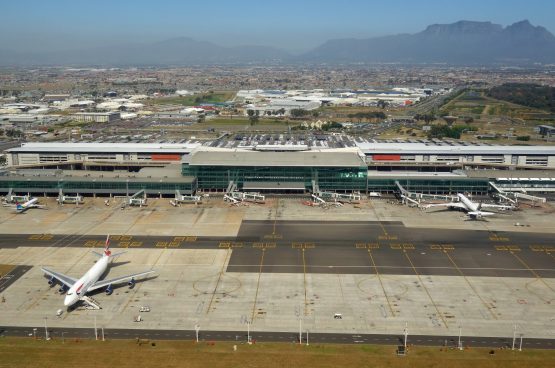
Cape Town International Airport, meanwhile, gets between 70% and 75% of its jet fuel from the Astron refinery, with the remaining 25% to 30% supplied through marine imports and stored at the Burgan terminal.
Cape Town currently has about 4.5 days of jet-fuel cover, based on demand of approximately 1,400 cubic metres a day, ACSA said. Stock is expected to increase to about 5.5 days following the return to service of a fuel-storage tank that underwent planned maintenance.
King Shaka International Airport has about 12 days of stock, while Chief Dawid Stuurman International Airport, King Phalo, George, Bram Fischer, Kimberley and Upington airports operate on fully import-backed supplies with daily replenishment and at least six days of cover, according to ACSA.
ACSA said it would trigger formal crisis-management measures if projected stock at any airport fell to three days. Those steps would include closer tracking of fuel deliveries, direct engagement with affected airlines and activation of the company’s Fuel Forum.
Transport Minister Barbara Creecy is being briefed on developments, ACSA said.






