
By Charmaine Ndlela
Operation Dudula says its members will participate in 30 June protests demanding the removal of undocumented foreign nationals, but insists it is not leading the campaign and cannot predict what will happen if the “deadline” passes without compliance.
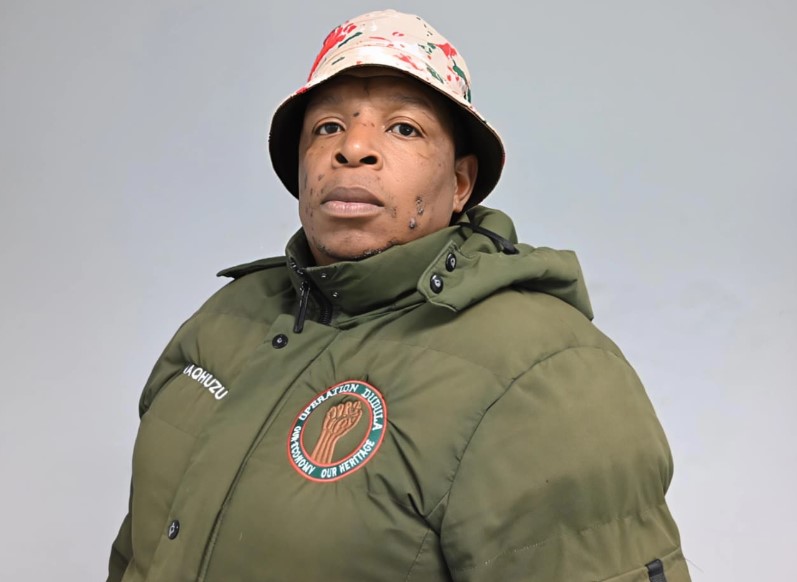
In an interview with Inside Politics in Illovo, Sandton, Operation Dudula National Executive Committee (NEC) member Siphiwe Shabangu said the organisation supported the ultimatum because it reflected “concerns” it had raised for years, but stressed that the campaign was being driven by other civic leaders and “ordinary South Africans”.
“As you have seen on television, civic leaders such as Nkosikhona ‘Phakelumthakathi’ Ndabandaba and Ngizwe Mchunu are leading the 30 June campaign. We support the programme, but we are not leading it,” Shabangu said.
The campaign has attracted national attention amid growing tensions over illegal immigration and the government’s handling of border management.
President Cyril Ramaphosa has said that the government is already addressing immigration challenges, but Shabangu said the authorities had failed to demonstrate meaningful progress.
“The government must tell South Africans exactly how it is addressing illegal immigration. If the issue was being addressed, we would not have millions of undocumented migrants in the country.
“Public parks have effectively become refugee camps and our children can no longer freely use some of these facilities,” he said.
Shabangu called for a state of emergency to be declared over immigration, saying mass deportations of undocumented foreign nationals were necessary.
“Mass deportation is needed in this country. Government must stop playing with South Africans,” he said.
Shabangu said Operation Dudula could not predict what would happen after the deadline passed if undocumented migrants remained in the country.
“What we do know is that we will continue with awareness campaigns, protests and lawful action aimed at forcing government to enforce South African laws,” he said.
“We have spent years marching, protesting and delivering memorandums to government. The response has been inadequate.”
Shabangu said inadequate support for the Border Management Authority had contributed to illegal migration and related criminal activity.
He said that the government had failed to fully implement provisions of the Immigration Act, claiming that some foreign nationals had obtained South African documentation through fraudulent means.
“What we are saying is that government must enforce the Immigration Act. There are requirements for foreign nationals who wish to conduct business in South Africa. Authorities must verify whether those requirements have been met and whether documentation was obtained lawfully,” he said.
Shabangu also linked immigration to South Africa’s unemployment crisis, claiming employers in sectors such as hospitality, security and transport continued to rely on undocumented foreign labour while South Africans remained unemployed.
“Our country is in a mess, young people are not working, but you go outside, go to all these places, these foreign nationals are working and the majority of them are illegal and they are being exploited by a [capitalist] system,” he said.
“They must leave our country. Government must deport undocumented migrants. We are forcing government to declare a state of emergency. People must return to their countries and resolve their own challenges there.”
The remarks come as authorities continue to manage the ongoing situation in Sherwood, Durban, where thousands of foreign nationals — most of them Malawians — have gathered after being chased from nearby informal settlements.
Using the Sherwood situation as an example, Shabangu accused the government of losing control of immigration management.
“Sherwood is not a refugee camp. It is a public facility meant to serve communities. The fact that people have occupied that space for weeks demonstrates government’s failure to deal effectively with illegal immigration,” he said.
He said residents living near the facility had become fearful because of criminal activity and instability in the area.
“People living around Sherwood feel intimidated. Many are afraid to move around freely, particularly at night. Government allowed a situation to develop where public spaces were occupied for weeks without a clear solution.”
He criticised the Malawian government for remaining silent about “what is happening to its people”, saying: “South Africa is now a dumping ground.”
Political alliances
Regarding political alliances, Shabangu said Operation Dudula had no relationship with parties that had previously spoken out strongly against immigration, such as the Patriotic Alliance (PA).
He accused the party of abandoning the anti-illegal-immigration position that helped it attract support ahead of the 2024 elections.
He also dismissed suggestions of a formal relationship between Operation Dudula and the uMkhonto weSizwe (MK) Party.
“We do not have a formal relationship with MK. We engage with different organisations on issues of common concern, but there is no formal political alliance,” he said.
However, Shabangu confirmed that Operation Dudula maintained “cordial” relations with the March and March movement — which is leading the anti-illegal immigrant sentiment with almost daily marches — which he said was a patriotic civic organisation advocating for stricter immigration enforcement.
The organisation on Sunday announced Zodwa Booi as its interim public face and leader during the transitional period following the resignation of former president Zandile Dabula.
The organisation recently marked its sixth anniversary and, according to Shabangu, continues to rely primarily on donations from supporters to keep afloat.
“Patriotic South Africans fund this organisation. Our banking details are publicly available on our social media platforms and people contribute voluntarily. We do not rely on a single donor or funder,” he said.
INSIDE POLITICS





