



By Levy Masiteng
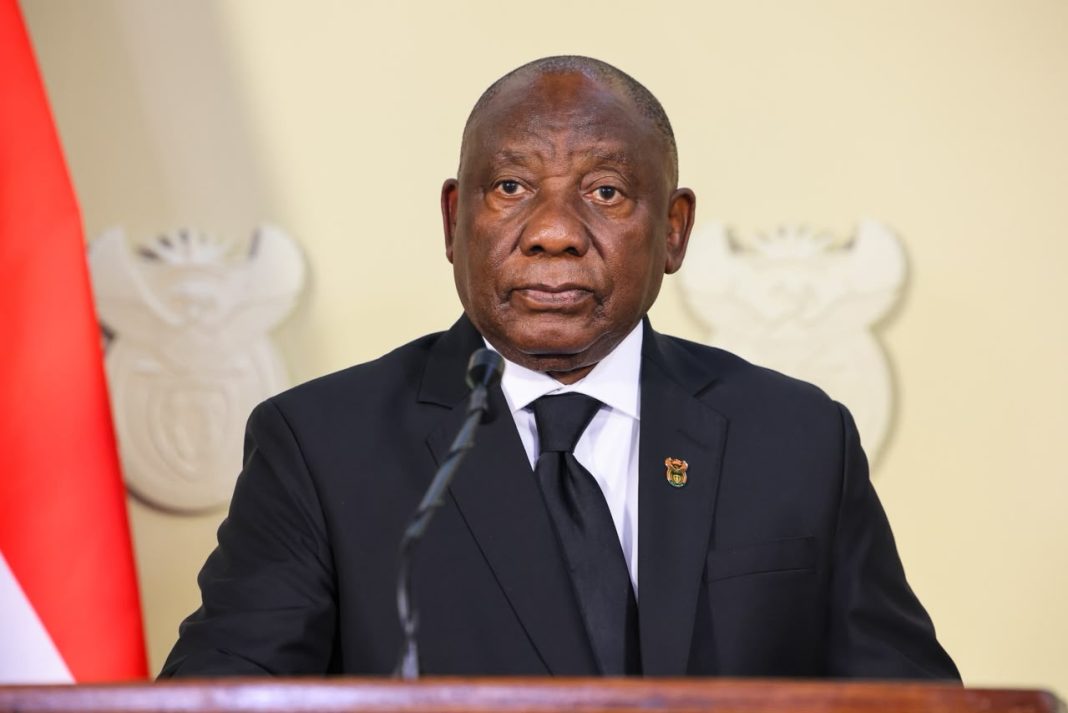
President Cyril Ramaphosa on Tuesday night vowed urgent action against gender-based violence and femicide (GBVF) after the discovery of 11 women’s bodies in Ekurhuleni, saying the killings were receiving attention at the highest levels of government and law enforcement.
Addressing the nation from the Union Buildings in Pretoria, Ramaphosa unveiled four immediate measures to tackle gender-based violence, including a national audit of unresolved cases, an effort to clear forensic backlogs and safety audits by every municipality.
The measures come as anger and concern over the killings in Ekurhuleni have intensified, putting renewed pressure on Ramaphosa’s administration to act against violence targeting women.
“What we have done has not been enough. We need to do much more,” Ramaphosa said.
He said specialised multidisciplinary investigations into the killings had been elevated to the national level under the coordination of the Deputy National Commissioner for Detective Services.
The investigations bring together detectives, Crime Intelligence, forensic specialists, investigative psychologists, digital investigators and other specialised capabilities.
The Council for Scientific and Industrial Research (CSIR) is also assisting with digital forensic investigations as police gather DNA, blood samples, clothing, cellphone and cellphone-record data.
Ramaphosa said arrests had been made in some of the cases, while investigations into others were continuing.
A suspect was arrested Sunday morning in connection with the murder of Ntombifuthi Nxumalo, whose body was found Saturday.
Two suspects have also appeared in court over the killing of Jabulile Ntimba, while another suspect is in custody in connection with the murder of Busisiwe Mahlangu.
But Ramaphosa cautioned against drawing conclusions that the killings were the work of a single perpetrator.
“At present, the police have not found evidence establishing that these killings were committed by a single perpetrator. All possibilities remain under investigation,” he said.
To prevent cases involving women and children from going cold, Ramaphosa directed the police and justice ministers, working with the South African Police Service (SAPS) and, with due regard to prosecutorial independence, the National Prosecuting Authority (NPA), to launch a national case-recovery operation.
The operation will target unresolved murders, attempted murders, rapes and serious sexual offences involving women and children.
Within 60 days, authorities must audit the number and age of unresolved cases, including those awaiting forensic evidence, cases where suspects have been identified but not arrested, and cases where investigative or prosecutorial action has been delayed.
“Within 90 days, individual recovery plans must be established for priority and stalled cases, identifying outstanding actions, responsible officials and deadlines,” Ramaphosa said.
The second measure targets the country’s forensic evidence backlog.
The police national commissioner and relevant forensic authorities must submit a funded plan within 60 days setting out the size and age of the backlog, staffing and equipment shortages, required resources and deadlines for reducing delays.
Priority forensic samples in rape and murder cases involving women and children must be fast-tracked, with progress reports published every three months.
The third measure requires every municipality to conduct a women’s safety audit with provincial authorities and police.
The audits will identify hazards including broken streetlights, overgrown public spaces, abandoned buildings, unsafe transport routes and poorly secured parks.
Municipalities will have 60 days to identify the risks and 90 days to address the most urgent hazards or include them in funded implementation plans.
“The results of the audits and progress in correcting the identified hazards will be published so that communities can see what has been identified, what has been fixed and what remains to be done,” Ramaphosa said.
The fourth measure targets alcohol-related violence.
Ramaphosa directed provincial and municipal authorities to strengthen enforcement of existing liquor laws and by-laws, particularly against unlicensed outlets and establishments operating outside permitted hours.
The ministers of Trade, Industry and Competition; Health; Social Development; Police; and Cooperative Governance must submit a coordinated legislative and enforcement package to Cabinet within 60 days aimed at reducing alcohol-related violence.
“Alcohol does not cause gender-based violence and it can never excuse it. Responsibility always lies with the perpetrator,” Ramaphosa said.
He said harmful alcohol use was nevertheless a significant aggravating factor in interpersonal violence and needed to be addressed as part of wider prevention efforts.
Ramaphosa said visible policing had been significantly increased in Ekurhuleni and would continue for as long as necessary.
But he warned that police action alone would not solve the crisis.
“We cannot police our way out of gender-based violence alone. We cannot arrest our way out of this crisis alone. And we cannot wait until a woman is murdered before the state intervenes.”
He urged the public to report missing people immediately, stressing that there is no requirement to wait 24 hours before reporting someone missing.
“Hours matter. Information matters. A photograph matters. A vehicle registration number matters,” he said.
Ramaphosa said the government had strengthened its response since gender-based violence and femicide was declared a national disaster last year, including additional resources for the Family Violence, Child Protection and Sexual Offences Units.
Additional funding is expected to be considered by Finance Minister Enoch Godongwana in the upcoming Medium-Term Budget Policy Statement (MTBPS), which he is scheduled to table in Parliament on October 21, 2026.
Sexual Offences Courts are being expanded, while Thuthuzela Care Centres continue to provide medical, forensic, counselling and legal services to survivors.
The government is also expanding shelter services and strengthening the processing of DNA and other forensic evidence.
Ramaphosa said legislative changes were being implemented to make it more difficult for alleged perpetrators of gender-based violence and domestic abuse to obtain bail.
Police stations have established Victim Friendly Services and GBV desks, with officers receiving training on gender-based violence.
“A woman who summons the courage to report abuse must not be turned away from a police station. A woman seeking a protection order must not be sent from office to office,” Ramaphosa said.
He said cases must not collapse because of lost dockets, poor investigations or survivors being treated without dignity.
The Inter-Ministerial Committee on Gender-Based Violence and Femicide and the National Council on Gender-Based Violence and Femicide will monitor implementation of the four measures and issue consolidated public progress reports every quarter.
The first report is due within 90 days.
“These directives are not just a statement of good intentions. They establish responsibilities, deadlines and a duty to submit reports on a regular basis to the nation,” Ramaphosa said.
INSIDE POLITICS






