

By Johnathan Paoli
MKP members of Parliament mounted a sustained and heated challenge to the analysis presented by Jean Redpath of the Dullah Omar Institute (DOI), accusing her of misleading the committee by using general murder statistics to assess the performance of the now-disbanded Political Killings Task Team (PKTT).
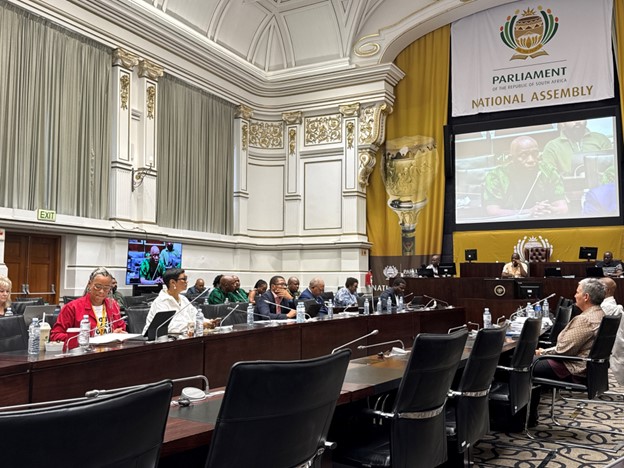
The confrontation unfolded during the ad-hoc committee’s hearings on public admissions, with MKP MP Sibonelo Nomvalo leading a forceful interrogation of Redpath’s written submission, particularly paragraph 20, which notes that murders in KwaZulu-Natal rose from about 4,395 in 2018/19 to 6,947 by 2022/23.
Nomvalo argued that the figures were being improperly used to suggest that the PKTT had failed.
“Because my problem here is that you are making an assessment on the performance of the task team, right? And in your assessment, you are using wrong figures. Is that not unfair?” he asked.
Nomvalo insisted that the task team’s mandate was limited strictly to politically motivated killings, contending that assessing the PKTT against overall murder statistics was outside its mandate.
Redpath responded that she fully understood the task team’s scope, but said her point was about impact beyond that narrow focus.
“The amount of resources expended on the PKTT only dealing with a very small part of the murder problem in the province is of great concern,” she said.
She said that an effective intervention should at least have disrupted hitmen networks, illegal firearms and organised violence more broadly.
As the exchange escalated, Nomvalo accused Redpath of inserting wrong numbers under a heading assessing the performance of the PKTT, arguing that the statistics gave the impression that the task team had been ineffective.
“This presentation won’t help us because it is not truthful. You are giving us wrong numbers here,” he said.
Redpath stressed that she was not criticising the PKTT’s narrow operational outcomes but questioning the prioritisation of resources.
The dispute drew an intervention from committee chairperson Soviet Lekganyane, who cautioned MPs against impugning witnesses’ integrity and sought to reframe the disagreement.
He acknowledged evidence that the PKTT had achieved successes in reducing political killings, including admissions by the President and the Minister of Police, while also noting Redpath’s argument that ordinary citizens continued to die in large numbers.
The tension continued when MKP MP David Skosana questioned the independence and funding of the Dullah Omar Institute, suggesting that civil society organisations pursued ideological agendas.
Redpath replied candidly that the Institute did have an agenda, promoting constitutional law, governance and human rights, and confirmed that it received mixed funding from various organisations while also undertaking consultancy work for government departments.
Skosana went on to defend the PKTT as a success and criticised Redpath’s comparison with the Gauteng aggravated robbery strategy, arguing that the task team had reduced politically related murders and that its costs could not be weighed against human lives.
He also challenged her interpretation of ministerial authority over SAPS operations.
Under questioning from Lekganyane, Redpath clarified that she had acknowledged the PKTT’s relative success compared with the general performance of the criminal justice system.
“Compared to the very poor performance in our courts generally, the cases at the PKTT seem to do relatively well,” she said.
However, she maintained that such performance could not be judged in isolation from funding, accountability and broader outcomes.
In her broader presentation, Redpath situated the PKTT within what she described as a deep, systemic deterioration of South Africa’s criminal justice system.
She highlighted collapsing public trust in police, shrinking detective capacity, falling convictions and worsening murder rates, with KwaZulu-Natal standing out as an extreme outlier.
She told the committee that approximately R500 million had been spent on the PKTT over several years, excluding salaries, and raised concerns about opaque budget allocations, prolonged accommodation and overtime costs, and weak parliamentary oversight.
Earlier in the day, the committee confirmed that it would both start a subpoena process regarding businessman Brown Mogotsi as well as pursuing the process in regards to forensic investigator Paul O’Sullivan.
The committee continues.
INSIDE POLITICS