
By Charmaine Ndlela
Trade, Industry and Competition Minister Parks Tau has called on Southern African countries to end their long-standing dependence on exporting raw materials, saying accelerated industrialisation and stronger regional value chains are critical to creating jobs, reducing poverty and improving the region’s global competitiveness.
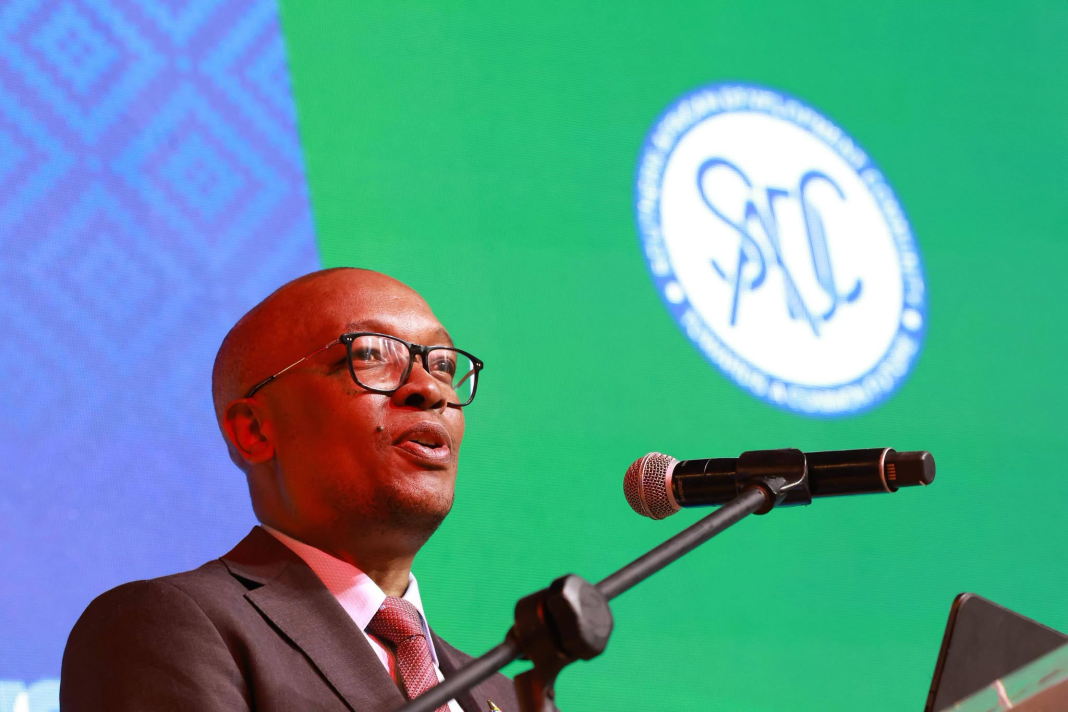
Delivering the keynote address at the opening of the 9th Southern African Development Community (SADC) Industrialisation Week at the Durban International Convention Centre on Monday, Tau said shifting global supply chains, geopolitical tensions, climate change and rapid technological change have created an urgent need for the region to transform its economies.
The week-long event has brought together government leaders, business executives, development partners and regional institutions to discuss ways to accelerate industrialisation, attract investment and strengthen cross-border value chains.
Tau said Southern Africa has significant competitive advantages, including abundant natural resources, critical minerals, fertile agricultural land and a growing young population, but these have yet to translate into sustained industrial growth.
“For too long we have exported raw materials and imported manufactured products,” he said.
Tau said the region must prioritise mineral beneficiation, advanced manufacturing and integrated regional value chains that retain more value within African economies.
While the SADC Industrialisation Strategy and Roadmap, adopted in 2015, provides a clear policy framework, Tau said implementation has lagged behind expectations.
He identified declining donor funding as one of the major constraints, noting that external financing is often aligned to donor priorities rather than SADC’s own development agenda.
“We must drive our own agenda and pursue partnerships that support beneficiation and value addition at source,” he said.
Tau said regional economic growth improved from 3.2% in 2024 to 3.4% in 2025 and is projected to reach 3.9% in 2026, supported by improved rainfall and stronger commodity prices.
However, he warned that economic recovery alone would not address the region’s structural challenges.
“Our economies are recovering but they are not transforming fast enough to cut poverty and unemployment or create opportunities for young people. Industrialisation remains our most urgent economic priority,” he said.
Tau called for industrialisation that is resilient, sustainable and inclusive, driven by innovation, clean energy and greater participation by women, youth, small businesses and historically disadvantaged communities.
He also emphasised the need to deepen regional integration through both SADC and the African Continental Free Trade Area (AfCFTA).
Although intra-SADC trade increased to 20.2% in 2025, Tau said member states must remove non-tariff barriers, simplify customs procedures, improve border efficiency and expand regional manufacturing networks.
He further highlighted the need to strengthen regional pharmaceutical manufacturing and vaccine production, citing lessons from the COVID-19 pandemic and the need to respond more effectively to livestock diseases such as foot-and-mouth disease.
Tau said the region should focus on measurable outcomes, including expanding manufacturing and mineral beneficiation, strengthening agro-processing and food security, developing bankable regional infrastructure projects and building industries capable of reducing strategic vulnerabilities.
He officially declared the 9th SADC Industrialisation Week open, urging delegates to move beyond policy discussions and deliver practical implementation.
eThekwini Executive Mayor Cyril Xaba said Durban was honoured to host one of the region’s most significant economic gatherings.
“Industrialisation is the most effective pathway we have to create the productive capacity, the quality jobs and the shared prosperity that our nations so desperately need,” Xaba said.
He said Durban’s strategic infrastructure, particularly the Port of Durban, positions the city at the centre of Southern Africa’s industrial ambitions.
“Our port is and must continue to be a catalyst for the economic transformation of SADC,” he said.
Xaba urged member states to accelerate implementation of the AfCFTA by removing trade barriers, harmonising regulations and improving cross-border infrastructure.
“The AfCFTA presents us with a once-in-a-generation opportunity to create a single unified market, but this potential will remain unrealised unless we move with speed and determination,” he said.
He also stressed that industrialisation must be inclusive.
“No industrialisation programme can ever thrive in the exclusion of the majority of its citizens. We must place our youth and women at the very centre of this agenda,” Xaba said.
This year’s SADC Industrialisation Week is being held under the theme: “Resilient, Sustainable and Inclusive Industrialisation through Infrastructure Development, Agriculture and Critical Mineral Transformation in Pursuit of a Just World.”
According to government, SADC has identified several regional value chains that build on the comparative strengths of member states to increase manufacturing, boost value addition and improve participation in regional and global markets.
INSIDE POLITICS





