


By Johnathan Paoli
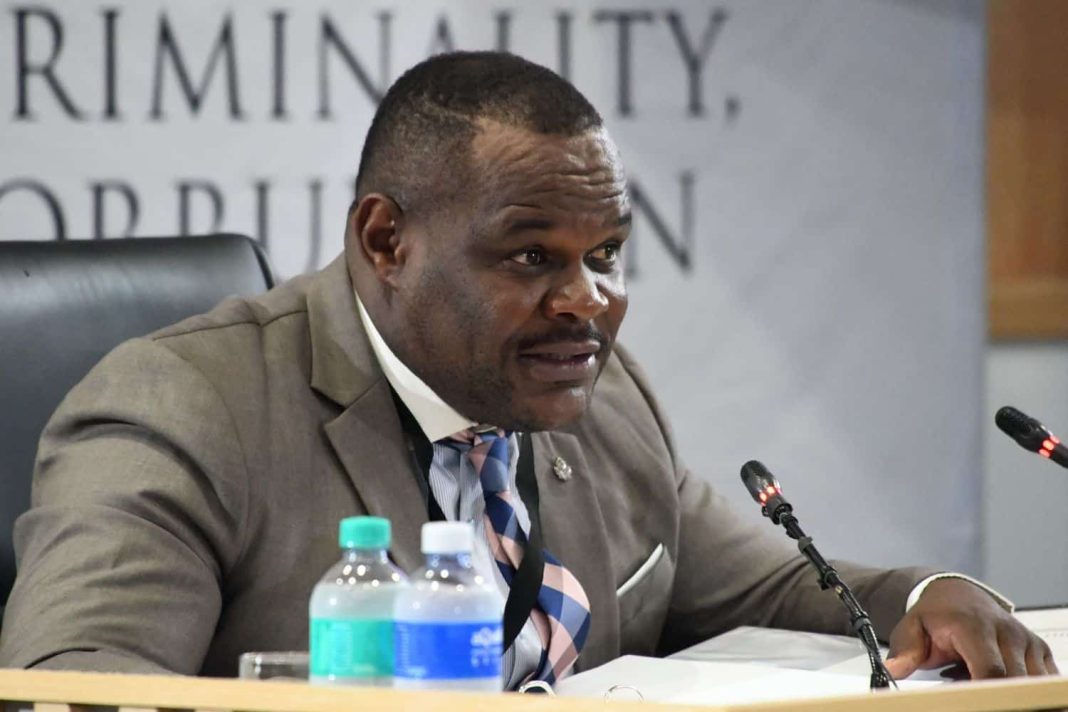
Sergeant Fannie Nkosi is not supposed to be one of the most consequential figures to emerge from the Madlanga Commission.
A non-commissioned officer in the Gauteng provincial division of the Organised Crime Unit, his role should, in theory, be confined to investigating criminal syndicates, not straddling them.
But after seven days of testimony, Nkosi has instead been cast by evidence leaders as a central intermediary in a network linking senior police leadership, alleged organised crime kingpins and politically connected businessmen.
Through his own admissions and the trail of WhatsApp messages, call records and financial transactions placed before the commission, Nkosi appears to have operated as a conduit of information, moving sensitive intelligence out of SAPS and into the hands of individuals under investigation.
The question confronting the commission is no longer simply whether Nkosi crossed ethical lines. It is whether a single sergeant could realistically sustain this level of access, influence and constant communication across multiple criminal and policing networks, or whether his position points to something far more systemic within the upper ranks of SAPS.
At the centre of this web sits suspended Deputy National Commissioner for Crime Detection Shadrack Sibiya, whose relationship with Nkosi has come under sustained scrutiny.
Evidence before the commission suggests Nkosi functioned as a de facto conduit between Sibiya and figures linked to organised crime: a role that allegedly went beyond administrative assistance and into the transmission of sensitive information.
ALSO READ: Mashatile warns AI could deepen inequality, calls for worker protections
Nkosi has repeatedly characterised his actions as merely “passing on a message”, but commissioners have pressed him on whether those messages were, in fact, instructions that he understood he was expected to relay further.
Through this channel, a network of controversial figures emerges.
Controversial businessman and attempted murder-accused Vusimusi “Cat” Matlala, murder-accused Katiso Molefe, slain taxi boss Jotham “King Mswazi” Msibi, and businessman Steve Motsumi all feature in Nkosi’s communications.
Nkosi’s own descriptions of these relationships are striking.
Msibi, he said, was “like a father” who raised him and put him through school, while Matlala was “a brother”.
Within hours of the April 2024 murder of Vereeniging engineer Armand Swart, Nkosi was in contact with individuals linked to Msibi’s network, including security company owner Phehello Mthakathi.
Call data presented to the commission showed 23 calls between Nkosi and Msibi and a further 30 with a Hawks officer (a certain “Officer Zungu”) at the scene.
Using that flow of information, Nkosi confirmed that suspect Tiego Floyd Mabusela had been arrested, and relayed that confirmation to Mthakathi.
He did so without informing the investigating officer.
Days later, Mthakathi sent Nkosi CCTV footage of the murder.
Nkosi told the commission he did not ask where it came from and did not see a need to alert investigators because the case had already been publicised.
The explanation drew immediate scepticism.
The issue, as evidence leader advocate Matthew Chaskalson put it, was not whether the murder was public knowledge, but why a police officer was receiving evidentiary material from an alleged associate of a suspect, and doing nothing with it.
A similar pattern of conduct emerges in matters linked to Molefe.
Nkosi was captured on CCTV visiting Molefe’s residence days before his arrest, leaving with a white bag he had not been carrying when he arrived.
He later sent a message to Tshwane official Mpho Lekukela, a friend of murdered musician Oupa “DJ Sumbody” Sefoka, a case in which Molefe is also implicated, asking why he did not “call him to order”.
When confronted, Nkosi said he could not recall the reason for the message, with commissioners accusing him directly of being untruthful.
His relationship with Matlala is even more deeply entangled.
Nkosi admitted under oath that he received R25,000 from Matlala, which he said was payment for providing a motorbike escort at a wedding.
He also conceded that he shared a confidential SAPS audit report with Matlala, a document linked to the cancellation of Matlala’s R360-million police tender.
Nkosi further acknowledged acting as an intermediary between Matlala and Sibiya.
In one exchange, Sibiya asked Nkosi to “ask Cat to make a turn”, a message Nkosi relayed.
When questioned about forwarding a warrant of arrest for entertainment blogger Musa Khawula to Matlala, Nkosi did not retreat.
Instead, he suggested that Sibiya himself may have instructed him to do so.
That triangular relationship, Sibiya, Nkosi and Matlala, has become a focal point for the commission’s inquiry into whether elements within SAPS were compromised by organised crime.
Both Sibiya and other senior officials have previously denied wrongdoing.
Beyond individual incidents, a broader, more troubling question has arisen: how Nkosi managed to sustain this volume of communication and activity across multiple, and often rival, networks while employed as a full-time organised crime officer.
On critical dates, Nkosi was in near-constant contact with figures on opposing sides of violent disputes.
In the days leading up to a police raid on Matlala’s home in December 2024, he exchanged multiple calls with Matlala while simultaneously communicating with taxi boss Joe “Ferrari” Sibanyoni.
On the eve of the raid, Nkosi sent Sibanyoni a message reading “today is laduma”, widely interpreted by the commission as celebratory.
Nkosi rejected that interpretation, stating that “there is no way that I would have celebrated”.
Another concern raised is that Matlala may have been tipped off ahead of the raid, allowing him to move allegedly kidnapped Pretoria businessman, Jerry Boshoga, who remains missing.
Nkosi denied tipping Matlala off, maintaining that his communications were part of efforts to persuade him to cooperate with police.
The commission has yet to make a finding on that issue, but the timing and frequency of the calls remain under scrutiny.
At the same time, Nkosi was engaged in a separate stream of communications that extended beyond criminal investigations and into the realm of public procurement.
WhatsApp messages presented at the commission show Nkosi interacting with municipal officials and politically connected individuals regarding tenders in the City of Tshwane.
These exchanges included discussions about which companies, with some allegedly linked to political parties, should be awarded contracts.
In parallel, Nkosi fielded requests from taxi industry figures to check case numbers, shared confidential police documents with external parties, and relayed internal SAPS developments to businessmen with no formal role in law enforcement.
This constant flow of information, outward from the police and into private networks, has become one of the defining features of his testimony.
Commissioner Sesi Baloyi’s intervention captured the growing frustration within the inquiry, accusing Nkosi of stonewalling and generally being economical with the truth.
That credibility gap was further exposed when Nkosi, under pressure, referenced a non-existent “Matthews Phosa municipality” while attempting to explain tender-related communications involving his brother.
Whether driven by personal relationships, financial incentives or institutional culture, Nkosi’s conduct has raised fundamental questions about the integrity of the structures within which he operated.
Those questions echo earlier allegations by KwaZulu-Natal Police Commissioner Lieutenant-General Nhlanhla Mkhwanazi, who warned in 2025 that criminal syndicates had penetrated parts of the state.
Nkosi’s testimony offers an account of how such penetration may function in practice, not necessarily through overt control, but through individuals who facilitate the movement of information, influence and access.