
- Advertisement -spot_img

Water Tariffs Stalemate Intensifies As SALGA Rejects Proposals By Eight Entities

- Advertisement -spot_img

Must read

LUCAS LEDWABA

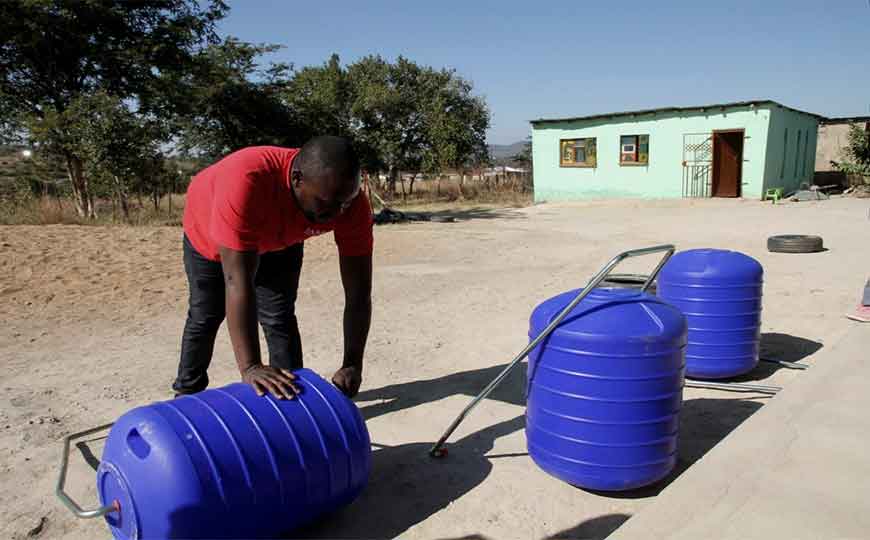
A GROUP of women and children are busy filling up dozens of 25 litre containers of water at a municipal borehole in Malanga, a village in the Collins Chabane local municipality in Limpopo.

“We have been here since very early today. We have to stand in a line to be first to fill up when they open the water at nine o’clock,” one of the agitated voices rises through the commotion.

Some of the women have brought their bales of laundry to wash right there by the borehole.

They have walked long distances from different parts of the village to reach the borehole.

Other reveal they have paid the driver of a bakkie which reverses to load some of the water containers R150 to transport the filled up sgubhus  back home.

Sometimes when the borehole runs dry, then they have to buy the water for as much as R2 for every 25 litre container, a huge ask in an area where jobs are scarce and locals depend on social grants for survival.

This is the daily struggle faced by many rural communities across SA who do not have access to running water in their yards.

While the women of Malanga were engaged in their daily struggle for water, unbeknown to them a battle of a different kind was going on between the SA Local Government Association (SALGA) and water supply authorities in parliament.

SALGA wants the Department of Water and Sanitation (DWS) to develop clear norms and standards to provide uniformity over tariffs across water boards.

SALGA this week rejected eight of the proposed water tariff increases by the country’s nine water supply authorities.

The stalemate has prompted a joint parliamentary portfolio committee on human settlements, water and sanitation and the portfolio committee and the portfolio committee on co-operative governance and traditional affairs to instruct SALGA and DWS to hold further engagements this coming week.

Scopa has further called for a full parliamentary inquiry to be conducted on DWS following presentations before the committees this week.

SALGA which only accepted the proposed 6.6% increase by Rand Water, has further recommended that the DWS expedite the processes it had initiated to set up an independent regulator for the sector.

“The absence of an independent regulator in the water sector remains a great concern. The ideal position of the regulator being that it will not be a directorate within the department but a standalone institution,” SALGA said in its presentation to parliament.

“SALGA strongly believes that the recurring issues it has been raising over the years will be resolved with the establishment of an independent regulator.”

The local government authority cited the fact that the quality and extent of information provided by the water boards differed, compromising the level of assessing the rationality of the tariff being proposed.

“Not all water boards demonstrate incorporation of capital expenditure into to their tariff proposals (non-cost reflective tariffs).None of the proposed tariffs were within the Consumer Price Index.”

At 12%, Magalies Water’s proposed hike was the highest followed Umgeni Water at 9.6%, Mhlathuze Water at 9.37% and Bloem Water at 9%.

The troubled Lepelle Northern Water asked for an 8.5% increase with Amatola following closely at 8.28%. SALGA also submitted that “the misalignment between the water boards and Eskom tariff submissions means that energy costs are subject to change based on what NERSA approves for Eskom.”

Last month, SALGA told parliament it was projecting a R14 billion revenue loss by municipalities resulting from the covid-19 lockdown which ensured local governments not operating at full capacity during that period.

“Lower collection rates will lead to a rise in bad debts provision, and thus a decline in municipalities’ operating balances over the next 1-2 fiscal years.”

SALGA said it advocates for a revision of tariffs water boards considering the further constraint in ability of municipalities to service their water accounts while guaranteeing the consistent supply of the service.  

Scopa was this morning briefed by the Office of the Auditor-General on the 2018/2019 audit outcomes of the department and its entities.

The joint meeting of the portfolio committee on human settlements, water and sanitation and the portfolio committee on cooperative governance and traditional affairs instructed the DWS and SALGA “to urgently meet to find a common ground on the proposed 2020/21 water tariff increase.”

“Furthermore, according to the committee, the proposed increases are concerning especially in the context of the reality of unaffordability by the majority of the clients of the municipalities and the ripple effect they will have on the current revenue collection system of the municipalities.”

The committees said while they acknowledged that bulk water tariff increases are required to ensure that water boards remain financially sustainable, they remained of the view that consideration should be holistic in nature and not only self-serving.

(Compiled by Inside Politics staff)

More articles

LEAVE A REPLY

Please enter your comment!
Please enter your name here

CATHSSETTA

spot_img

AVBOB STEP 12

spot_img

Inside Education E-Edition

spot_img

Inside Metros G20 COJ Edition

spot_img

JOZI MY JOZI

spot_img

QCTO

spot_img

Latest article



