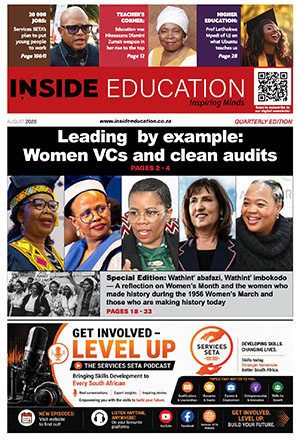
This Women’s Month, we should stop asking women to become more confident and start asking organisations why capable women must continually prove that they belong.
By Dr Siphiwe Wendy Mbatha
Every August, women are funnelled into breakfasts, panels and workshops and told the same thing: be more confident, more resilient, more courageous. Speak up. Network harder. Find a mentor. Claim your seat at the table. I’m tired of it. And I think it’s the wrong conversation entirely. The hidden message behind most Women’s Month programming is this: if women aren’t advancing, they must need fixing. I disagree.
Women do not need another month of coaching on how to survive organisations that were never designed for their leadership. Organisations need to examine how they distribute authority, opportunity, recognition and support, because that is where the real problem lives.
My doctoral research explored the lived experiences of African Black women leaders in corporate South Africa. These women were not waiting to be empowered. They were educated, experienced, and already sitting in leadership seats. Their problem was never ambition or confidence. It was that an appointment did not automatically bring legitimacy.
They could hold the title and still have their judgment second-guessed. They could carry the weight of business results without the authority or resources to deliver them. They could appear in the transformation report while remaining locked out of the informal networks where decisions actually get made. A seat at the table means nothing if your voice is questioned, interrupted or ignored once you’re in it.
One pattern from my research stood out sharply. Black women were expected to prove their competence again and again. Past success bought them nothing. Every new assignment became a fresh audition.
A single mistake didn’t just cost them; it became “evidence” that they never belonged in the role to begin with. Meanwhile, they were forced onto an impossible tightrope: confident but not intimidating, decisive but not controlling, warm but never weak. Behaviour praised as strong leadership in others gets relabeled as aggression or difficulty the moment a Black woman displays it.
No confidence workshop fixes an environment where authority is handed out freely to some and rationed conditionally to others. Women’s Month shouldn’t just prepare women for leadership. It should interrogate who organisations instinctively trust with power.
Mentorship is not sponsorship
Corporate South Africa has made real progress appointing Black women into leadership. That matters. But presence is not power.
A woman can be in the room but included too late to shape the decision. She can hold the executive title but sit outside the relationships that actually move the organisation. She can be held fully accountable for performance while being denied the freedom to make real decisions.
This is why mentorship isn’t enough. Mentors give advice. Sponsors give access. They put your name forward when the room is closed, and the stakes are real.
Too many capable women are over-mentored and under-sponsored, drowning in tips about “executive presence” while almost no one with actual institutional power opens a door for them. Sponsorship can’t be left to chance or personal chemistry with a senior leader. It has to be built into succession planning and leadership accountability, full stop.
We need to be far more careful about how we celebrate women’s resilience. Faith, determination and grit have carried many women through hostile leadership environments.
My research saw this clearly. But resilience becomes dangerous the moment organisations use it as a substitute for accountability. We cannot keep applauding women for surviving exclusion while doing nothing to dismantle what excludes them.
An organisation is not inclusive just because a handful of exceptional women succeeded despite its culture. Women shouldn’t need superhuman emotional endurance just to access the ordinary conditions of leadership: being trusted, heard, supported, and allowed to make mistakes without it becoming a referendum on their competence.
The goal isn’t building women tough enough to survive unhealthy organisations. It’s building organisations healthy enough that women’s energy goes into leading, not surviving.
Leadership is stewardship, and stewardship is everyone’s job. Rooted in Ubuntu, this means recognising that our humanity is bound together, and that advancing women isn’t a favour we extend to them. It’s a leadership responsibility we owe to the organisation. Every executive controlling appointments, budgets, assessments, and succession is a steward of opportunity, whether they act like it or not. So, this Women’s Month, let’s ask different questions.
Instead:
- Stop asking who needs more coaching. Ask who is repeatedly forced to prove their competence.
- Stop launching another mentorship programme. Ask who is actively sponsoring women into influential roles.
- Stop counting women in leadership. Examine how much real authority they hold.
- Stop praising resilience. Ask what broken practice is demanding so much of it.
This isn’t simply about fairness. Organisations are wasting leadership capability when they recruit, promote, and then fail to create conditions in which talented women can exercise authority effectively. They incur the cost of developing people and then lose them to cultures that make leadership unnecessarily difficult.