
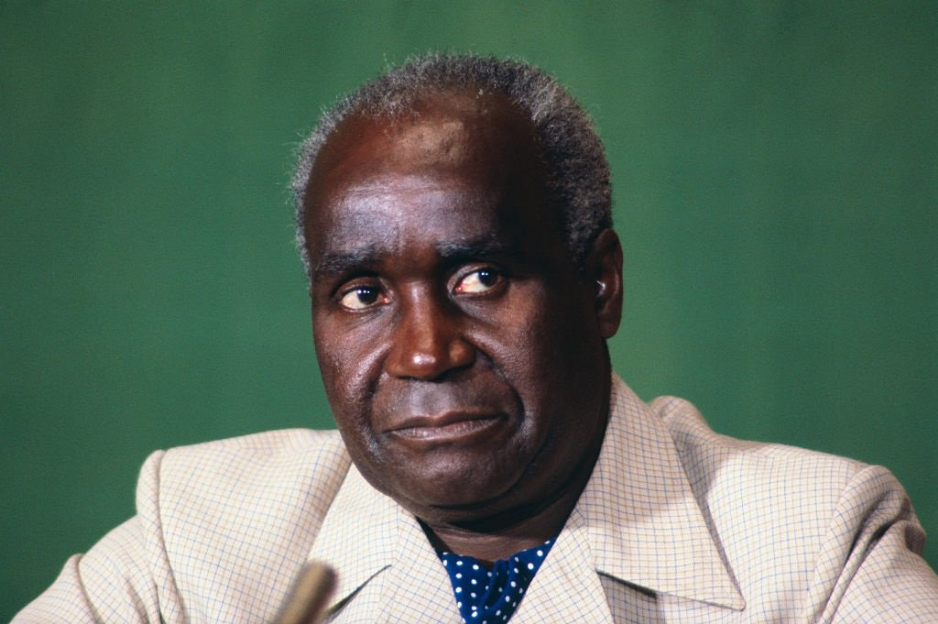
Zambia’s founding father and former president Kenneth Kaunda has died aged 97.
Kaunda was admitted to the Maina Soko Medical Centre on Monday.
Reports from Zambia say the 97-year-old statesman succumbed to pneumonia on Thursday.
He became the first president of independent Zambia, serving from 1964 to 1991.
His office released a terse statement on Monday, saying that he has been unwell and was admitted to Maina Soko Medical Centre, a military hospital in the capital Lusaka without giving further details.
Initially a popular leader, Kaunda became increasingly autocratic and banned all opposition parties.
He eventually ceded power in the first multi-party elections in 1991, losing to trade unionist Fredrick Chiluba.
While in power, he hosted many of the movements fighting for independence or black equality in other countries around the region, including South Africa’s African National Congress (ANC).
Also nicknamed “Africa’s Gandhi” for his non-violent, independence-related activism in the 1960s, he charmed mourners at Nelson Mandela’s burial in December 2013.
When organisers attempted to usher him away from the podium after he ran over his allotted time, he drew laughs by saying they were “trying to control an old man who fought the Boers”, or Afrikaners — the white descendants of South Africa’s first Dutch settlers.
Kaunda was imprisoned in the late 1950s for his troubles. Speaking to CNN in 2010, Kaunda said his imprisonment was rewarding. “I think I succeeded in the end but it meant going into prison defying unjust laws, being arrested by the police, beaten up, thrown into prison,” he said.
In the early 1960s, Kaunda joined active politics shortly after his release from prison, becoming the leader of the newly formed United National Independence Party (UNIP).
Following Zambia’s independence in 1964, Kaunda emerged as the country’s first president and kept his grip on power for 27 years under a one-party rule.
Kaunda was widely criticized and accused of championing a dictatorship regime over his preference for a one-party system. He told CNN his decision to uphold a single-party arrangement was justified and not borne out of a dictatorship.
“…I have never been a dictator. It (a one-party system) was a bargain with the people. But even then I knew it was not the best thing to do. But in that situation it was the only way out,” he explained, stating that Zambia’s liberation from colonialism could not have been achieved with a multi-party system.
“My colleagues and I decided we’re going to go into one party. The reason for that, there was no way, no way at all in which we could have fought and defeated colonialism all around us, with so many parties in Zambia at that time. No way at all,” Kaunda told CNN.
Kaunda was one of the first African leaders to hand over power peacefully in 1991 after popular protests forced him to allow multi-party elections, which he lost to Fredrick Chiluba.
He was a charismatic politician whose popular beginnings after Zambia’s independence gradually lost public support as his 27-year rule wound down.
He became a beloved African statesman in his post-presidency, dedicating much of his time to the fight against HIV/AIDS, after the disease claimed the life of one of his children. He was among the last living leaders of Africa’s independence struggle.
During his term, he supported Black majority rule in South Africa and present-day Zimbabwe and hosted anti-apartheid leaders in Zambia. His signature safari jacket paired with a formal trouser is still known as a Kaunda suit in many parts of Africa.
A 21-day period of national mourning has been declared, Simon Miti, Secretary to the Cabinet and Principal Private Secretary to the President, announced on state TV.
- Additional reporting by AFP/CNN





