By Johnathan Paoli
The Madlanga Commission of Inquiry has heard how police Sergeant Fannie Nkosi shared confidential internal tender documents and bidder information linked to a City of Tshwane security contract with a taxi boss identified as “Mr Mampane”, effectively undermining legal tender processes.
Appearing before the commission for the seventh day on Friday, Nkosi confirmed that on 30 April 2025 he forwarded a list of bidders and their quoted prices for the Tshwane Metro Police Department (TMPD) ad hoc security services tender to a contact he had saved as “Mampane Taxi Man”; but insisted he believed the information was no longer confidential.
“I believed the bidder list became public once bids were captured and logged,” he said.
The document, the commission heard, was not public but formed part of an internal pre-compliance evaluation report.
Nkosi, however, maintained his position despite being confronted with evidence that the document contained non-public evaluation notes and pricing details.
Evidence leader Advocate Matthew Chaskalson challenged this claim, stating the document originated from TMPD Deputy Chief Umashi Dlamini and was “a confidential internal draft, not a public bid-opening list”.
Nkosi conceded that he had acted as “an informal intermediary” in sharing the information, acknowledging that Mampane had himself bid on the same tender.
He further testified that he shared the document with Tshwane CFO Gareth Mnisi.
The commission scrutinised a WhatsApp response from Mampane following receipt of the document, which read: “Please let him say no to that appointment”.
Nkosi claimed he could not recall the meaning of the message, nor who it referred to.
“I can’t remember what this meant,” he said, adding that, to his knowledge, Mampane and Tshwane CFO Gareth Mnisi did not know each other.
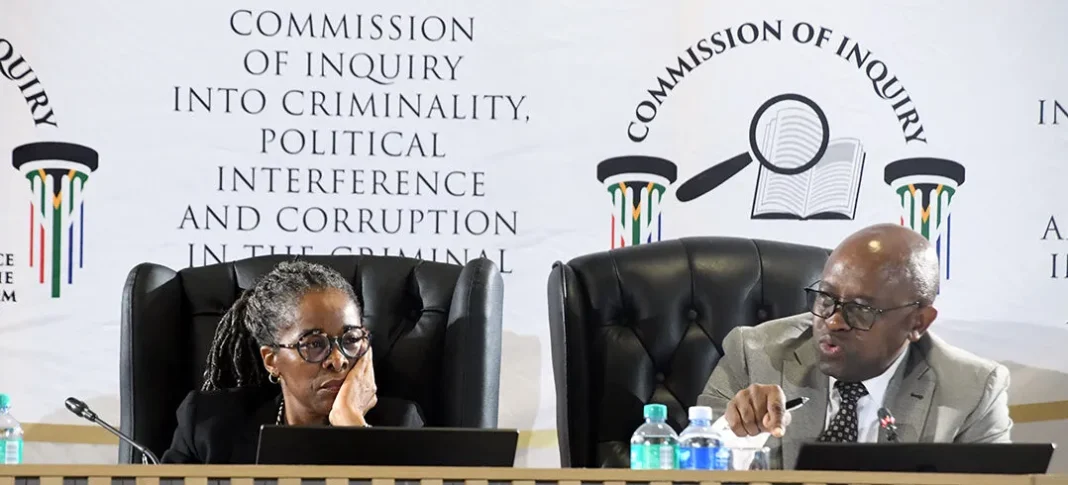
Commissioner Sesi Baloyi expressed visible frustration at Nkosi’s repeated inability to account for key details, particularly when confronted with contradictions in the timeline.
“You are not answering satisfactorily when facts are put to you that you are not disputing. And then you say, I cannot comment. I don’t know if you want to comment, if you want to say anything. If you do, feel free to do that. But I think you need to be reminded of your obligations as a witness,” she said.
Nkosi initially suggested that Mampane had indicated the tender was already cancelled at the time of their April 2025 exchange.
However, the commission established that the tender was only cancelled in October 2025.
Pressed on this discrepancy, Nkosi eventually conceded the error.
“If the tender was cancelled in October, then he could not have known that in April,” Baloyi said.
She warned Nkosi about his obligation to provide truthful and helpful testimony.
The commission further heard that the internal adjudication document shared between Nkosi and Mampane effectively revealed which companies were likely to succeed in the tender process.
This, according to evidence before the commission, would have alerted unsuccessful bidders, including those linked to Nkosi and Mampane, that they were unlikely to secure the contract.
It was put to Nkosi that this may have created a motive to pressure officials to cancel the tender altogether, thereby allowing existing service providers to continue operating under the current panel.
Nkosi did not engage with this proposition, stating he did not know whether Mampane had bid or stood to benefit, and declined to comment on whether Mampane had an interest in preventing new appointments.
Baloyi rebuked Nkosi’s evasiveness during questioning, noting a pattern of “I don’t remember” responses when confronted with critical evidence.
The commission also established that Nkosi had prior knowledge of developments around the tender’s cancellation and had discussed the matter with Mampane, who he described as being involved in the taxi industry.
Despite this, Nkosi denied any coordinated effort to influence the outcome of the procurement process.
In a further concession, Nkosi admitted to forwarding the internal tender report first to Mnisi and then to Mampane, though he continued to characterise his actions as benign.
“It was an innocent thing to do,” he said.
However, Chaskalson suggested that the sequence of communications, combined with Mampane’s response, pointed to a deliberate attempt to influence or halt the tender process in favour of incumbent service providers.
INSIDE POLITICS