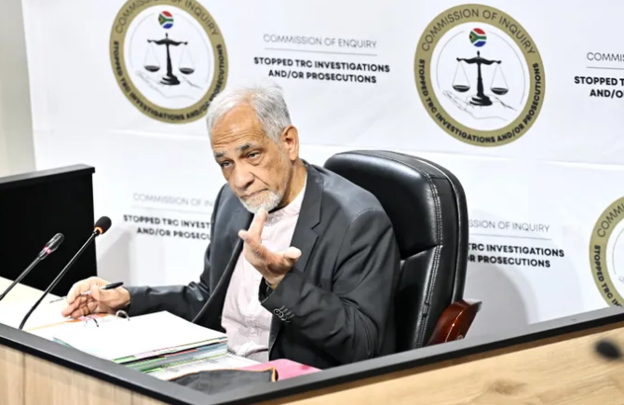
By Simon Nare
Former justice and constitutional development minister Mohamed Enver Surty has denied any political interference in, or suppression of, investigations and prosecutions arising from the Truth and Reconciliation Commission (TRC) during his seven-month tenure between 2008 and 2009.
Testifying before the inquiry into the handling of TRC cases on Thursday, Surty said he had always upheld the principle that decisions to prosecute rested exclusively with the National Director of Public Prosecutions.
Appearing before the commission chaired by retired Constitutional Court Justice Sisi Khampepe, Surty said the National Prosecuting Authority (NPA) was never pressured by him to pursue or halt high-profile matters.
“I state categorically that during my brief tenure as minister, I neither interfered with, influenced, or suppressed any investigation or prosecution, including investigations or prosecutions relating to the TRC matters,” he said.
Surty said he never held discussions with the NPA leadership about TRC cases and was never asked to intervene in them.
Instead, he testified, he insisted that investigations continue after then acting National Director of Public Prosecutions Advocate Mokotedi Mpshe submitted a memorandum suggesting that TRC investigations be suspended while Advocate Vusi Pikoli’s fitness to hold office was being investigated.
Former president Thabo Mbeki had established the Ginwala Inquiry, chaired by former National Assembly speaker Dr Frene Ginwala, to determine whether Pikoli was fit to remain in office after his relationship with then justice minister Brigitte Mabandla deteriorated.
Surty said he “emphatically” rejected the proposal to halt the investigations.
He said he viewed the memorandum as a suggestion rather than a directive and believed there was no justification for suspending investigations because police could continue investigating cases involving individuals who had not received TRC amnesty.
After reviewing both the memorandum and the Ginwala report, Surty said he found nothing linking the inquiry into Pikoli’s fitness to the TRC investigations.
“There was nothing, no reflection in the report that I had read, and it’s a long time ago, which suggested that work had to be suspended or stayed at the time. So, I have no knowledge of that being a directive or a consequence of the Ginwala report being initiated.
“So, there’s nothing that would prevent investigations, and I think that probably is the reason why I was emphatic to say investigations must continue,” he told the commission.
Surty acknowledged that the NPA struggled between 2003 and 2010 to secure investigators for TRC matters but said he only became aware of the problem after joining the justice department, having previously served as deputy minister of education.
He declined to comment on the NPA’s 2008/09 annual report, which stated that prosecutions in TRC matters would be delayed pending an appeal after the prosecution guidelines were declared unconstitutional.
However, he said his personal view was that prosecutions should have continued because the outcome of the appeal was uncertain.
“I was not the author of the decision to appeal regarding the matter and I had insufficient knowledge regarding the content of the matter in respect of policy or guidelines to be able to make a decision,” he said.
The Pretoria High Court had ruled that the NPA’s amended guidelines for prosecuting TRC cases were unlawful and unconstitutional because they effectively created a new amnesty process without legislative authority or public participation.
The subsequent appeal and legal proceedings reportedly delayed the processing of TRC-related prosecutions for several years.
INSIDE POLITICS