



By Johnathan Paoli
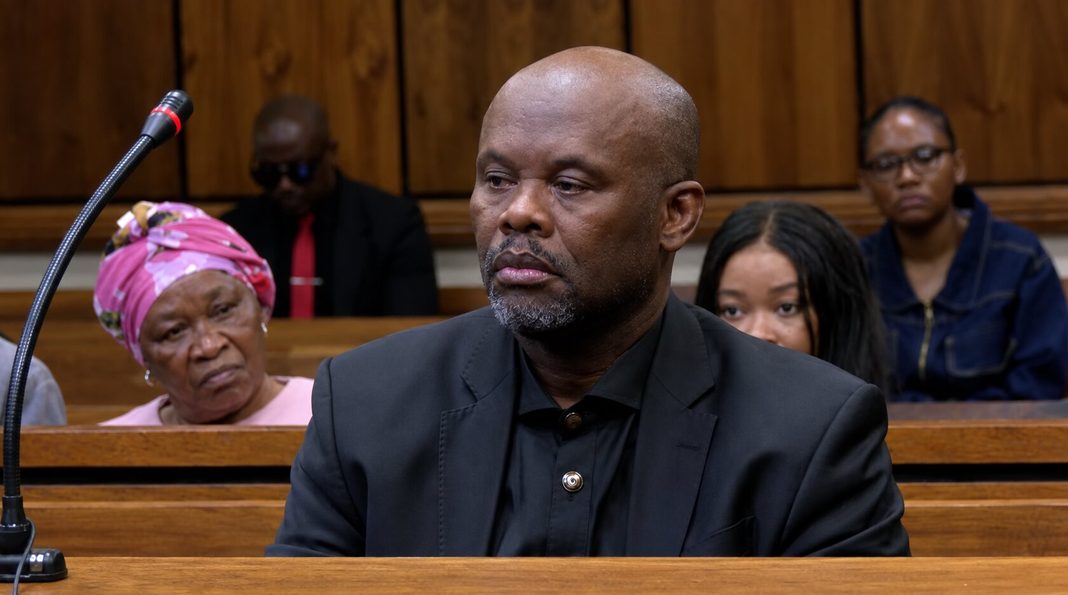
Suspended deputy national police commissioner Lieutenant-General Shadrack Sibiya will spend another weekend behind bars after his bail application was postponed to Wednesday, with the court ordering proper translations of audio recordings the State says point to attempts to interfere with witnesses.
Appearing at the Randburg Magistrates’ Court on Friday, recordings became a central feature of the proceedings, but the court struggled to follow the translated versions as they were played.
Magistrate Hleziphi Mkhasibe ordered that the recordings be properly transcribed by speakers of the relevant languages.
The State said the recordings supported its case that witnesses could be intimidated or influenced if Sibiya were released on bail.
One recording allegedly captured Sibiya speaking to Mr M, whom he described as someone he had financially supported and regarded as a younger brother.
“You said lots of wrong things about me while I was still being with you. I never discussed those things with you. I heard so many things that you said about me, but I didn’t even discuss them with you. And it’s easy to deal with you,” Sibiya allegedly said in the clip.
Defence advocate Amanda Nel challenged the State’s case that Sibiya could interfere with witnesses if released on bail, arguing that much of the evidence relied upon by the investigating officer was based on inference rather than direct evidence.
Another recording allegedly involved a person telling Mr M that a police officer had approached them and wanted a meeting to discuss money and the possibility of having the case withdrawn.
The State conceded that the recording did not directly implicate Sibiya but argued that it was relevant to the broader issue of witness interference.
Nel asked that the audio evidence be set aside until proper transcripts were available.
She said the defence could not properly deal with the recordings without an independent translation.
“This is new evidence that we have to consider, so I think let us park that issue for now until the state provides us with both the clips,” she said.
Earlier, Nel challenged the State’s characterisation of the three young women involved in the allegations against Sibiya.
She questioned the investigating officer, Madlanga Commission Recommendations Task Team Sergeant Nokukhanya Ndlovu, over the State’s description of the 18-year-old complainant as a vulnerable teenager.
The exchange centred on the fact that the complainant was legally an adult.
The defence argued that the distinction was relevant to its challenge to the human trafficking allegations.
Sibiya faces six charges, including human trafficking, rape, sexual grooming and a firearm-related charge.
The State alleges that Sibiya exercised control over the young women and that the circumstances surrounding their movements and interactions with him form part of its human trafficking case.
Nel disputed this, arguing that the evidence did not demonstrate the type of coercion or control required to sustain the allegation.
She also challenged the State’s reliance on Sibiya allegedly telling the young women not to take photographs of him.
Ndlovu maintained that such instructions amounted to “strict control”, while Nel questioned how an instruction not to photograph someone could constitute human trafficking.
The defence also challenged the allegations involving the 16-year-old girl.
The State alleges that Sibiya possessed and distributed explicit photographs and videos involving the teenager.
Nel questioned Ndlovu about how the material came into Sibiya’s possession and why the teenager had taken explicit photographs of herself in the first place.
“Did you ever ask why a 16-year-old had naked pictures of herself and of her genitalia?” she asked.
Ndlovu said a social worker was better placed to address the sensitive circumstances.
Nel also asked whether there was any evidence that Sibiya had instructed the teenager to make the photographs or videos.
Ndlovu said the messages preceding the exchange could not simply be ignored.
The defence maintains that the teenager took the photographs herself and that Sibiya’s version is that some of the material was sent to him by her father.
Nel also challenged Ndlovu’s description of Sibiya’s arrest at The Grand in Rivonia.
She argued that The Grand also has a restaurant and hotel and that Sibiya had been eating at the restaurant with other men when police arrested him.
Ndlovu rejected this.
“He was not at the hotel side. He was not at the restaurant side. He was at the strip club,” she told the court.
Nel maintained that Mr M was never employed by Sibiya, while Ndlovu said he provided protection services and was paid R10,000 a day.
The defence has argued that Mr M was instead the central figure in the alleged exploitation of the young women.
Nel also renewed the defence’s complaint about Sibiya’s detention in solitary confinement at the C-Max facility at Kgosi Mampuru II Correctional Centre.
She said the conditions were hampering consultations with her client and argued that there was no justification for keeping him in conditions normally associated with dangerous or high-risk prisoners.
The State said Sibiya was being held there for security reasons and that the conditions were “proper for any human being”.
Mkhasibe ruled that Sibiya would remain at C-Max but said arrangements should be made to ensure his legal team could consult with him.
The court postponed the bail application until Wednesday, when cross-examination is expected to continue and the properly transcribed recordings are expected to be dealt with.
INSIDE POLITICS






