



By Simon Nare
Former president Thabo Mbeki has said that South Africa faces growing political uncertainty, predicting an increase in hung municipalities as voters grapple with unanswered questions about what has gone wrong in the country.
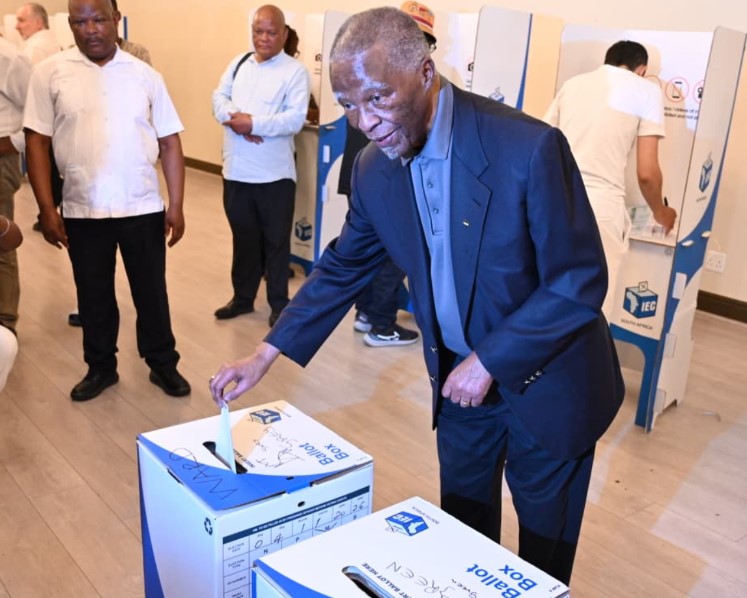
Speaking to reporters after casting his local government election vote at Killarney Country Club in Johannesburg on Wednesday, Mbeki said he agreed with opinion polls predicting that many municipalities would be left without outright majorities following the elections.
“Things have gone wrong. The population is also saying that. That’s why you find a lot of fragmentation in terms of voting and a lot of parties. But the story of what went wrong is a long one to tell, but clearly things have gone, and as a result of which I think what we are going to see is what the polls are predicting.
“I think they are correct, that we are going to see a lot of hung municipalities because of this uncertainty about where the country should go and where the municipalities should go…” Mbeki said.
READ: The disruptors: Zille and Zuma shake up the battle for metros
He said fundamental questions about the country’s direction needed to be addressed before decisions could be made about allocating budgets and tackling service delivery challenges.
Mbeki said that answering these questions was essential to addressing unemployment, poverty and inequality, regardless of whether the country was holding national, provincial or local government elections.
“It is clear that something went wrong in the country as a result that many of the problems that our people want solved, problems of poverty, problems of unemployment and problems of inequality, none of them were not solved, and the situation is getting worse.
“It’s very very important to answer that question, what went wrong and what needs to be done in order to get this country right. I think the country needs to answer that question honestly. Look at it honestly and answer it honestly so that we have a better sense of direction as to where we should go,” he said.
Mbeki voted at the same polling station where former president Kgalema Motlanthe cast his ballot earlier in the day.
READ: Motlanthe says poor service delivery will persist unless local government is strengthened
Both former presidents are residents of the politically contested City of Johannesburg, which has a population of 4,803,262 and where 270 municipal council seats are being contested.
The metro has an overall budget of R97.1 billion, including a capital budget of R8.8 billion. However, Johannesburg has experienced significant political instability in recent years, largely driven by fragile coalition arrangements and repeated changes in political leadership.
The city entered the 2021–2026 council term without any party securing an outright majority. The Democratic Alliance (DA) initially formed an administration under Mpho Phalatse, with support from several smaller parties, before successive changes in political leadership brought ANC-backed administrations into office.
READ: Joburg signed multibillion-rand salary deal just hours before local elections
Executive mayor Dada Morero took office in August 2024, leading an ANC-centred coalition arrangement that has drawn support from parties including ActionSA, the Economic Freedom Fighters (EFF), Patriotic Alliance (PA), Inkatha Freedom Party (IFP), African Independent Congress (AIC) and Al Jama-ah.
Johannesburg’s reported combined infrastructure requirements exceed R220 billion, while non-revenue water accounts for approximately 44.7% of its water supply.
City Power’s electricity distribution losses stand at approximately 27%, while the municipality’s revenue collection rate has declined from 88.6% to about 86%.
INSIDE POLITICS






