



By Johnathan Paoli
The Electoral Commission of South Africa (IEC) says it has overcome significant logistical challenges ahead of Wednesday’s local government elections, including the reprinting of millions of ballot papers following a Constitutional Court judgment, as it prepares to receive 29.2 million registered voters.
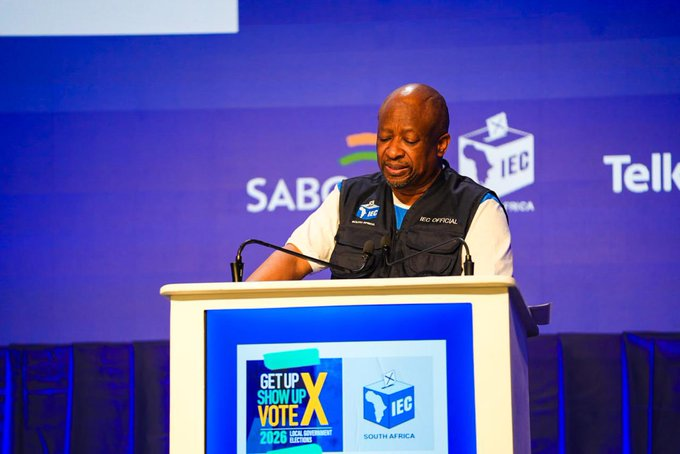
IEC chairperson Mosotho Moepya said on Tuesday evening that the commission had successfully concluded two days of special voting, during which 1,425,942 voters cast their ballots.
He assured voters that all necessary election materials had been distributed and that the commission was ready for Election Day.
“We have had our battles. We’ve seen our worst days and as you are aware, yesterday was bad for us in the city of Cape Town. I must say for the record, it is that city that has borne the brunt of it ultimately,” Moepya said.
Addressing concerns over the last-minute reprinting of ballot papers for approximately 121 municipalities affected by the Constitutional Court judgment, Moepya acknowledged that the exercise had presented enormous logistical challenges but defended the commission’s handling of the process.
“The challenge we dealt with in the reprinting of ballot papers was indeed enormous. There is no hiding that issue. But there was no point in the Electoral Commission raising the fear that it was not in control, it was sleeping on the steering wheel, and it was not managing a difficult process,” he said.
Moepya said the reprinting of 33 million ballot papers had been an exceptionally difficult exercise, requiring the support of printers, paper suppliers, service providers and members of the public.
“To say that it is just the Electoral Commission of South Africa and its management team and staff that pulled it off would be an understatement. There are many South Africans who have come to the party on this,” he said.
He said the exercise was necessary to ensure that the elections remained free, fair and credible.
Moepya dismissed suggestions that the reprinting exercise would necessarily cause further problems on Wednesday, saying the commission had done everything within its power to prepare for voting.
“Are we going to battle to do this tomorrow? No. We have had our battles. We’ve seen our worst days,” he said.
Responding to questions about whether ballot papers had reached voting stations, Moepya said all required materials had been secured. He added that the commission had verified that special voting stations had received the correct ballots, with all participating parties and candidates appearing on them.
“The challenge is to get to the voting stations tomorrow on time and to make sure that all is well,” he said.
The briefing followed reports of logistical difficulties in Cape Town during special voting, as well as allegations of misconduct involving IEC officials in KwaZulu-Natal and Botshabelo.
Moepya said officials found to have deliberately acted contrary to their responsibilities would be removed.
“When a member of staff that we employ and we train and they do the opposite of that which they are meant to do, possibly intentionally, there is no room for them to be with us. And that we do without fear, without favour, and without prejudice,” he said.
He acknowledged that mistakes could occur, as the commission employed people rather than robots, but urged voters to report problems instead of interfering with electoral officials.
The IEC said 1,425,942 special votes had been recorded between November 2 and 3, comprising 974,852 votes cast at voting stations and 451,090 through home visits.
Gauteng recorded the highest number of special votes at 264,898, followed by KwaZulu-Natal with 208,846 and the Eastern Cape with 207,258.
The figures were preliminary and were expected to be finalised on Tuesday night. Special ballots will be counted together with ordinary ballots after voting stations close.
The commission said approximately 188,000 trained electoral officials had been deployed across 23,696 voting stations.
Voting will take place between 07:00 and 21:00 on Wednesday.
Moepya also addressed concerns that dissatisfaction with municipal service delivery, including persistent water shortages and power outages, could discourage voter participation.
He said elections provided citizens with an opportunity to express their grievances through the ballot, but warned against protests that prevented others from exercising their democratic rights.
“What would be unlawful tomorrow is when anyone that is doing that inhibits or stops people from exercising their right to vote,” he said.
The IEC reminded political parties and independent candidates that campaigning must end at midnight on Tuesday.
Voters must cast their ballots at the voting stations where they are registered and present a valid identity document, including a smart ID card, green barcoded ID book or temporary identity certificate.
The Department of Home Affairs will remain open nationwide throughout Wednesday to assist people who have lost or misplaced their identity documents.
The commission appealed for tolerance and peaceful participation, saying every eligible voter should be afforded the opportunity to participate in free, fair and credible elections.
INSIDE POLITICS






