

By Lebone Rodah Mosima
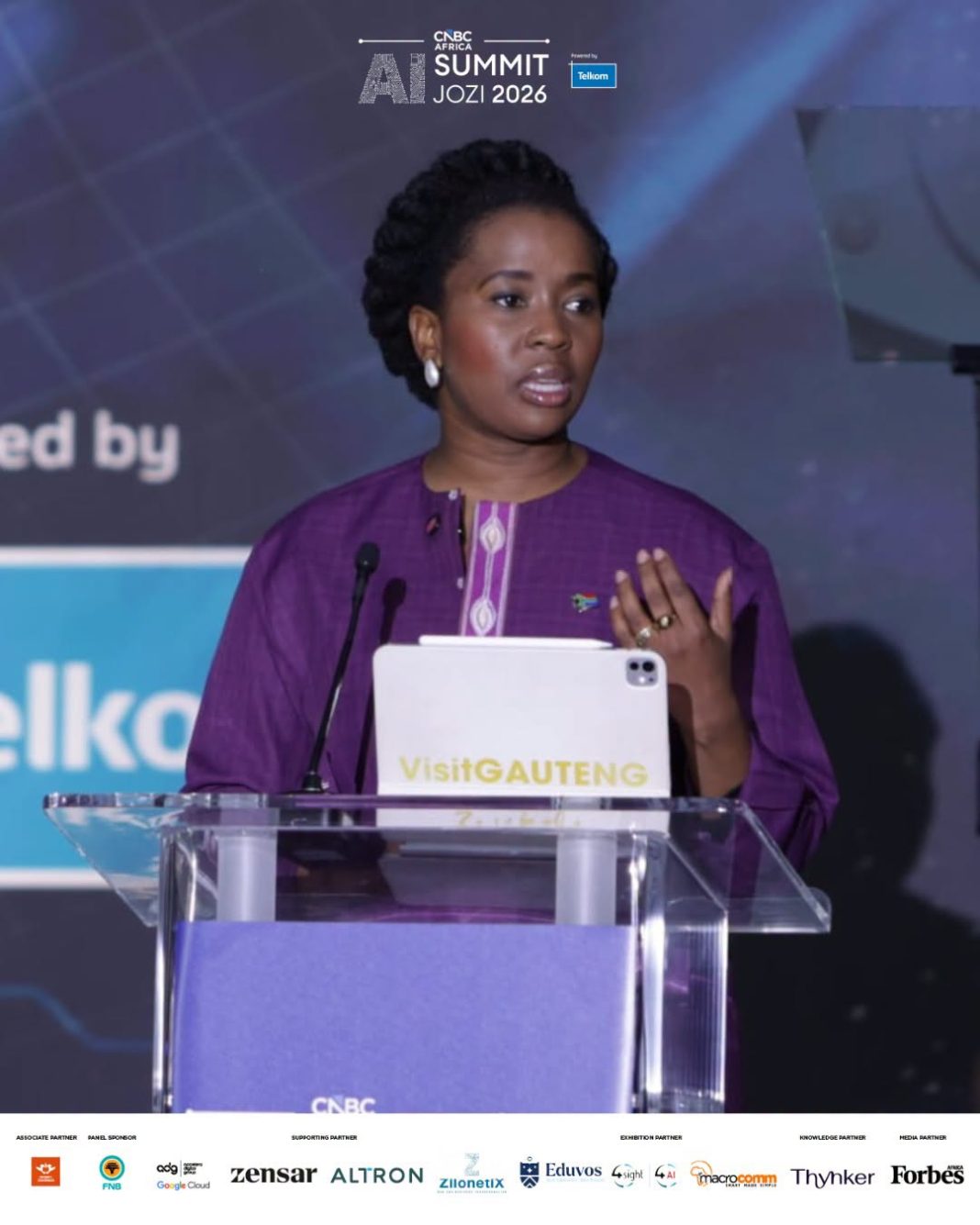
Africa risks becoming little more than a consumer of artificial intelligence unless it develops its own technology, intellectual property and productive capacity, MEC Vuyiswa Ramokgopa said on Thursday.
Ramokgopa, the Gauteng MEC for Economic Development, Agriculture and Rural Development, told the CNBC Africa AI Summit that the continent could not afford to provide markets, consumers, data and labour while the highest-value elements of the technology were developed and owned elsewhere.

She also referred to comments attributed to Bill Gates that AI could be “the greatest equaliser ever invented, or the worst source of injustice”.
“Artificial intelligence is no longer a future technology waiting to arrive. It is already changing how businesses make decisions, how products are designed and manufactured, how financial services manage risk, how logistics systems operate and how agriculture and healthcare respond to increasingly complex information,” she said.
Ramokgopa said the question was no longer whether AI would transform economies, but what kind of AI economy Africa would build, who would participate in it and whether the continent would have the productive capacity to shape it rather than simply consume technologies developed elsewhere.
She said Gauteng’s approach rested on three arguments: building the capabilities needed to participate in the AI economy; using AI to strengthen sectors in which the province already had an advantage; and ensuring its benefits were more widely shared.
“Our greatest immediate opportunity is to use AI to make the sectors in which Gauteng already has strength more productive, innovative and globally competitive,” she said.
“Our AI economy must be inclusive by design, expanding opportunities for enterprises, workers and young people rather than concentrating its benefits among a narrow group of firms and highly skilled individuals.”
ALSO READ: Dlamini-Zuma stands by vote-buying claims against Mbalula in ANC leadership contests
She said UN Trade and Development estimated that the global AI market could reach $4.8 trillion by 2033, while the computing power, data infrastructure, research capacity, intellectual property and investment underpinning it remained highly concentrated.
For Africa, she said, this presented an opportunity and a warning.
Not every African country or province needed to build a frontier AI model, she said, but economies needed to identify where they could develop capabilities, specialised applications, intellectual property and companies able to tackle local productive challenges.
Gauteng, she said, was well positioned to do so.
“That is why AI should not be treated as a niche within the technology sector,” she said.
“It is increasingly a capability that will shape the competitiveness of the entire economy.”
Ramokgopa said an AI economy required more than algorithms. She said there was the need for digital infrastructure, connectivity, data, computing capacity, reliable energy, investment, research institutions, skills and an enabling institutional environment.
Gauteng was aiming to move towards annual economic growth of at least 3% while rebuilding productive capacity needed for sustainable employment.
“AI cannot compensate for weak infrastructure or inadequate investment,” she said.
“It cannot substitute for capable institutions. But where these foundations are strengthened, AI can become a powerful multiplier of productivity.”
She said government had a responsibility to create conditions in which businesses could invest, researchers could innovate, entrepreneurs could scale and workers could develop skills demanded by a changing economy.
While South Africa continued developing its national AI policy framework, Ramokgopa said provinces did not need to wait for every policy issue to be resolved.
“We can develop partnerships, support innovation, build skills, attract investment and create practical applications now,” she said.
“Our second argument is that the AI economy cannot be separated from the economy we already have.”
Gauteng’s strategy, she said, was not to pursue technology for its own sake, but to modernise productive sectors it already had while developing industries capable of becoming new engines of growth.
For every priority sector, she said, the province should ask whether AI could improve productivity, competitiveness and growth, help companies export, reduce production costs, improve quality, help SMMEs access markets or strengthen value chains.
“Technological progress does not automatically produce inclusive economic progress,” she said.
“We must therefore ask what it means if Gauteng becomes an AI hub but young people do not have the skills to participate in the economy being created.”
Ramokgopa also questioned what it would mean if large corporations adopted AI while smaller businesses could not afford or access the technology, or if township entrepreneurs remained consumers rather than becoming developers, suppliers and innovators.
“That is not the outcome we want,” she said.
“Our economic priorities are clear: attract investment, create sustainable jobs and strengthen good governance. AI must advance all three.”
She said skills development could therefore not be designed around yesterday’s economy.
Ramokgopa said Gauteng secured approximately R206 billion in investment commitments at the 2026 Gauteng Investment Conference, supported by more than 90 bankable projects, and had mobilised more than R518 billion in investment over the past two years.
“But the real measure of success is implementation,” she said.
Investment created value when factories were built, equipment installed, technology deployed, companies began operating and people were employed, she said.
The summit also featured discussions on autonomous AI agents and automation, the future of African enterprise and the cybersecurity risks emerging alongside rapid advances in AI.
IBM Research Africa research scientist and manager Ndivhuwo Makondo said AI agents were currently widely used in code generation but were beginning to move into other business applications.
“We’re also starting to see AI agents moving into other domains that are more applicable for business,” he said.
“These are some of the works that we’re doing now to have data agents. These are agents that allow you to connect data sources and you can go through the data management process through an AI assistant that helps you to reduce time from data to insights.”
Makondo said the technology could be particularly useful for smaller organisations without extensive data expertise.
“But there’s still a lot of bottleneck on actually preparing your data and having it ready for analysis,” he added.
Nedbank Divisional Executive of Hyper Automation Group Technology Portia Matsena said most organisations could adopt Agentic AI, including in entry-level functions.
Agentic AI are systems capable of independently carrying out a series of tasks and making decisions to achieve a defined goal, rather than simply responding to individual prompts.
ALSO READ: Former Nkandla architect Minenhle Makhanya ordered to pay R147.2m over unlawful conduct
“I looked into what type of entry jobs can be automated. From our side, what we looked at is entry jobs such as your tellers when you go into the branch,” Matsena said.
“We introduced it, and it has helped those entry jobs start selling, increasing our sales from 5% to 13%, but that is excluding home loans and cars. It helps when you’re doing a lot of administration.”
Matsena said she believed about 90% of organisations could deploy Agentic AI while re-skilling employees to perform higher-value work.
Absa Group CEO Kenny Fihla said AI was already changing financial services, including client onboarding, query resolution and software development.
“Most of the codes now that our IT team develop and launch are effectively done by AI,” he said.
Fihla cautioned, however, that organisations faced a proliferation of AI tools and needed to select technology suited to specific problems.
“Without this, organisations risk losing revenue and missing out on potential benefits,” he said.
PwC CEO Dion Shango said AI was challenging the traditional professional-services business model, which had long relied heavily on billing clients for time.
“Many of our clients have already told us that they do so much more themselves, leveraging and using AI, that it gives them the power to do a lot more than what they used to need us for in the past,” he said.
Shango said professional firms would have to reconsider their future role and value proposition as AI assumed more routine work.
“It’s essential we upskill and reskill our people to reinvent our value proposition,” he said.
He also raised questions about how future professionals would be trained if technology increasingly performed work previously given to trainees and junior staff.
“These are the questions about: how do we maintain and even enhance our relevance in a world that’s much more impacted by technology?” he said.
ADG Group Chief Innovation Officer Cliff De Witt said regulation would be critical as organisations deployed AI, although regulators faced the challenge of keeping pace with rapid technological developments.
“Regulation is vital as it sets responsible guardrails for AI’s proper use, protecting privacy and defining access,” he said.
De Witt said AI could itself be deployed in cyberattacks, impersonation and identity theft, meaning defenders would also increasingly have to use the technology.
“To defend properly, we must also use AI offensively,” he said.
He said AI could continuously analyse large quantities of information and detect suspicious patterns across areas such as banking transactions and network traffic.
“AI can reason over large data sets 24/7 and trigger alerts to humans,” he said.