




By Lebone Rodah Mosima
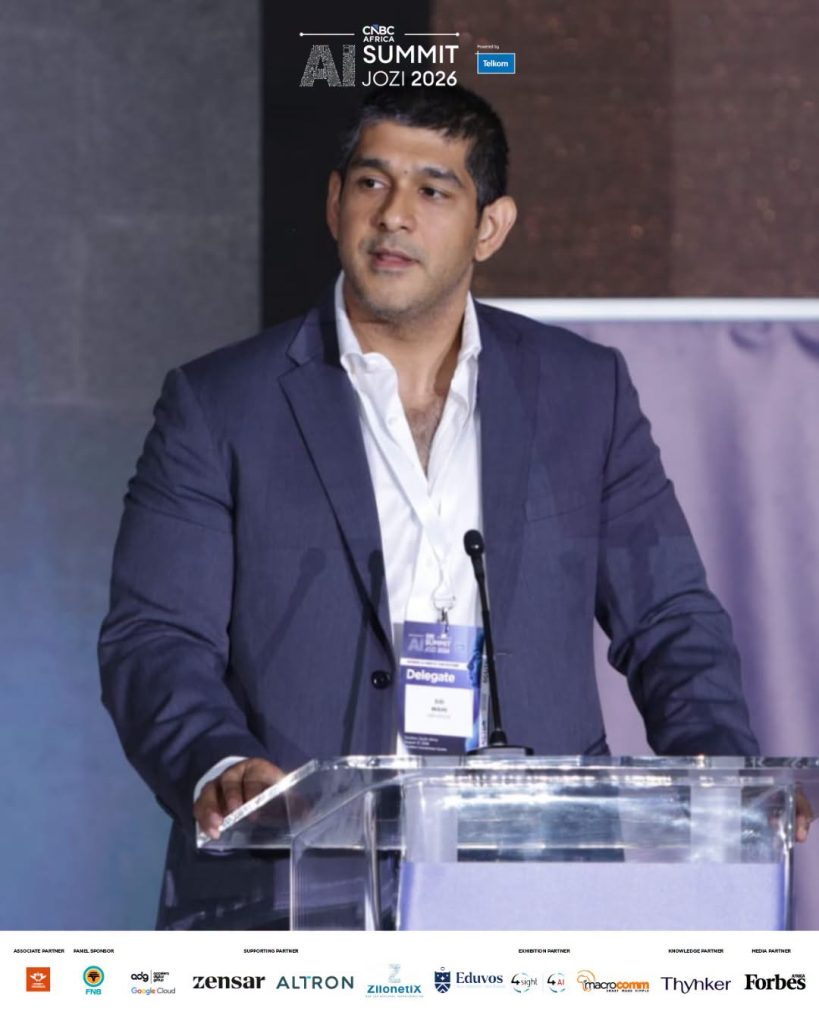
Sid Wahi, Vice-chairman of CNBC Africa, said on Thursday that the cost of AI inference for near-frontier-level intelligence has fallen dramatically, while the most advanced intelligence is becoming more expensive.
Speaking at the CNBC Africa AI Summit at the Sandton Convention Centre in Johannesburg, Wahi said cheaper tokens did not necessarily translate into lower overall costs as aggregate AI usage continued to grow.
He said AI was moving towards a future in which humans would manage fleets of agents, with an orchestrator overseeing one or more agents that could themselves manage hundreds of sub-agents to achieve a specific outcome.
“In order for an agent to be useful to enterprises, you need a number of things, but most importantly, I think you need two things. You need a context window big enough to process tokens, and you need cheap inference,” Wahi said.
“The more complicated a task is, the more tokens get utilised, and thus requiring a larger context window.”
Wahi said China viewed AI as part of a national industrial strategy, while the United States had traditionally relied more heavily on private-sector leadership.
He said China’s ambition was not simply to develop better AI models, but to embed AI across manufacturing, commerce, surveillance, biotechnology and robotics.
“Chinese firms are less obsessed with artificial general intelligence and more focused with deploying cheaper models into real-world systems, partly because they have less access to frontier chips and capital,” he said.
“China is trying to compensate for its shrinking workforce through automation and humanoid robots.”
Wahi also highlighted the growing capital requirements of the AI industry, describing demand for AI infrastructure as driving “astronomically eye-watering” levels of capital expenditure.
He said hyperscalers were investing billions of dollars in data centre expansion and that the trend was expected to continue.
“This has largely been financed by debt, and we saw more borrowing in the first seven months of 2026 than all of last year,” he said.
“We’ve also seen Google announce for the first time in their history a negative free cash flow number as a result of their capex.”
Computing power, electricity, cooling, bandwidth and inference budgets were all emerging as constraints, he said.
Wahi said lower-return work would increasingly be handled by smaller models or cheaper workflows, while frontier intelligence would be reserved for complex problems where its capabilities justified the cost.
“So adoption is becoming less about what frontier models can do in principle, but more about the price and scarcity of the inputs required to make AI operational at scale,” he said.
“Enterprises will thus ration scarce capacity towards area where the marginal productivity of AI justifies the marginal cost of using it.”
He said the most durable productivity gains were likely to come from using AI to complement human labour rather than replacing workers outright.
Wahi said humans would increasingly be responsible for allocating intelligence by deciding which tasks to delegate to AI and which required frontier-level intelligence or lower-cost inference.
“We need to find a balance. If we outsource too much thinking, writing, remembering, and problem solving to AI, we may become extraordinarily productive, but we are slowly weakening the very skills required to judge whether the output is any good,” he said.
“So the danger isn’t that AI becomes smarter, but the danger is that we become less practiced at thinking without it.”
He said AI was highly effective in predictable situations but could become dangerous when organisations allowed systems to make final decisions in circumstances requiring additional context, exceptions and “just good old-fashioned common sense”.
The goal, he said, should be to amplify human judgement rather than automate it away.
Referring to Thinker, a strategic AI consulting company he founded last year, Wahi said: “It isn’t designed to remove humans from the loop, but it’s designed to remove the repetitive work around the human loop.”
“Let the machine do what is repeatable, and let the person do what requires judgement,” he said.
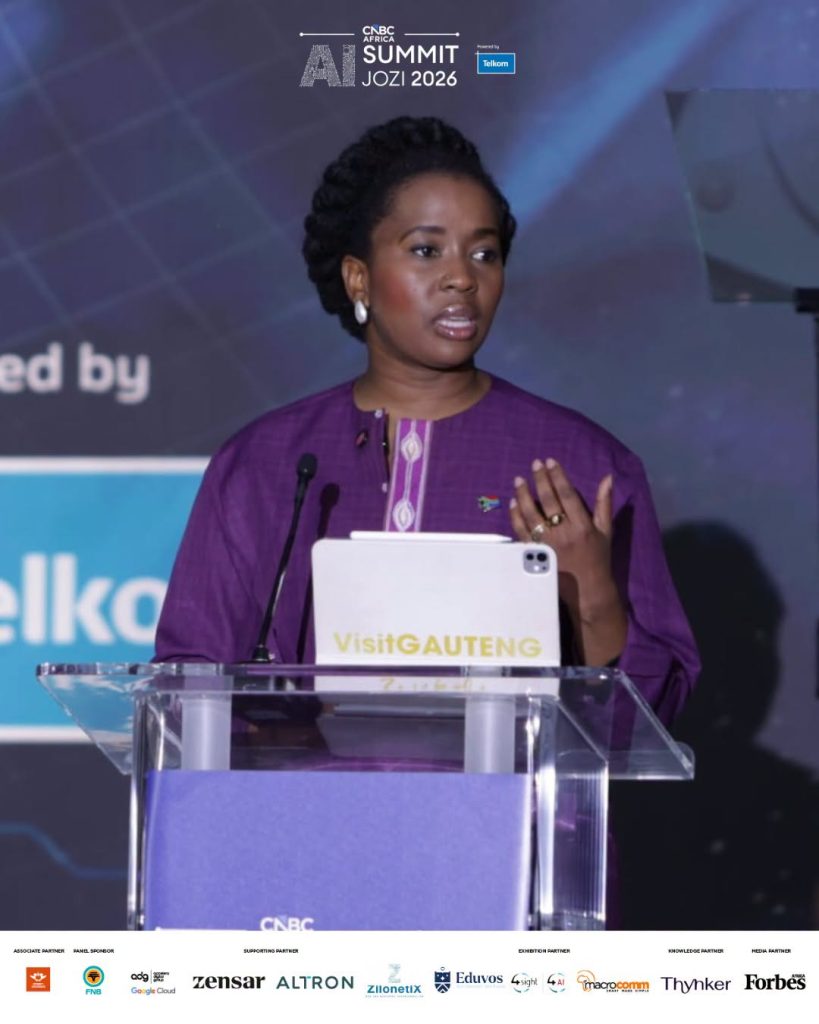
Meanwhile, Telkom SA Group Executive for Innovation and Transformation Mmaki Jantjies said the markers of an innovative nation moving beyond being an AI consumer included domestic research capacity, sovereign digital infrastructure, local data ownership and deliberate investment in homegrown solutions.
Jantjies said, according to the South African National Advisory Council on Innovation, gross domestic expenditure on research and development stood at about 0.6% of GDP and was declining.
“Pure emerging and global economies invest between 2% and 4%, with the OECD average sitting at around 2.7%, and leading innovative economies around the world investing up to 5%,” Jantjies said.
“While global peers aggressively capitalise their innovation pipelines, our domestic investment specific to R&D moving us from being consumers to dictating the terms and being creators, has seen a decline with private sector contribution lagging behind public sector spend on R&D.”
She said AI was often described as the next technological revolution, but argued that for Africa the more important question was whether it could become a major economic opportunity.
Access to AI alone would not make South Africa more competitive, she said. The country needed to determine what had to be built to turn AI capabilities into meaningful economic and social value.
“As a consumer we actively internally applying AI through platforms such as Bafo and voice-of-the-customer engines to improve operations, understand our customers, and turn data into intelligent decisions,” she said.
“As a contributor, we believe in the future of South Africa. We’re investing in the broader ecosystem through digital skills, our recently announced investment in our AI institute, and enterprise programmes because a competitive AI economy cannot be built by large corporations alone.”
Jantjies said Telkom also believed Africa should not remain merely a consumer of foreign algorithms, but should develop technologies and solutions tailored to South African languages and local needs.
“That is why we continue to invest in language translation technologies. We must build technologies for our industries, our infrastructure, and our communities, and thus we continue to collaborate within this area,” she said.
“This vision relies on two interconnected foundations: digital infrastructure and human capability. Our networks connect millions of South Africa. It is no secret that Open Serve provides some of the longest fibre infrastructure and supports our increasing digital economy.”
She said Telkom’s PCX brought cloud, data and enterprise technology closer to organisations, enabling AI deployment while promoting innovation, skills development and entrepreneurship.
She said Telkom was helping to build the capabilities needed to turn emerging technologies into solutions addressing South African and African challenges.
“Innovation without infrastructure cannot scale, and infrastructure without skills cannot build capability,” Jantjies said.
“We need the engineers, we need the researchers, we need the entrepreneurs, and leaders who know how to apply AI responsibly. And finally, technology without trust will not achieve adoption,” she said.
“Our task today, beyond the summit, is to connect these pieces, move from AI as an experiment to intelligence that drives real economic progress for our businesses, for our communities, for our country, for our continent.”






